
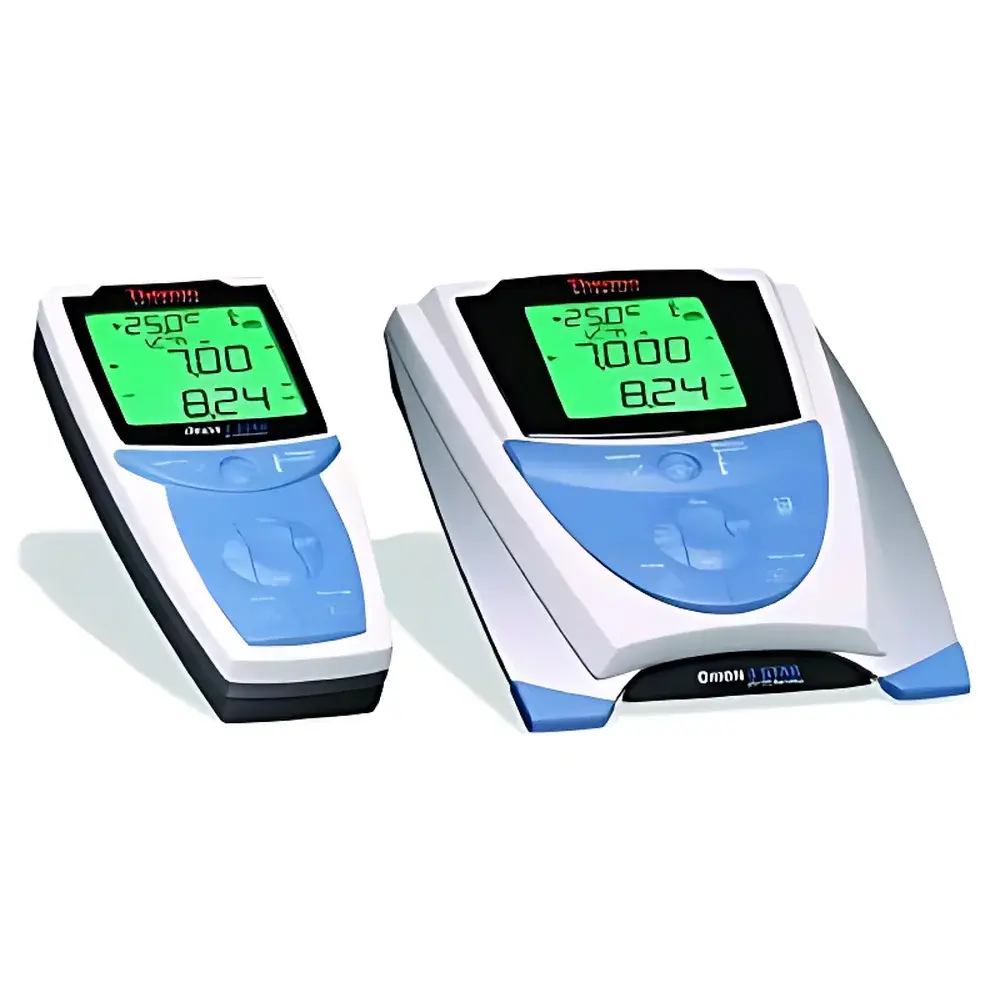
Thermo Fisher Scientific Orion Star A215 Benchtop/Portable pH and Dissolved Oxygen Meter
| Brand | Thermo Fisher Scientific |
|---|---|
| Origin | USA |
| Manufacturer | Thermo Fisher Scientific |
| Category | Imported Instrument |
| Model | Star A215 |
| Price | Upon Request |
| pH Range | −2.000 to 19.999 |
| pH Resolution | 0.1 / 0.01 / 0.001 |
| pH Accuracy | ±0.001 |
| pH Calibration | 1–5 points, NIST/US, DIN, and user-defined buffers |
| ORP Range | ±1999.9 mV |
| ORP Resolution | 0.1 mV |
| ORP Accuracy | ±0.1 mV or ±0.05% (whichever is greater) |
| DO Range | 0.00–90.0 mg/L (0.0–600% saturation) |
| DO Resolution | 0.01 mg/L / 0.1% |
| DO Accuracy | ±0.5% ±1 digit |
| Salinity Compensation | 0–45 ppt |
| Barometric Pressure Range | 450–850 mmHg |
| DO Calibration | Air-saturated water, water-saturated air, Winkler titration, zero-point |
| Sensor Type | Polarographic membrane electrode |
| Temperature Range | −5 to 105 °C |
| Temperature Resolution | 0.1 °C (−5 to 99.9 °C), 1.0 °C (>99.9 °C) |
| Temperature Accuracy | ±0.1 °C |
| Temperature Compensation | Automatic or manual |
| Display | Backlit LCD with icon-driven interface |
| Connectivity | Dual-mode RS232, optional USB cable |
| Input Interfaces | pH (BNC), temperature (miniDIN), stirrer (phono-jack, benchtop only) |
| Data Logging | 750 measurements |
| Calibration History | Last 10 calibrations |
| Method Storage | 10 user-defined methods |
| Password Protection | 10 independent user profiles |
| Power | 4×AA alkaline batteries (up to 2000 h portable operation) or universal AC adapter (benchtop) |
| Certifications | CE, CSA, UL, TÜV, FCC Class A |
| Environmental Rating | Benchtop IP54 (dust- and splash-resistant) |
| Dimensions (Benchtop) | 9.4 × 17.0 × 22.4 cm (H×W×L) |
| (Portable) | 4.8 × 9.7 × 21.3 cm (H×W×L) |
Overview
The Thermo Fisher Scientific Orion Star A215 Benchtop/Portable pH and Dissolved Oxygen Meter is a dual-parameter electrochemical analyzer engineered for high reproducibility and regulatory compliance in environmental monitoring, wastewater treatment, drinking water validation, and aquatic research. It operates on two fundamental measurement principles: potentiometric detection for pH and oxidation-reduction potential (ORP), and Clark-type polarographic amperometry for dissolved oxygen (DO). The instrument’s architecture integrates temperature-compensated signal conditioning, intelligent endpoint detection (Smart Stability™), and real-time averaging algorithms (Smart Averaging™) to minimize operator dependency and maximize measurement repeatability. Designed as the direct successor to the legacy Orion 4-Star platform, the Star A215 conforms to U.S. EPA Method 4500-OG and ISO 5814 for DO determination, and supports ASTM D1293 and Standard Methods 4500-H+ for pH analysis—making it suitable for GLP/GMP-aligned laboratories requiring auditable data integrity.
Key Features
- Dual-mode form factor: Fully functional benchtop configuration with stirrer control port and AC/DC power flexibility, plus ruggedized portable variant rated IP67 for field deployment in rain, dust, or submerged conditions.
- Intelligent calibration management: Auto-buffer recognition for NIST/US (pH 1.68, 4.01, 7.00, 10.01, 12.46) and DIN (pH 1.68, 4.01, 6.86, 9.18) standards; five-point pH calibration with non-linear slope evaluation; four DO calibration options including Winkler titration reference and zero-point verification.
- Regulatory-ready data handling: Onboard storage of 750 measurement records with time/date stamps, full audit trail of the last 10 calibrations, and 10 password-protected method templates—enabling multi-user environments without cross-contamination of analytical protocols.
- Advanced sensor interface architecture: Isolated BNC input for pH electrodes, miniDIN for thermistors or RTDs, and dedicated phono-jack for analog stirrer control (benchtop only); all inputs feature auto-detection and electrical noise suppression.
- Comprehensive environmental compensation: Integrated barometric pressure sensor (450–850 mmHg) and salinity correction (0–45 ppt) applied automatically during DO calculation per ISO 5814 equations; temperature compensation range extends from −5 to 105 °C with ±0.1 °C accuracy.
Sample Compatibility & Compliance
The Star A215 is validated for use with Thermo Fisher’s full portfolio of Orion pH and DO sensors—including refillable pH electrodes with double-junction reference systems, ruggedized field-grade DO probes with Teflon membranes, and self-stirring BOD electrodes compliant with EPA Method 5210B. Its measurement performance meets the precision requirements of ISO/IEC 17025-accredited testing labs and satisfies critical clauses of FDA 21 CFR Part 11 when paired with optional Orion LogR software (version 4.0+), which provides electronic signatures, role-based access control, and immutable audit logs. The instrument’s CE, UL, CSA, and TÜV certifications confirm conformity with IEC 61010-1 safety standards for laboratory electrical equipment, while its IP54 (benchtop) and IP67 (portable) ratings ensure operational reliability across indoor QC labs and outdoor watershed sampling sites.
Software & Data Management
Data export and method transfer are supported via bidirectional RS232 communication or optional USB-to-serial adapter. Orion LogR software enables secure PC-based data download, graphical trend analysis, customizable report generation (PDF/CSV), and full 21 CFR Part 11 compliance—including user authentication, electronic signature workflows, and tamper-evident audit trails for calibration events and measurement sessions. All stored methods retain embedded calibration parameters, temperature coefficients, and unit preferences—ensuring method portability between instruments within a networked lab. Firmware updates are delivered through Thermo Fisher’s official support portal and applied via serial interface without external programming hardware.
Applications
- Drinking water quality assurance per WHO and EPA drinking water standards (e.g., pH 6.5–8.5, DO >5 mg/L for distribution system integrity).
- Wastewater treatment process control: activated sludge DO profiling, nitrification/denitrification monitoring, and BOD5 incubation tracking using self-stirring electrodes.
- Aquatic ecosystem assessment: lake stratification studies, river DO saturation modeling, and wetland restoration benchmarking under variable salinity and altitude conditions.
- Pharmaceutical water system validation: purified water (PW) and water for injection (WFI) pH and DO trending in accordance with USP and EP 2.2.42.
- Educational laboratory instruction: standardized experiments in general chemistry, environmental science, and analytical instrumentation courses requiring traceable, repeatable electrochemical measurements.
FAQ
Is the Star A215 compatible with older Orion 4-Star electrodes and accessories?
Yes—the Star A215 maintains full electrical and mechanical compatibility with all Orion pH, ORP, and DO sensors designed for the 4-Star platform, including legacy ROSS Ultra pH electrodes and polarographic DO probes with miniDIN connectors.
Does the instrument support automatic temperature compensation for both pH and DO measurements?
Yes—temperature is measured continuously via integrated or external probe and applied dynamically to both pH slope calculation and DO solubility correction using built-in Nernst and Henry’s law algorithms.
Can calibration data be exported for audit purposes?
Yes—calibration history (including date/time, buffer IDs, slope/mV offset, and acceptance criteria) is retained onboard and exportable via RS232 or USB, and fully traceable within Orion LogR’s 21 CFR Part 11-compliant environment.
What is the battery life for continuous field operation?
Using standard alkaline AA cells, the portable configuration delivers up to 2000 hours of typical usage (based on 10 measurements/hour with backlight enabled); lithium AA batteries extend service life under sub-zero conditions.
How does the Smart Stability™ algorithm improve measurement reliability?
It monitors signal variance over time and only locks the reading when drift falls below user-configurable thresholds (e.g., <0.01 pH units/10 sec), eliminating premature readings caused by slow electrode equilibration or thermal transients.







