
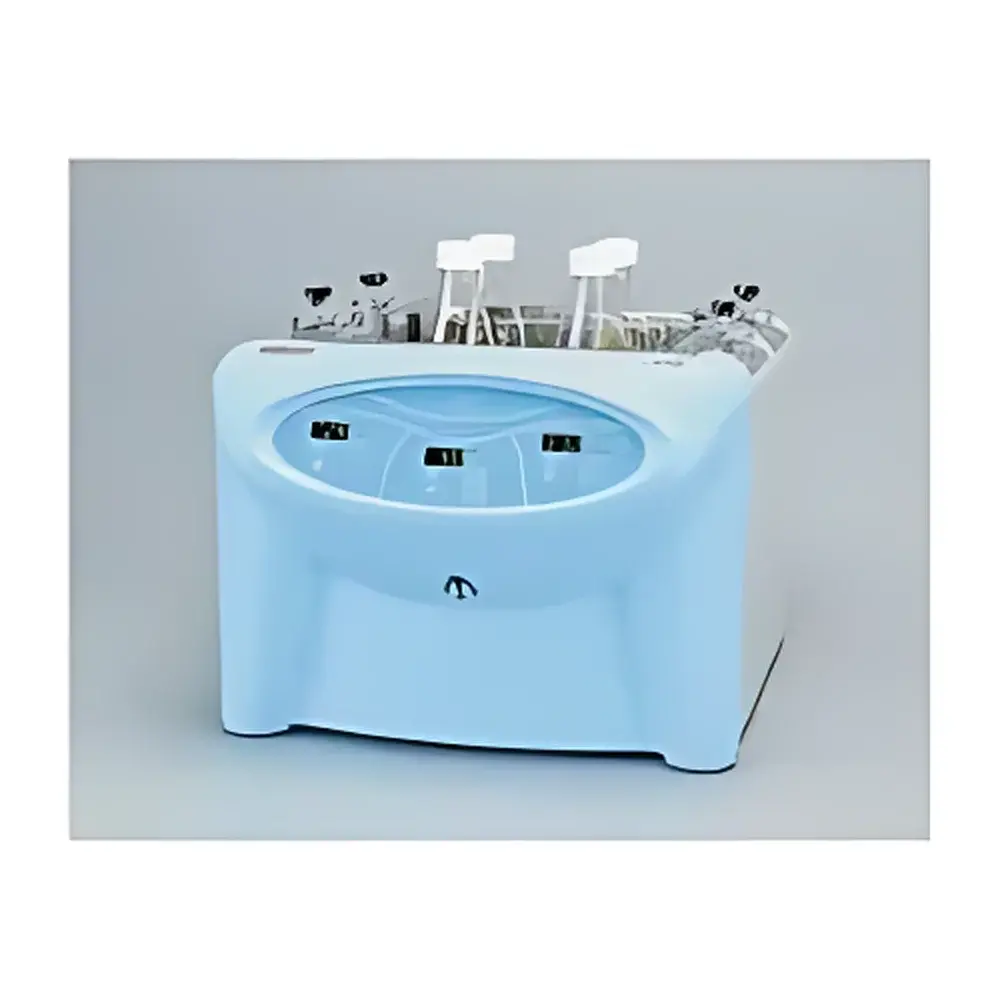
Thermo Scientific™ MaxQ™ 7000 Benchtop Water Bath Shaker
| Brand | Thermo Fisher |
|---|---|
| Origin | USA |
| Manufacturer | Thermo Fisher Scientific |
| Product Type | Water Bath Incubator Shaker |
| Model | SHKE7000-1CE |
| Control Modes | Analog + Digital |
| Speed Range (Analog) | 40–400 rpm |
| Speed Range (Digital) | 15–500 rpm |
| Temp. Control Accuracy | ±0.1°C at 37°C |
| Temp. Alarm Threshold | ±1°C deviation |
| Speed Alarm Threshold | ±10% deviation |
| Drive System | Triple-eccentric cam drive |
| Safety Features | Low-level alarm, Over-temperature protection, Imbalance detection, Soft-start, Power-fail memory, RS232 interface, Optional cooling coil & insulated lid |
Overview
The Thermo Scientific™ MaxQ™ 7000 Benchtop Water Bath Shaker is an engineered platform for precise, reproducible incubation and agitation of biological samples in aqueous environments. Designed for laboratories requiring strict thermal stability and mechanical consistency—such as microbiology, molecular biology, cell culture, and protein expression workflows—the instrument integrates water bath temperature control with orbital shaking via a triple-eccentric cam drive system. This architecture ensures uniform motion distribution across the entire platform, minimizing vortex formation and sample splashing even at high speeds (up to 500 rpm). Temperature regulation employs a PID-controlled heating system with dual-sensor feedback, delivering ±0.1°C accuracy at 37°C—a performance benchmark aligned with ISO/IEC 17025-compliant calibration practices for incubation equipment. The unit operates within a standard water bath temperature range of ambient +5°C to 65°C (extendable downward with optional cooling coil), supporting both short-term kinetic assays and extended overnight cultures.
Key Features
- Triple-eccentric cam drive mechanism ensures stable, low-vibration oscillation under heavy loads (up to 10 kg), enabling continuous 24-hour operation without drift or mechanical fatigue.
- Dual-control architecture: analog mode (40–400 rpm, knob-adjusted) and digital mode (15–500 rpm, microprocessor-controlled) with independent timer options (0.1 min–999 min or 0.1 hr–999 hr).
- PID temperature controller with real-time monitoring and auto-compensation; LED displays simultaneously show setpoint temperature, actual temperature, speed, and elapsed/remaining time.
- Integrated safety interlocks: imbalance detection halts operation upon excessive lateral displacement; over-temperature cutoff activates a redundant thermal limiter independent of the main controller.
- Low-water level sensor triggers audible/visual alert and disables heating to prevent dry-run damage; front-mounted drain port enables rapid bath emptying and decontamination.
- Power-fail memory retains user-defined parameters during unexpected outages and resumes operation automatically upon power restoration.
- RS232 serial interface supports remote monitoring of speed, temperature, and runtime; analog output port allows external logging of temperature profiles for audit-ready documentation.
Sample Compatibility & Compliance
The MaxQ™ 7000 accommodates standard laboratory vessels—including flasks (up to 2 L), test tubes, microtiter plates, and culture bottles—via interchangeable platforms and universal clamps. Its stainless-steel chamber and corrosion-resistant interior meet ASTM E1079-22 standards for laboratory equipment durability. The system complies with IEC 61010-1:2010 for electrical safety and supports GLP/GMP documentation requirements through timestamped event logging (e.g., temperature excursions, speed deviations, alarm activations). Optional insulated lid minimizes evaporation and thermal loss during prolonged runs, while the cooling coil accessory extends operational range to 4°C, satisfying USP environmental control recommendations for sterile compounding support.
Software & Data Management
Although the MaxQ™ 7000 does not include proprietary PC software, its RS232 interface is compatible with third-party data acquisition systems compliant with FDA 21 CFR Part 11 guidelines when configured with electronic signature and audit-trail modules. Temperature and speed outputs can be logged using standard terminal emulation or LabVIEW-based interfaces. All alarms—including temperature deviation (>±1°C), speed error (>±10%), imbalance detection, and low-water status—are latched and displayed until acknowledged, ensuring traceability for internal quality reviews. Calibration verification follows documented SOPs using NIST-traceable tachometers and thermistors, with records maintained per ISO 9001 clause 7.6.
Applications
- Bacterial and yeast culture expansion under controlled aeration and thermal conditions.
- Enzyme kinetics studies requiring simultaneous temperature stabilization and gentle mixing.
- Solubility testing and dissolution profiling in pharmaceutical development labs.
- Antibiotic susceptibility assays (e.g., broth microdilution) where uniform suspension is critical.
- Cell detachment protocols using enzymatic reagents (e.g., trypsin-EDTA) with minimized shear stress.
- Hybridization and washing steps in nucleic acid probe-based assays.
FAQ
What is the maximum load capacity for stable operation?
The unit maintains rated performance up to 10 kg distributed evenly across the platform, verified per manufacturer’s mechanical endurance testing protocol.
Can the MaxQ™ 7000 operate unattended overnight?
Yes—its robust thermal regulation, imbalance detection, and automatic shutdown features support validated unattended operation for durations exceeding 16 hours.
Is calibration traceable to national standards?
User-performed speed and temperature calibration may be conducted using ISO/IEC 17025-accredited instruments; factory calibration certificates are available upon request.
Does the system support regulatory compliance for pharmaceutical QC?
When integrated with compliant data logging hardware and procedural controls, it meets baseline requirements for USP , ASTM E2500, and Annex 11-aligned validation frameworks.
How often should preventive maintenance be performed?
Thermo Fisher recommends biannual inspection of drive components, seal integrity, and sensor calibration—aligned with ISO 13485 preventive maintenance schedules for Class I medical device support equipment.
Related Products



