
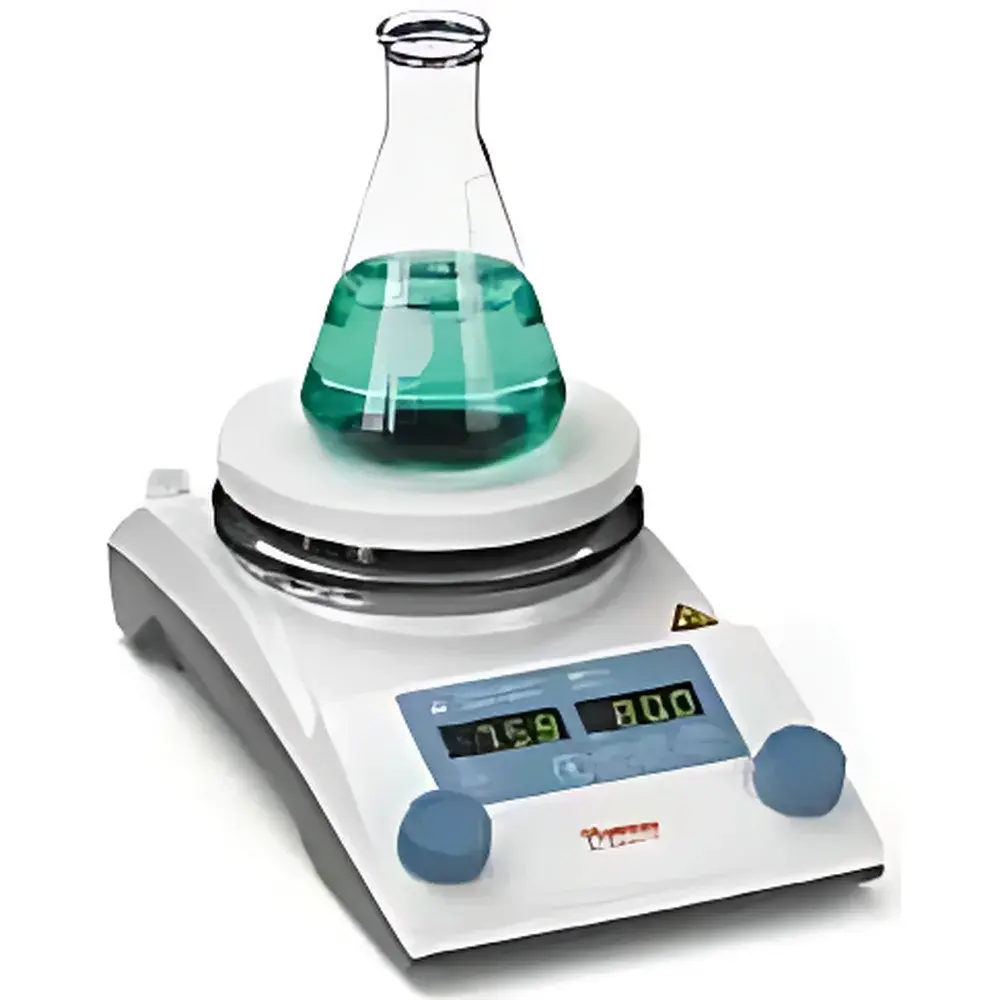
Thermo Scientific RT2 Hotplate Stirrer
| Brand | Thermo Fisher Scientific |
|---|---|
| Origin | South Korea |
| Manufacturer Type | Original Equipment Manufacturer (OEM) |
| Product Category | Imported Laboratory Equipment |
| Model | RT2 Hotplate |
| Instrument Type | Magnetic Hotplate Stirrer |
| Temperature Control Range | RT + 50 °C to 350 °C |
| Heating Surface | 140 mm Ceramic-Coated Aluminum Plate |
| Control System | PID Microprocessor-Based Digital Controller |
| Safety Features | Over-Temperature Protection with Auto-Shutoff and Visual High-Temp Alarm |
| Temperature Modes | Five Programmable Profiles (Optimized, Fast, Slow, Setpoint, User-Defined with Auto-Tuning) |
| Display | Dual LED Readout (Actual vs. Setpoint Temperature) |
| Optional Accessories | Non-Slip Heating Bath Insert, Transparent Polycarbonate Safety Cover |
Overview
The Thermo Scientific RT2 Hotplate Stirrer is a compact, microprocessor-controlled heating platform engineered for precision thermal management in routine laboratory workflows requiring stable, repeatable surface heating without mechanical agitation. Unlike combined hotplate stirrers, the RT2 is configured as a dedicated hotplate—designed specifically for applications where magnetic stirring is either unnecessary or performed separately using external stir bars and independent stirrers. Its core operational principle relies on resistive heating elements embedded beneath a 140 mm ceramic-coated aluminum plate, delivering uniform thermal distribution across the surface. The integrated PID (Proportional-Integral-Derivative) controller enables dynamic thermal regulation with minimal overshoot and high reproducibility—critical for temperature-sensitive procedures such as solvent evaporation, sample preheating prior to analysis, reagent conditioning, or controlled drying of thin films. With a maximum operating temperature of 350 °C (and short-term tolerance up to 450 °C), the RT2 supports a broad range of thermal protocols while maintaining compliance with IEC 61010-1 safety standards for laboratory electrical equipment.
Key Features
- Ceramic-coated aluminum heating surface (140 mm diameter) for chemical resistance, rapid thermal response, and long-term durability under repeated thermal cycling
- PID-based digital temperature control with dual LED display showing real-time actual temperature and user-defined setpoint simultaneously
- Five programmable heating profiles: Optimized (minimizes both ramp time and temperature fluctuation), Fast (maximizes heating rate), Slow (reduces thermal gradient-induced stress), Setpoint (linear ramp to target with fixed power delivery), and User mode (supports auto-tuning for customized process adaptation)
- Over-temperature protection circuitry that triggers automatic heater shutdown and activates a visual alarm when surface temperature exceeds safe operational limits
- Optional accessories include a non-slip silicone-lined heating bath insert for secure placement of round-bottom flasks or beakers, and a transparent polycarbonate safety cover compliant with ANSI Z87.1 impact resistance standards
Sample Compatibility & Compliance
The RT2 accommodates standard laboratory glassware—including 50–500 mL beakers, Erlenmeyer flasks, and crystallization dishes—on its flat, chemically inert ceramic surface. It is not designed for direct use with volatile organic solvents under open-vessel conditions without appropriate fume hood containment. The device conforms to ISO/IEC 17025-relevant environmental testing requirements for thermal stability verification and meets CE marking directives (2014/30/EU EMC and 2014/35/EU LVD). Its construction and thermal safety architecture support GLP-compliant documentation when integrated into validated laboratory workflows, particularly where temperature traceability and deviation logging are required per internal SOPs.
Software & Data Management
The RT2 operates as a standalone instrument with no embedded data logging or PC connectivity. All temperature settings, mode selections, and timer configurations are managed via front-panel push-button interface. While it lacks USB or RS-232 output, its dual-display functionality enables manual recording of temperature trajectories during timed experiments. For laboratories requiring electronic audit trails, integration with external data acquisition systems (e.g., LabVIEW-compatible thermocouple readers or PLC-based monitoring networks) is feasible using optional K-type thermocouple inputs routed through auxiliary ports on compatible third-party controllers.
Applications
- Pre-heating samples prior to HPLC injection or GC sample introduction
- Controlled drying of precipitates or thin polymer films on watch glasses or Petri dishes
- Conditioning calibration standards at defined temperatures before spectrophotometric or electrochemical measurement
- Warming reagents to reaction temperature in synthetic chemistry workflows (e.g., Grignard preparation, esterification)
- Stabilizing viscosity reference oils during rheometer calibration cycles
- Supporting ASTM D92 (Cleveland Open Cup) flash point pre-conditioning steps
FAQ
Does the RT2 include magnetic stirring functionality?
No—the RT2 is a hotplate-only configuration. It does not incorporate a built-in stir motor or magnetic drive system. Users requiring simultaneous heating and stirring must pair it with an external magnetic stirrer or select the RT2 Stirrer variant (model-dependent).
What is the maximum recommended continuous operating temperature?
The rated continuous operating range is RT + 50 °C to 350 °C. Short-term excursions up to 450 °C are permitted for <5 minutes during startup or recovery phases but are not advised for routine use.
Is the RT2 compatible with corrosive reagents like concentrated acids?
The ceramic coating provides moderate resistance to mild acids and bases; however, prolonged exposure to hydrofluoric acid, molten alkalis, or halogenated solvents may degrade the surface. Routine cleaning with ethanol or isopropanol is recommended.
Can the RT2 be used inside a fume hood?
Yes—its low-profile design and absence of moving parts make it suitable for fume hood installation. Ensure adequate ventilation clearance (≥5 cm on all sides) to maintain thermal sensor accuracy and prevent overheating of internal electronics.
How often should the temperature calibration be verified?
Per ISO/IEC 17025 guidelines, verify calibration at least once per quarter using a NIST-traceable contact thermometer or infrared calibrator with ±0.5 °C uncertainty.



