
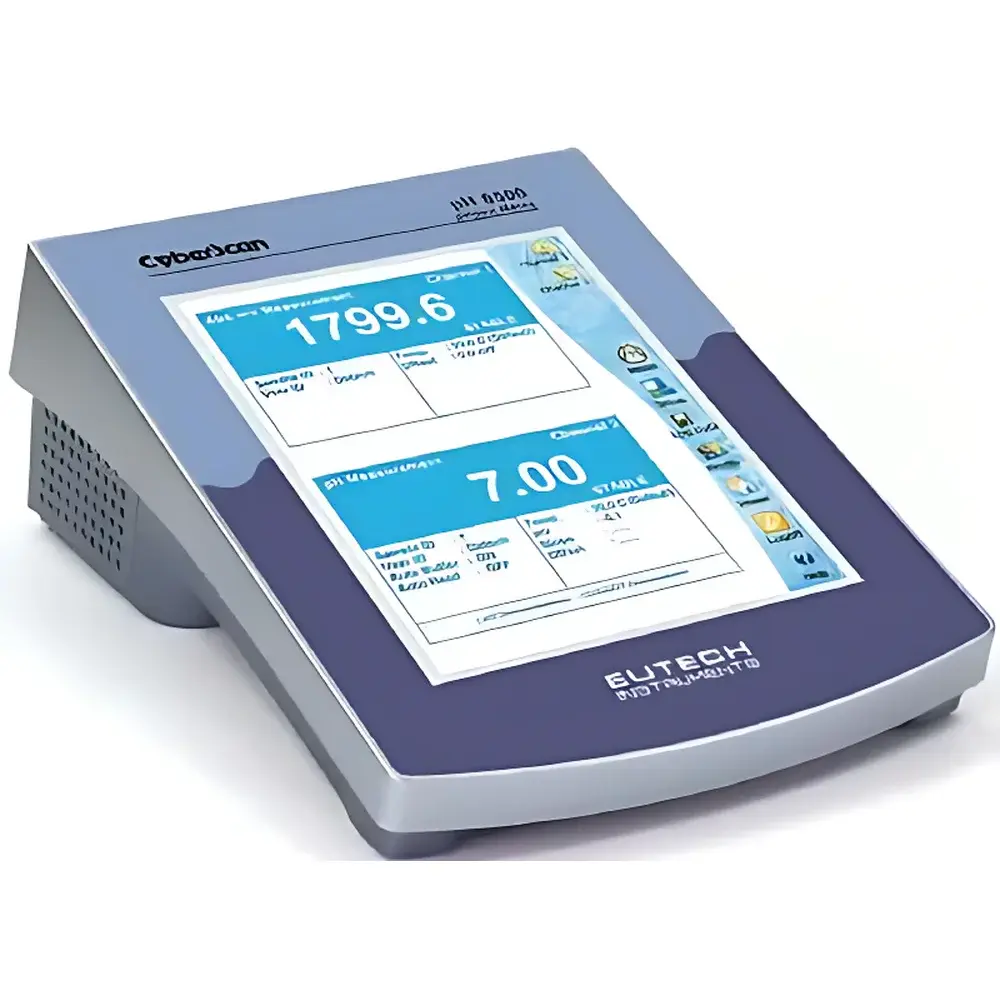
Eutech CyberScan pH6500 Benchtop pH and Ion Meter
| Brand | Thermo Fisher Scientific |
|---|---|
| Origin | Singapore |
| Manufacturer | Eutech Instruments (a Thermo Fisher brand) |
| Model | pH6500 |
| Type | Dual-Channel Benchtop Electrochemical Analyzer |
| Measurement Modes | pH, mV (ORP/RmV), Ion Concentration (ISE), Temperature |
| pH Range | –2.000 to 20.000 |
| pH Resolution | 0.1 / 0.01 / 0.001 |
| pH Accuracy | ±0.002 pH + 1 LSD (at 25 °C) |
| Ion Range | 1×10⁻⁶ to 9.99×10¹⁰ ppm |
| Ion Accuracy | ±0.17% of full scale (monovalent), ±0.34% (divalent) |
| ORP/RmV Range | ±2000.0 mV |
| ORP Resolution | 0.1 mV |
| ORP Accuracy | ±0.2 mV |
| Temperature Range | –5.0 to 105.0 °C |
| Temp. Accuracy | ±0.2 °C |
| Calibration Points | up to 5-point pH, 2–5-point ISE |
| Buffer Recognition | USA, NIST, Euro, Custom |
| Temperature Compensation | Auto/Manual (0.0–100.0 °C) |
| GLP Compliance | Yes |
| Data Storage | 1000 entries with timestamp, electrode ID, calibration history |
| Display | 11.43 × 15.24 cm (4.5 × 6 in) Windows CE–based color touchscreen |
| Connectivity | USB host/device, RS232, IrDA, RJ45 Ethernet, SD card slot, BNC, DIN, phono inputs |
| Power | 9 V DC, 3.3 A (100–240 VAC SMPS) |
| Dimensions (W×D×H) | 16.5 × 23.5 × 8.9 cm |
| Weight | 1.1 kg |
Overview
The Eutech CyberScan pH6500 is a dual-channel benchtop electrochemical analyzer engineered for high-precision, multi-parameter measurement in regulated laboratory environments. Built upon the proven architecture of the CyberScan pH6000 series, the pH6500 integrates potentiometric pH, redox potential (ORP/RmV), ion-selective electrode (ISE) concentration analysis, and temperature measurement into a single, unified platform. Its core measurement principle relies on high-impedance voltage sensing (<1 pA input bias current) coupled with real-time analog-to-digital conversion at 24-bit resolution—ensuring stable readings even with high-resistance glass electrodes or low-output ISFET sensors. Designed for routine QC, environmental testing, pharmaceutical process control, and academic research, the instrument supports both standardized and custom calibration protocols while maintaining traceable data integrity per GLP and ISO/IEC 17025 requirements.
Key Features
- Dual independent measurement channels: simultaneous, non-interfering acquisition of pH and ISE signals—eliminating mode-switch recalibration and reducing operator-induced error.
- Universal electrode compatibility: native support for standard BNC pH electrodes and DIN-style pH-ISFET sensors without external adapters or signal conditioning modules.
- Advanced ISE methodology suite: direct measurement, known addition/subtraction, and sample addition/subtraction modes—enabling rigorous quantification across complex matrices per ASTM D1129 and ISO 10523 guidelines.
- Configurable concentration units: seamless switching between ppm, % (w/v), mg/mL, and mol/L—critical for method transfer across regulatory submissions (e.g., USP , EP 2.2.3).
- Windows CE–driven 4.5″ × 6″ color touchscreen: intuitive icon-based navigation, context-sensitive help, real-time error diagnostics (e.g., “High impedance warning”, “Calibration slope out of range”), and tactile feedback for gloved operation.
- Comprehensive connectivity: USB host (for flash drives), USB device (PC tethering), RS232, IrDA, and Ethernet (RJ45) enable secure, audit-ready data export and remote firmware updates compliant with FDA 21 CFR Part 11 Annex 11 requirements.
Sample Compatibility & Compliance
The pH6500 accommodates aqueous and mildly organic samples within –5.0 to 105.0 °C, supporting common electrode types including combination glass, refillable reference, double-junction, and solid-state ISFET probes. Its auto-temperature compensation (ATC) algorithm applies Nernstian correction across the full operational range, referenced to either Pt100 or thermistor inputs. The instrument conforms to IEC 61010-1:2010 safety standards and meets electromagnetic compatibility (EMC) requirements per EN 61326-1:2013. All stored data—including calibration logs, measurement timestamps, electrode serial numbers, and user IDs—are structured in CSV/Excel-compatible format and retain full audit trail integrity for GLP/GMP validation. Predefined buffer sets (USA, NIST, Euro) align with ISO 3696 Grade 2 water specifications and ASTM E1157–22 reference material protocols.
Software & Data Management
Data capture is managed via embedded non-volatile memory storing up to 1000 measurement records with full metadata: date/time stamp, channel ID, electrode model and serial number, calibration coefficients (slope, offset, R²), ambient temperature, and user-defined sample IDs. Export options include USB mass storage, SD card dump, or network transfer via FTP/SFTP over Ethernet. Optional Eutech LogEasy software (Windows-compatible) enables automated report generation with customizable templates, statistical summaries (mean, SD, RSD, confidence intervals), and trend visualization—supporting IQ/OQ/PQ documentation for laboratory accreditation. Audit trail functionality records all configuration changes, calibration events, and user logins with immutable timestamps, satisfying FDA 21 CFR Part 11 electronic signature and record retention mandates.
Applications
- Pharmaceutical QC labs: pH and chloride/bromide ISE testing of parenteral solutions per USP and EP 2.2.3; buffer verification for HPLC mobile phases.
- Environmental monitoring: field-deployable analysis of surface water alkalinity (pH), heavy metal ions (Pb²⁺, Cd²⁺), and nitrate/nitrite in wastewater per EPA Method 300.0 and ISO 10304-1.
- Food & beverage R&D: titratable acidity (pH), sodium (Na⁺), and potassium (K⁺) profiling in dairy, juice, and fermented products aligned with AOAC 984.27 and ISO 5725 precision criteria.
- Academic electrochemistry: teaching Nernst equation derivation, selectivity coefficient determination (Nicolsky-Eisenman), and multi-ion interference studies using programmable addition sequences.
- Industrial process control: inline pH and fluoride (F⁻) monitoring in semiconductor wet etch baths, requiring sub-millivolt stability and drift compensation over 8-hour shifts.
FAQ
Does the pH6500 support automatic buffer recognition during calibration?
Yes—it identifies and validates standard buffers from USA, NIST, and European metrology institutes based on measured mV and temperature, rejecting outliers beyond ±5 mV tolerance.
Can I use the same electrode for both pH and ISE measurements without recalibration?
Yes—the dual-channel architecture maintains independent calibration curves; switching between modes retains each channel’s slope and offset values.
Is the instrument compatible with LIMS integration?
Yes—via RS232 or Ethernet using ASCII-based command protocol (SCPI-like syntax); configurable delimiter and header settings ensure seamless ingestion into LabVantage, STARLIMS, and Thermo Fisher SampleManager.
What temperature sensor types are supported?
Pt100 RTD probes (DIN 43760), thermistors (2.252 kΩ @ 25 °C), and built-in thermistor in ATC cables—all selectable via menu with linear or Steinhart-Hart compensation.
How is data security enforced for regulated environments?
User access levels (Operator, Supervisor, Administrator) restrict calibration edits and data deletion; all actions generate time-stamped, non-erasable audit logs meeting ALCOA+ principles.
Related Products





