
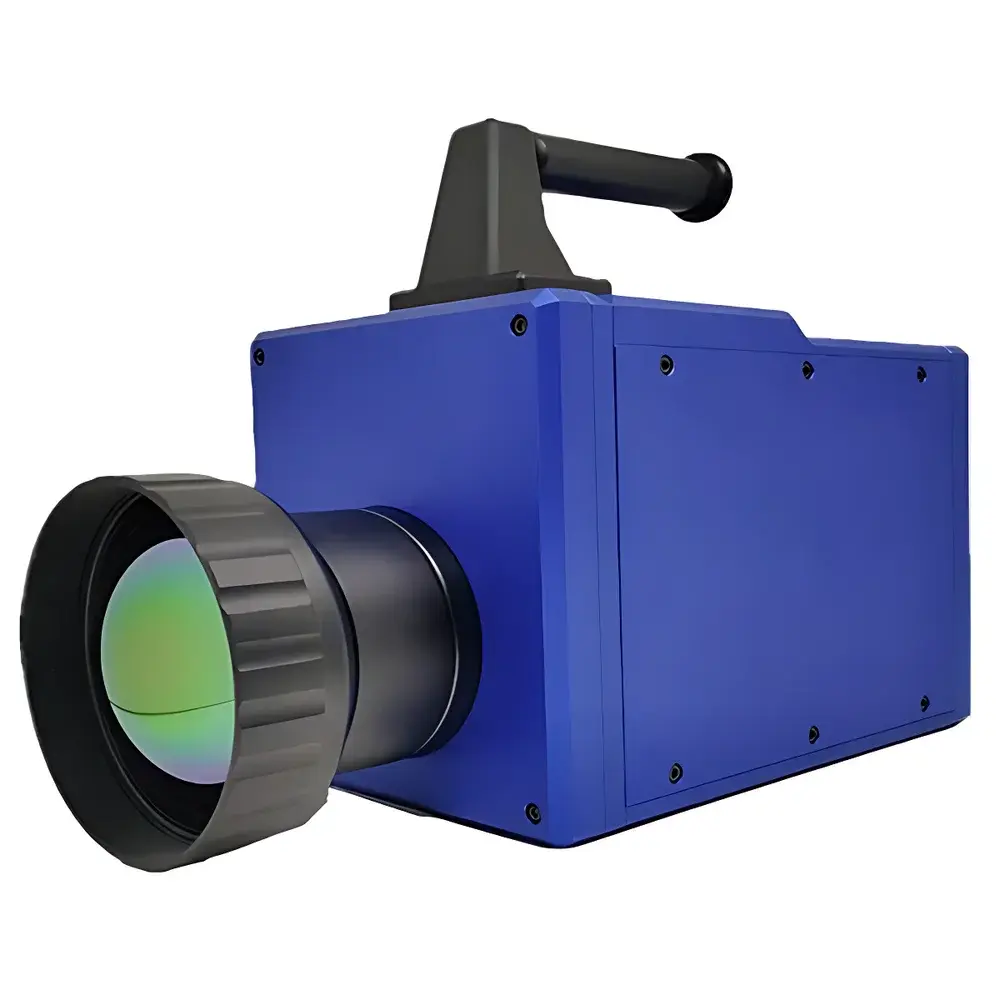
Optoprecise GW-STL-HD Series Stirling-Cooled Mid- and Long-Wave Infrared Thermal Imaging Camera
| Brand | Optoprecise |
|---|---|
| Origin | Beijing, China |
| Model | GW-STL-HD Series |
| Detector Type | Stirling-cooled focal plane array (FPA) |
| Spectral Ranges | 3.7–4.8 µm (MWIR) / 7.7–9.5 µm (LWIR) |
| Detector Resolution | 1280 × 1024 px |
| Pixel Pitch | 10 µm / 12 µm / 15 µm |
| NETD | <20 mK (MWIR), <25 mK (LWIR) |
| Full-frame Frame Rate | 100 Hz @ 1280×1024 |
| Sub-window Mode | 900 Hz @ 320×256 |
| Temperature Range | −10°C to 1000°C (extendable to 2500°C with high-temp calibration) |
| Accuracy | ±2°C or ±2% of reading |
| Dynamic Range | 14-bit |
| Spectral Filter Wheel | 5-position (standard), optional 11-position, 1″ format filters |
| Cooling Time | <7 min |
| F-number | F2 / F4 |
| Digital Interfaces | CameraLink, GigE Vision |
| Trigger I/O | TTL external trigger input & sync output |
| Power Input | 24 ± 2 VDC |
| Power Consumption | ≤20 W @ 25°C |
| Operating Temperature | −40°C to +60°C |
| Dimensions | ≤310 × 135 × 180 mm |
| Weight | ≤5 kg (with standard lens) |
| Storage Format | 14-bit radiometric JPG + RAW (non-encrypted) |
| Software | IR-SVision M2.0 (monitoring) & R2.0 (professional analysis), SDK included |
Overview
The Optoprecise GW-STL-HD Series is a high-performance, Stirling-cooled infrared thermal imaging camera engineered for demanding scientific, industrial, and defense applications requiring precise mid-wave (MWIR) and long-wave (LWIR) radiometric measurement. Built around a high-resolution, small-pitch focal plane array—available in 1280 × 1024 formats with pixel pitches of 10 µm, 12 µm, or 15 µm—the system delivers exceptional spatial resolution and thermal sensitivity (NETD <20 mK in MWIR, <25 mK in LWIR). Its dual-band spectral capability (3.7–4.8 µm and 7.7–9.5 µm) enables selective detection of combustion signatures, gas emissions, material emissivity variations, and high-temperature phenomena such as plasma, molten metal, or turbine blade surface dynamics. The integrated Stirling cooler achieves stable detector operating temperature in under 7 minutes, ensuring rapid deployment and high thermal stability over extended acquisition periods—critical for quantitative thermography, time-resolved thermal mapping, and multi-spectral analysis.
Key Features
- Stirling-cooled InSb or MCT detector architecture optimized for low-noise, high-dynamic-range (14-bit) radiometric imaging
- Configurable spectral bands: MWIR (3.7–4.8 µm) and LWIR (7.7–9.5 µm), supporting flame temperature analysis, gas identification, and emissivity-corrected measurements
- High-speed imaging modes: 100 Hz full-frame (1280×1024), 300 Hz subsampled (640×512), 900 Hz windowed (320×256), and up to 6 kHz line-scan operation
- Motorized 5-position (optional 11-position) filter wheel compatible with industry-standard 1″ optical filters—enabling narrowband, broadband, high-temperature, and custom spectral selection
- Calibration-integrated filter positioning: each wheel position is registered with NIST-traceable temperature calibration data for automated radiometric correction
- Multi-lens support: standardized C-mount interface accommodates wide-angle (12 mm), telephoto (50–200 mm), macro (0.5×–8×), and micro (up to 8× magnification, 1.9 µm spatial resolution) optics
- Radiometric file output: embedded 14-bit temperature data in JPEG and vendor-neutral RAW format, preserving full dynamic range for post-processing
- Robust mechanical design: IP54-rated enclosure (optional conformal coating), qualified for 5–500 Hz random vibration (2.1 gRMS) and 30 g shock (11 ms half-sine)
Sample Compatibility & Compliance
The GW-STL-HD Series supports non-contact temperature measurement across diverse sample types—including metallic alloys, ceramics, composites, thin films, electronic components, and transient combustion events—without perturbing thermal equilibrium. Its calibrated temperature range spans −10°C to 1000°C (extendable to 2500°C via high-temperature blackbody calibration), meeting ASTM E1933-19 requirements for infrared thermography system performance verification. The system complies with CE marking directives (EMC 2014/30/EU, RoHS 2011/65/EU) and supports audit-ready data integrity through IR-SVision R2.0’s GLP/GMP-aligned features: timestamped metadata, user-access logs, calibration history tracking, and FDA 21 CFR Part 11–compatible electronic signatures (when deployed with validated IT infrastructure). All radiometric outputs retain raw sensor values and calibration coefficients, enabling traceable recalibration per ISO/IEC 17025 laboratory requirements.
Software & Data Management
IR-SVision software suite provides comprehensive control, visualization, and analysis capabilities across two editions: M2.0 (real-time monitoring) and R2.0 (offline quantitative analysis). Both versions offer dual-language UI (English/Chinese), radiometric video streaming over GigE Vision, and hardware-synchronized triggering. R2.0 extends functionality with region-of-interest (ROI) statistics (min/max/mean/std dev), dynamic thermal profiling, mask-based analysis, blackbody self-correction, and batch export of time-series thermal sequences in ASCII or CSV. The included Software Development Kit (SDK) conforms to GenICam 3.0 standards and supports C++, Python, and MATLAB integration—enabling OEM embedding, custom GUI development, and integration into automated test benches or SCADA systems. RAW data files are stored unencrypted, ensuring interoperability with third-party tools including MATLAB Image Processing Toolbox, Python OpenCV, and commercial thermal analysis platforms.
Applications
- Aerospace: Turbine blade thermal stress mapping, combustor flame structure analysis, and hypersonic vehicle surface heating characterization
- Materials Science: Phase transformation kinetics, laser welding melt pool dynamics, and additive manufacturing in-situ process monitoring
- Energy & Power: Transformer hotspot detection, solar cell defect screening, and boiler tube wall temperature profiling
- Research & Development: Combustion chemistry studies (via spectral filtering), nanomaterial thermal conductivity measurement, and microelectronics junction temperature validation
- Defense & Security: Long-range target identification, missile plume signature analysis, and maritime vessel thermal signature assessment
- Automotive: Battery thermal runaway detection, brake disc friction heating analysis, and exhaust aftertreatment system diagnostics
FAQ
What spectral filter options are available for customized gas detection?
Standard narrowband filters include methane (3.3 µm), CO₂ (4.26 µm), NO (5.3 µm), and SO₂ (7.3 µm); custom bandpass, notch, and multi-spectral filter sets can be fabricated upon request and installed in the motorized wheel.
Can the system perform real-time temperature measurement at 1000 Hz?
Yes—using sub-windowing (e.g., 320×256 ROI), the camera achieves 900 Hz frame rate; line-scan mode supports up to 6 kHz for one-dimensional thermal profiling along a defined axis.
Is the RAW data format compatible with third-party analysis software?
Yes—RAW files contain unprocessed 14-bit digital counts, detector gain/offset coefficients, and calibration metadata in plain binary format, fully importable into MATLAB, Python (NumPy), and commercial thermal analysis packages.
How is temperature calibration maintained during long-duration experiments?
The system performs automatic non-uniformity correction (NUC) before each acquisition sequence; optional shutterless NUC algorithms minimize downtime while preserving radiometric accuracy across thermal drift cycles.
Does the SDK support Linux or only Windows platforms?
The SDK provides native libraries and header files for Windows (x64), Linux (x64, Ubuntu 20.04+), and macOS (Intel x86_64); documentation includes build scripts and API reference for all supported OS environments.





