
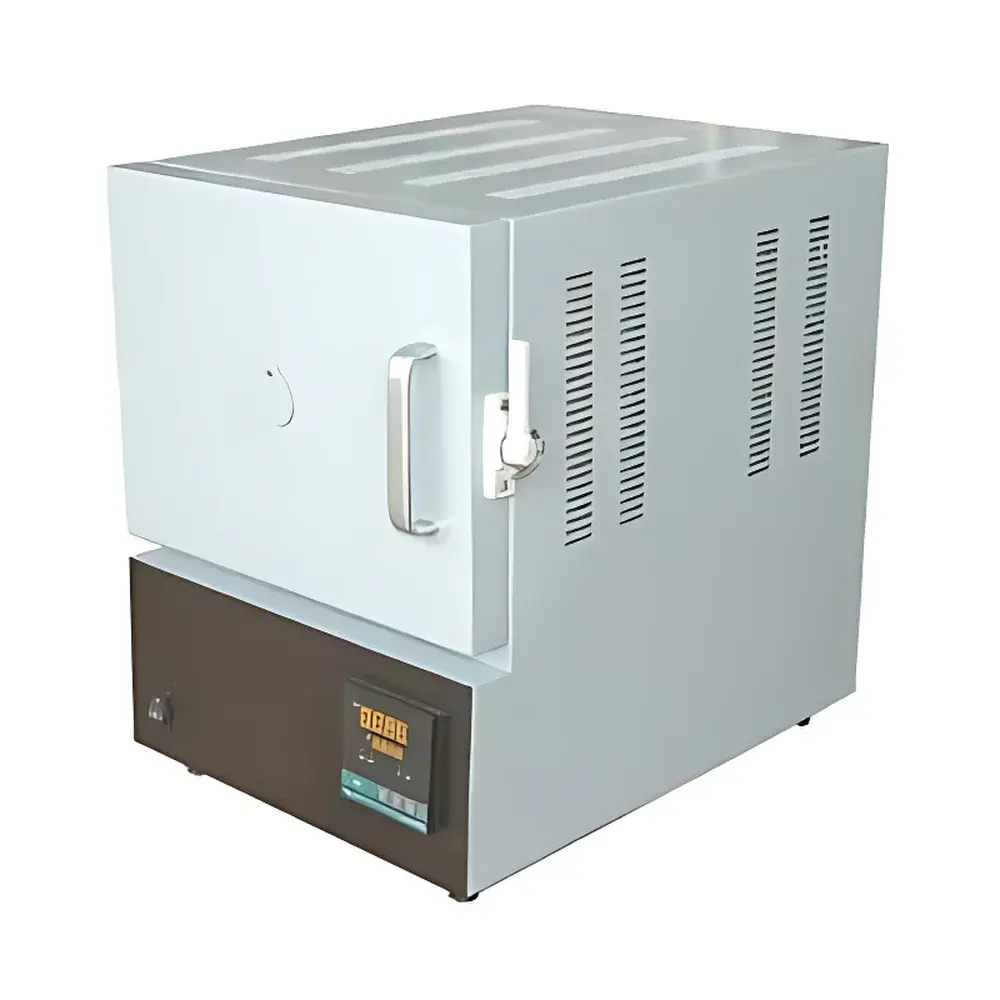
Hogon HG-10-4 Ceramic Fiber Muffle Furnace
| Brand | Hogon |
|---|---|
| Origin | Shanghai, China |
| Manufacturer Type | Direct Manufacturer |
| Product Category | Domestic |
| Model Series | HG-10-4 |
| Instrument Type | Box-Type Muffle Furnace |
| Maximum Temperature | 1000 °C |
| Temperature Control Accuracy | ±3 °C |
| Rated Power | 3500 W |
| Heating Rate to Max Temp | ≤10 min |
| Heating Method | Kanthal® Resistance Wire Elements |
| Internal Chamber Dimensions | 510 × 400 × 530 mm |
| Voltage | 220 V / 50 Hz (Standard Variant) |
| Weight | 30 kg |
Overview
The Hogon HG-10-4 Ceramic Fiber Muffle Furnace is an engineered high-performance box-type laboratory furnace designed for precise thermal processing in research, quality control, and routine analytical workflows. Utilizing the fundamental principle of resistive heating via embedded high-alloy resistance wire elements—specifically Kanthal® A1 alloy—it delivers rapid, uniform, and stable thermal environments up to 1000 °C. Its core architecture integrates a 50 mm-thick insulation layer composed of ultra-pure ceramic fiber (Al₂O₃–SiO₂ composition), offering exceptional thermal retention, low heat loss, and minimal external surface temperature rise during operation. Unlike traditional refractory brick furnaces, this design enables faster ramp rates (≤10 minutes to 1000 °C), improved energy efficiency, and extended service life—particularly critical for laboratories performing repetitive ashing, calcination, annealing, or pre-treatment protocols under GLP or ISO/IEC 17025-compliant conditions.
Key Features
- High-purity ceramic fiber insulation (50 mm thickness) ensures superior thermal efficiency, low standby power consumption, and consistent internal temperature distribution across the entire chamber volume.
- Kanthal® A1 resistance heating elements—manufactured to ASTM B568 specifications—provide long-term structural integrity, minimal oxidation at elevated temperatures, and excellent resistance to thermal cycling fatigue.
- Advanced digital PID temperature controller with 30-segment programmable ramp-soak capability, supporting both multi-step thermal profiles and single-stage PID operation for reproducible process execution.
- Robust stainless-steel outer casing with reinforced door sealing mechanism minimizes heat leakage and enhances operator safety during extended high-temperature operation.
- Four-sided heating configuration (standard on HG-10-4E variant; optional on other models) ensures radial temperature uniformity within ±5 °C across the working zone per ASTM E220 calibration methodology.
- Compliance-ready architecture supports integration into laboratory information management systems (LIMS) through RS-485 communication interface (optional) and audit-trail-capable data logging.
Sample Compatibility & Compliance
The HG-10-4 series accommodates a broad range of sample forms—including crucibles (alumina, quartz, platinum), petri dishes, filter papers, biological tissues, coal pellets, pharmaceutical tablets, and ceramic substrates—without risk of contamination from off-gassing or metallic leaching. Its inert ceramic fiber lining and non-catalytic heating elements ensure chemical neutrality during ashing, volatilization, or residue quantification procedures. The furnace meets key regulatory requirements for routine testing applications: it supports USP and ASTM D3174 (ash content), ASTM D3175 (volatile matter), ASTM D5373 (ultimate analysis), and ISO 1171 (determination of ash). When operated with validated temperature mapping and periodic calibration using NIST-traceable thermocouples, the system fulfills documentation requirements for FDA 21 CFR Part 11–compliant electronic records and GLP/GMP traceability frameworks.
Software & Data Management
While the base model features a front-panel digital controller with real-time temperature display and setpoint adjustment, optional PC-based software (HogonTherm v3.2) enables remote monitoring, automated profile execution, and export of time-stamped temperature logs in CSV or XML format. All recorded data include timestamp, setpoint, actual PV, ramp rate, and alarm status—supporting full audit trail generation per ISO/IEC 17025 clause 7.7. Data files are digitally signed and stored with immutable metadata, satisfying requirements for regulated environments requiring data integrity verification. Optional RS-485 Modbus RTU protocol allows seamless integration with SCADA platforms or centralized lab automation infrastructures.
Applications
- Materials Science: Heat treatment of advanced ceramics, sintering of nanocomposites, thermal stability assessment of polymer-derived ceramics, and phase transformation studies under controlled atmospheres.
- Environmental & Coal Analysis: Determination of moisture, ash, volatile matter, fixed carbon, and fusibility characteristics per ASTM D3172–D3176 and ISO 1171–1172 standards.
- Pharmaceutical & Clinical Labs: Residue-on-ignition testing (USP ), sterilization validation support, and preparation of inorganic reference standards for ICP-OES/MS analysis.
- Food & Agriculture Testing: Total ash quantification in feedstuffs, soil mineralization prior to elemental analysis, and determination of crude fiber content.
- Academic Research: Teaching labs use the HG-10-4 for thermogravimetric method demonstrations, kinetics experiments, and comparative studies of thermal degradation pathways.
FAQ
What is the maximum recommended continuous operating temperature?
The HG-10-4 is rated for continuous operation at 1000 °C; prolonged use above 950 °C may reduce element lifetime and requires periodic thermocouple verification.
Is the furnace compatible with inert or reducing atmospheres?
Standard configuration is air-atmosphere only; optional quartz tube inserts or flanged gas inlet ports (N₂, Ar, H₂/N₂ mixtures) are available upon request with appropriate safety interlocks.
How often should temperature uniformity mapping be performed?
Per ISO/IEC 17025 and ASTM E220, initial mapping is required before first use; subsequent verification is recommended every 6 months or after major maintenance events.
Can the HG-10-4 be integrated into an automated sample handling system?
Yes—via optional digital I/O signals (start/stop, ready, fault) and Modbus RTU interface, enabling synchronization with robotic arms or conveyor-based ashing workflows.
Does the furnace comply with CE or UL safety directives?
The HG-10-4 meets IEC 61010-1:2010 for electrical safety and EMC requirements; CE marking is available upon request for EU shipments with accompanying Declaration of Conformity.



