
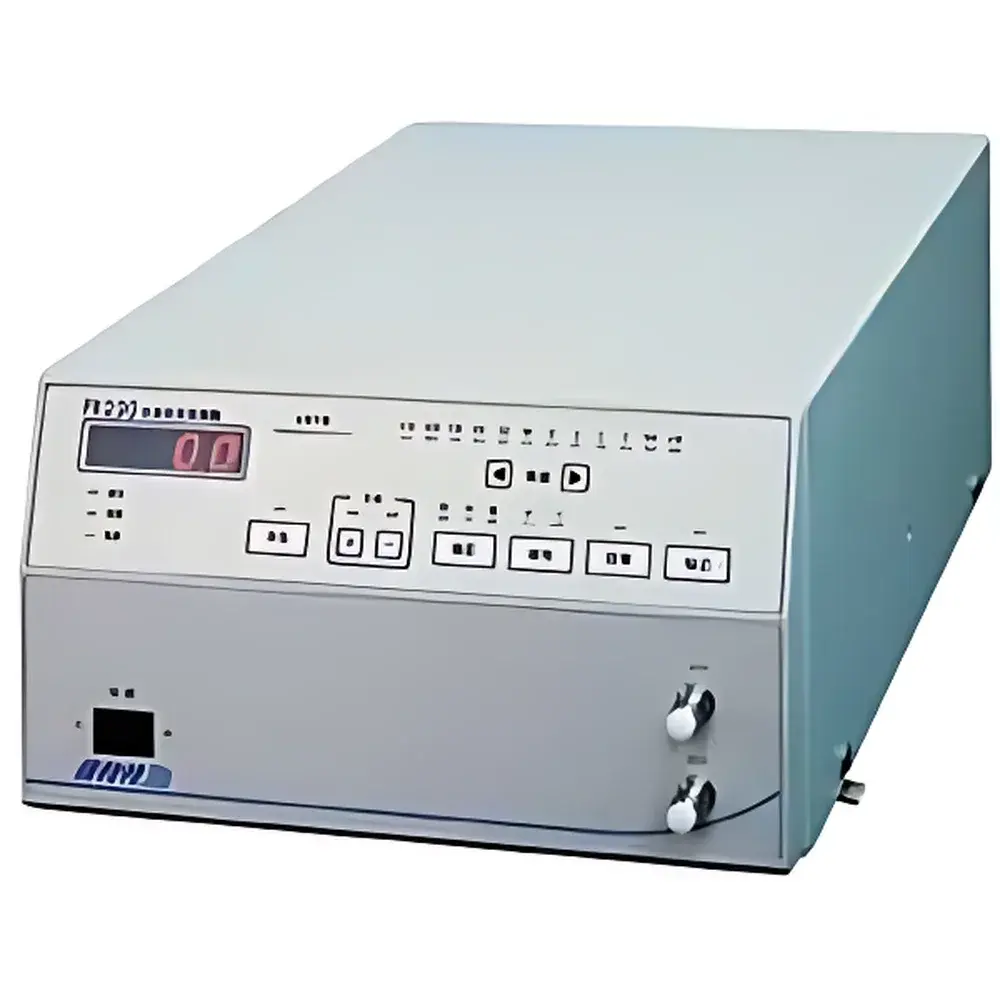
RI201H Refractive Index Detector for HPLC
| Origin | Shanghai, China |
|---|---|
| Manufacturer Type | Authorized Distributor |
| Origin Category | Domestic (PRC) |
| Model | RI201H |
| Instrument Type | Refractive Index Detector (RID) |
| Refractive Index Range | 1.00–1.75 |
| Detection Sensitivity | 1/4 RIU/FS to 512 × 10⁻⁶ RIU/FS |
| Linear Range | 6 × 10⁻⁴ RIU |
| Zero Adjustment | Digital auto-zero with optical zero compensation |
| Auto-Zero Range | ≥ ±1 × 10⁻⁴ RIU |
| Auto-Zero Resolution | ≥ 1 × 10⁻⁸ RIU |
| Drift Adjustment Range | 0–6 × 10⁻⁶ RIU |
| Drift Resolution | 3 × 10⁻⁸ RIU |
| Response Time Settings | 3 modes (Fast / Standard / Slow) |
| Noise Level | ≤ 2.5 × 10⁻⁹ RIU (Standard response) |
| Integrator Output | 0–1.024 V (Sensitivity: 2 mV per 1 × 10⁻⁶ RIU) |
| Recorder Output | 0–10 mV/FS |
| Input Signals | Flush / Zero / Mark / Polarity |
| Output Alarms | Intensity Alert / Overflow Alert / Mark Pulse |
| Thermostatic Control | 35 °C (±0.1 °C) |
| Flow Cell Volume | 8 µL |
| Max. Flow Rate | 10 mL/min (with aqueous mobile phase) |
| Max. Operating Pressure | 0.05 MPa |
| Total System Dead Volume | ~590 µL (pre-cell: ~60 µL |
| post-cell | ~520 µL) |
| Wetted Materials | Stainless Steel (316), PTFE (Teflon®), Fused Silica |
| Power Supply | 100–220 V AC, 50/60 Hz |
| Power Consumption | 60 W |
| Dimensions (W×D×H) | 400 × 260 × 150 mm |
| Weight | 13 kg |
Overview
The RI201H Refractive Index Detector is a precision optical detector engineered for integration into high-performance liquid chromatography (HPLC) and gel permeation chromatography (GPC) systems. It operates on the principle of differential refractometry—measuring minute changes in the refractive index of the eluent stream as analytes elute from the column relative to a reference solvent stream. Unlike UV-Vis or fluorescence detectors, the RI201H provides universal detection capability for compounds lacking chromophores or native fluorescence, making it indispensable for carbohydrate analysis (e.g., mono-/disaccharides, polysaccharides), polymers, lipids, and other non-absorbing solutes. Its design emphasizes baseline stability, low electronic and thermal noise, and robust resistance to flow-induced drift—critical for quantitative GPC molecular weight distribution (MWD) analysis and isocratic sugar profiling in food, pharmaceutical, and polymer quality control laboratories.
Key Features
- Wide refractive index range (1.00–1.75 RIU) accommodates diverse mobile phases including water, THF, chloroform, and DMF—enabling compatibility with both aqueous SEC and organic-phase GPC.
- Ultra-low noise performance (≤2.5 × 10⁻⁹ RIU at standard response) ensures high signal-to-noise ratios essential for trace-level detection and accurate integration of broad, low-intensity peaks typical in polymer chromatograms.
- Dual-mode auto-zero system: combines digital zero-point tracking with real-time optical zero compensation to counteract sensitivity drift caused by cell fouling, temperature fluctuation, or solvent composition change.
- High-resolution drift adjustment (3 × 10⁻⁸ RIU) and extended drift compensation range (0–6 × 10⁻⁶ RIU) support stable long-run analyses (>24 h) without manual intervention—ideal for unattended overnight GPC calibration runs.
- Microprocessor-controlled thermostatic cell housing maintains detector temperature at 35 °C (±0.1 °C), minimizing thermal lensing effects and enhancing reproducibility across ambient lab conditions.
- PTFE- and fused silica-wetted path minimizes adsorption and carryover, especially critical for polar, high-molecular-weight carbohydrates and polyethylene glycols (PEGs).
- Leak-resistant mechanical architecture isolates optical and electronic components from fluid pathways, extending service life and reducing downtime in regulated environments.
Sample Compatibility & Compliance
The RI201H is validated for use with common HPLC/GPC mobile phases and sample matrices, including aqueous buffers (e.g., phosphate, acetate), organic solvents (THF, chloroform, DMF), and mixed-phase systems. Its stainless steel/PTFE/fused silica fluidic path complies with USP and ISO 10993-1 biocompatibility guidelines for contact materials. While the detector itself does not bear CE or FDA 510(k) certification, its analog voltage outputs (0–1.024 V integrator, 0–10 mV/FS recorder) are compatible with GLP-compliant data acquisition systems that implement 21 CFR Part 11 audit trails and electronic signature controls. The instrument supports ASTM D5296 (GPC of polymers) and AOAC 982.27 (carbohydrate analysis in foods) workflows when paired with validated chromatographic methods and calibrated standards.
Software & Data Management
The RI201H delivers analog output signals optimized for seamless interfacing with third-party chromatography data systems (CDS), including Thermo Chromeleon, Waters Empower, Agilent OpenLab CDS, and open-source platforms such as OpenChrom. Its dual-output architecture—separate integrator-grade (low-noise, high-impedance) and recorder-grade (high-current drive) channels—allows simultaneous connection to peak integration hardware and real-time monitoring displays. All operational parameters (response time, zero offset, drift offset, alarm thresholds) are adjustable via front-panel membrane keys with LED feedback; no proprietary software driver is required. For automated labs, TTL-compatible flush, zero, mark, and polarity control inputs enable synchronization with autosampler events and column-switching valves under sequence-based method control.
Applications
- Gel Permeation Chromatography (GPC/SEC): Absolute molecular weight determination and dispersity (Đ) calculation for synthetic polymers (PS, PMMA, PE), biopolymers (hyaluronic acid, dextran), and nanomaterials.
- Carbohydrate Analysis: Quantitative profiling of sucrose, glucose, fructose, lactose, and oligosaccharides in dairy, beverage, and nutraceutical products per AOAC and IDF standards.
- Quality Control of Excipients: Verification of PEG, PVP, and polysorbate purity, concentration, and batch-to-batch consistency in pharmaceutical formulations.
- Process Monitoring: Real-time detection of sugar fermentation intermediates or polymerization reaction endpoints in pilot-scale bioreactors and continuous manufacturing lines.
- Method Development Support: Complementary detection mode for method validation where UV response is inconsistent (e.g., saturated aliphatic chains, glycosylated proteins).
FAQ
Is the RI201H compatible with UHPLC systems?
The detector is rated for a maximum operating pressure of 0.05 MPa (0.5 bar), limiting its use to conventional HPLC and low-pressure GPC systems. It is not suitable for UHPLC backpressures (>600 bar) without an external pressure-reduction interface.
What is the minimum detectable refractive index change?
The instrument achieves a resolution of ≥1 × 10⁻⁸ RIU in auto-zero mode, corresponding to sub-nanogram-level mass detection for typical analytes under optimized flow and cell conditions.
Can the RI201H be used with gradient elution?
Refractive index detection is inherently sensitive to solvent composition changes; therefore, gradient operation is not recommended unless compensated via dual-flow referencing or post-column solvent modulation—neither of which is natively supported by this model.
How often does the flow cell require cleaning?
With routine use in clean aqueous or THF mobile phases, cell maintenance intervals exceed 200 injections. A dedicated “Reference Cell Flush” function simplifies cleaning between batches using the front-panel interface.
Does the detector support temperature ramping or multi-point thermostating?
No—the RI201H maintains a fixed setpoint of 35 °C. For variable-temperature RID applications (e.g., temperature-dependent polymer conformation studies), external column ovens and thermostatted transfer lines must be employed.





