
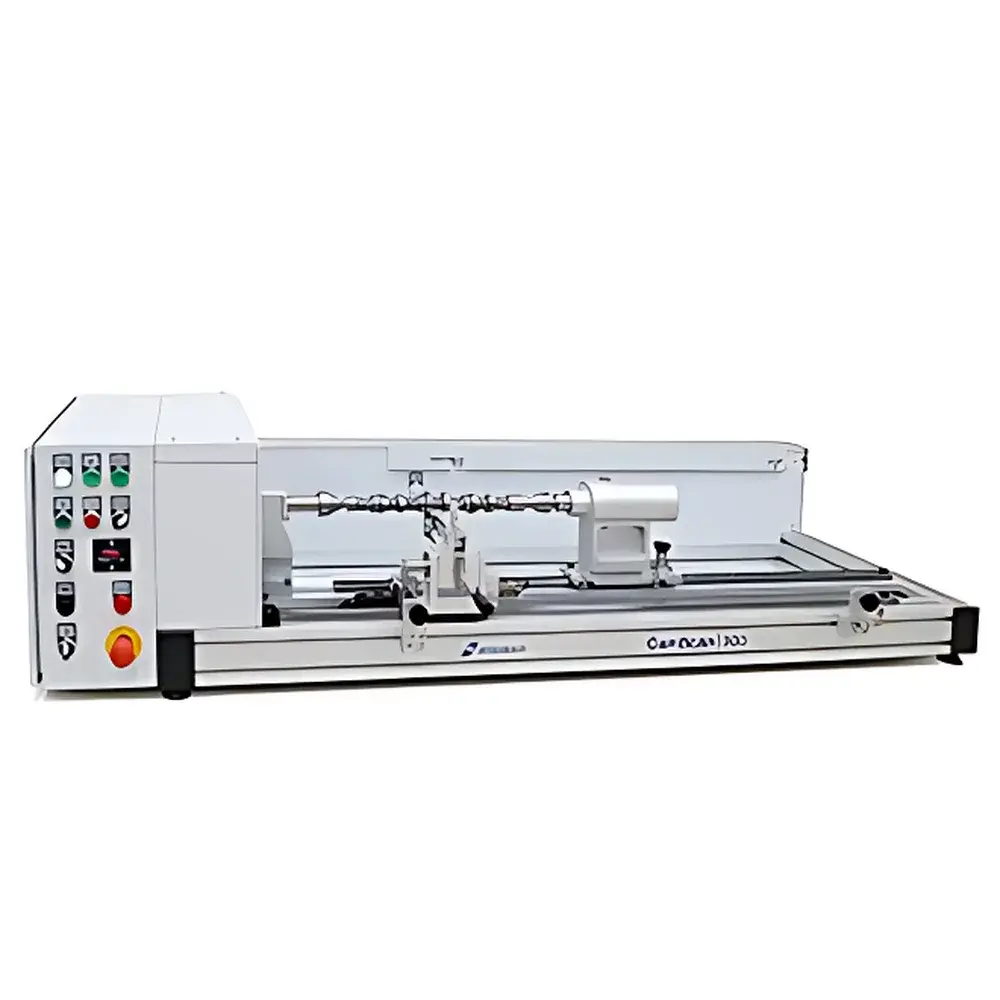
Stresstech CrankScan Automated or Semi-Automated Crankshaft Grinding Burn Detection System
| Brand | Stresstech Oy |
|---|---|
| Origin | Finland |
| Manufacturer Status | Authorized Distributor |
| Origin Category | Imported |
| Model | CrankScan |
| Pricing | Upon Request |
Overview
The Stresstech CrankScan Automated or Semi-Automated Crankshaft Grinding Burn Detection System is a dedicated non-destructive testing (NDT) instrument engineered for the reliable, quantitative assessment of grinding-induced surface damage—commonly referred to as “grinding burn”—in crankshafts used in internal combustion engines. Unlike conventional destructive methods such as acid etching (e.g., ASTM E1382), the CrankScan system employs the Barkhausen Noise Analysis (BNA) principle—a magneto-acoustic technique that detects microstructural changes in ferromagnetic materials caused by residual tensile stresses, martensitic phase transformations, and plastic deformation near the surface layer. These alterations occur during aggressive grinding or improper heat treatment and are strongly correlated with reduced fatigue life and premature failure. The system delivers objective, repeatable pass/fail evaluations or graded severity assessments directly on the production floor, supporting early-stage quality gate enforcement prior to final assembly.
Key Features
- Multi-mode operation: supports both manual handheld scanning and semi-automated or fully automated robotic integration via programmable motion stages and encoder-synchronized data acquisition
- High-resolution spatial mapping: capable of inspecting critical crankshaft geometries—including journal surfaces, fillet radii (inner corners), side faces, thrust shoulders, and crankpin bends—with precision probe positioning and adaptive lift-off compensation
- Rapid measurement cycle: single-track acquisition in 6–8 seconds per journal face; multi-channel configurations enable simultaneous evaluation of up to four measurement zones, significantly reducing total inspection time per component
- User-configurable alarm thresholds: customizable amplitude, RMS, and spectral energy-based limits for real-time go/no-go decision support; full traceability of threshold settings within audit logs
- Robust industrial design: IP54-rated enclosure, shock-resistant housing, and temperature-stable electronics suitable for shop-floor deployment adjacent to grinding cells or heat-treatment lines
- Integrated calibration verification: built-in reference standards and daily verification routines compliant with ISO 17025 metrological traceability requirements
Sample Compatibility & Compliance
The CrankScan system is validated for use on forged and cast steel crankshafts ranging from small passenger vehicle units (e.g., inline-4 gasoline engine crankshafts, ~50–120 mm journal diameter) to heavy-duty diesel applications (e.g., V8/V12 marine or locomotive crankshafts, up to 350 mm journal diameter). It operates exclusively on ferromagnetic alloys—including 42CrMo4, C70S6, 1045, and 5140 steels—where sufficient magnetic permeability and coercivity enable measurable Barkhausen emission. The methodology aligns with established NDT standards including ASTM E1444/E1444M (Standard Practice for Magnetic Particle Testing) and ISO 20962 (Non-destructive testing — Barkhausen noise analysis — General principles). Data integrity and operator accountability meet GLP/GMP expectations through optional 21 CFR Part 11-compliant software modules featuring electronic signatures, audit trails, and secure user role management.
Software & Data Management
CrankScan utilizes Stresstech’s proprietary WinView 5.x software platform, which provides synchronized waveform visualization, spectral analysis (FFT-based frequency band decomposition), and 2D/3D defect mapping across the crankshaft geometry. Measurement data—including raw BNA signals, envelope curves, statistical descriptors (peak amplitude, RMS, kurtosis), and positional metadata—is stored in structured .csv and .stx binary formats for long-term archival and third-party statistical process control (SPC) integration. The software supports automated report generation compliant with AIAG CQI-9 (Heat Treatment System Assessment) and IATF 16949 clause 8.5.1.2 (Control of production processes), including batch-level summary statistics, trend charts, and nonconformance flagging with root-cause tagging.
Applications
- Final quality assurance of crankshafts post-grinding or hard-turning operations in Tier-1 automotive suppliers and OEM engine plants
- In-process monitoring at intermediate grinding stations to detect thermal damage before subsequent machining steps
- Root-cause analysis of field failures linked to subsurface microcracking or untempered martensite layers
- Process validation and capability studies (Cpk/Ppk) for grinding parameter optimization (wheel speed, feed rate, coolant flow)
- Supplier qualification audits requiring objective, instrumented evidence of burn-free surface integrity
FAQ
How does Barkhausen Noise Analysis differ from eddy current or ultrasonic testing for burn detection?
Barkhausen Noise is uniquely sensitive to near-surface (< 0.1 mm) magnetic domain wall mobility changes induced by grinding-induced residual stress and microstructural phase shifts—parameters not reliably resolved by bulk-wave techniques like ultrasound or conductivity-based eddy current methods.
Can CrankScan be integrated into an automated production line?
Yes—via digital I/O interface, EtherNet/IP or Modbus TCP protocols, and mechanical mounting kits for robotic arms or custom gantries; full PLC handshake and recipe-driven measurement sequencing are supported.
Is operator certification required to perform measurements?
While no formal Level II NDT certification is mandated, Stresstech recommends completion of their certified CrankScan Operator Training Program (8-hour hands-on course) to ensure consistent probe coupling, lift-off control, and interpretation fidelity.
What maintenance is required for long-term accuracy?
Annual recalibration against NIST-traceable magnetic reference samples is recommended; routine verification using included CrankScan Verification Block should be performed daily prior to first measurement.
Does the system support multi-language UI and documentation?
WinView 5.x supports English, German, French, Spanish, Chinese, and Japanese language packs; technical manuals and calibration certificates are provided in English with localized translations available upon request.





