
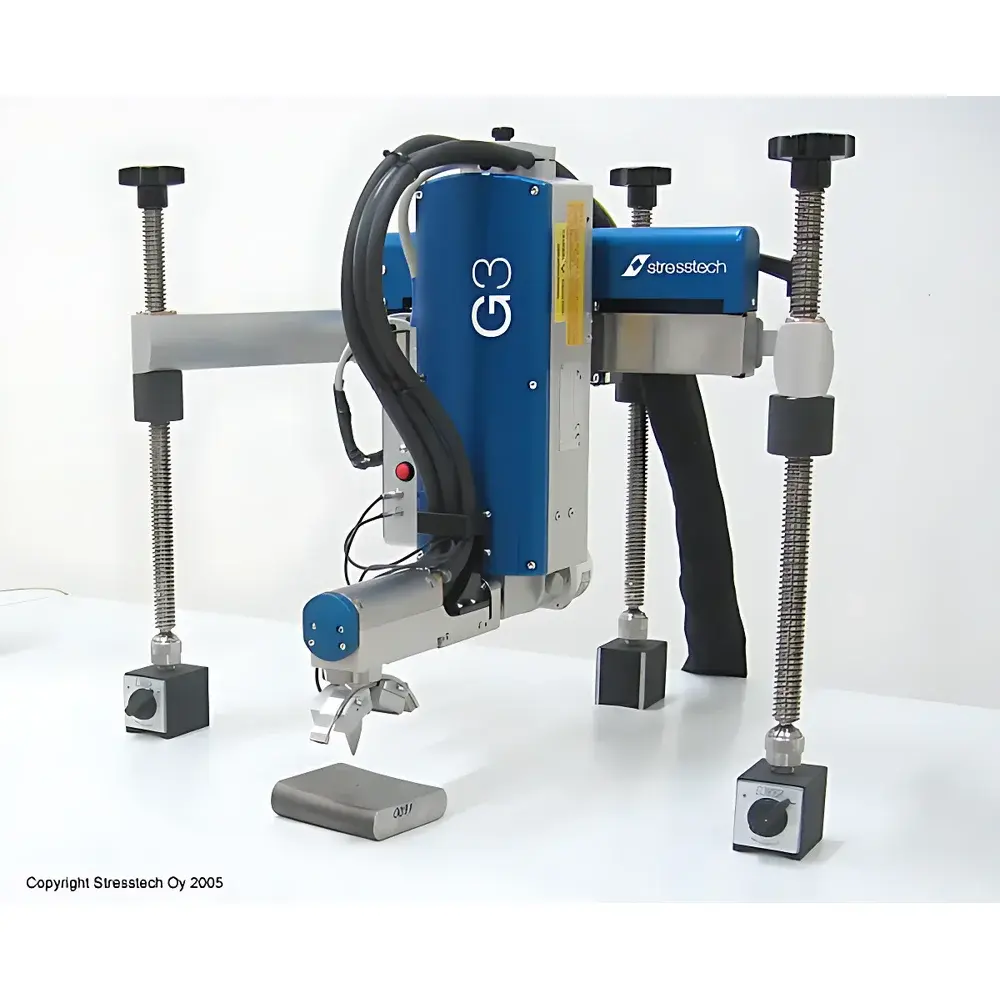
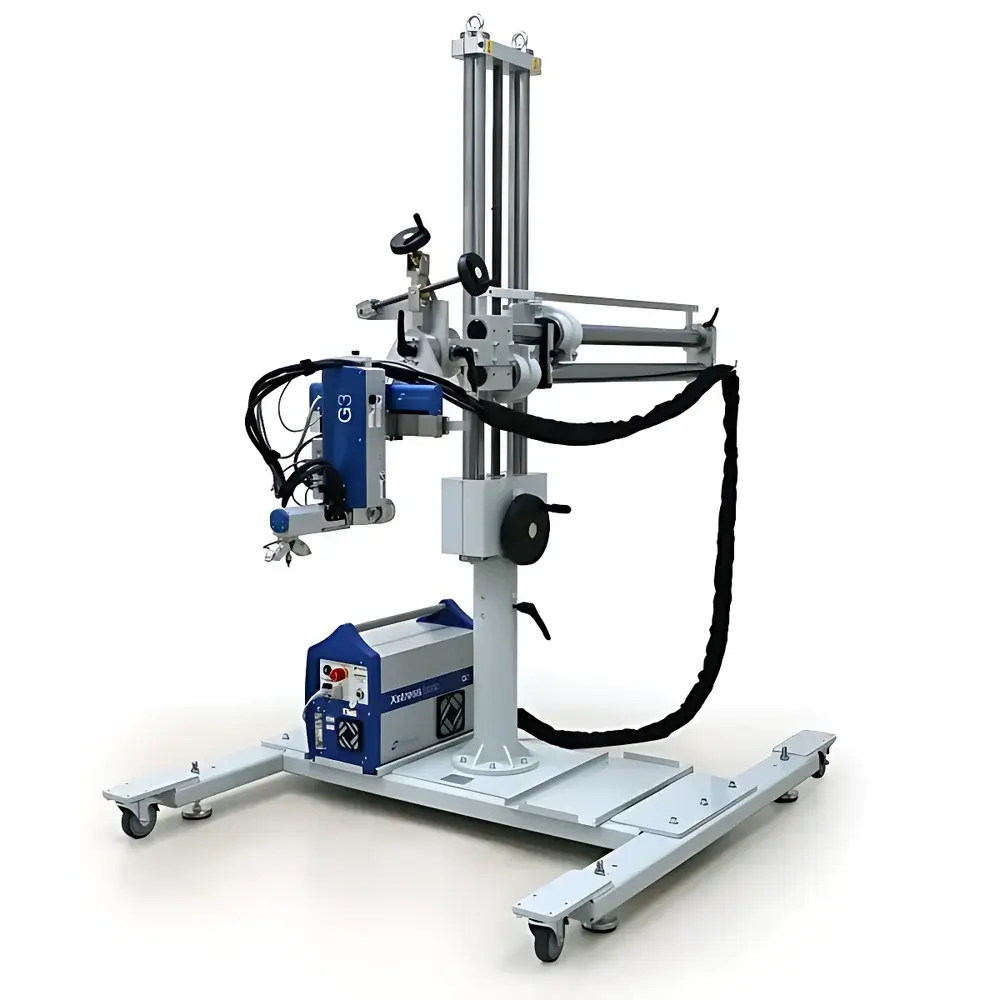
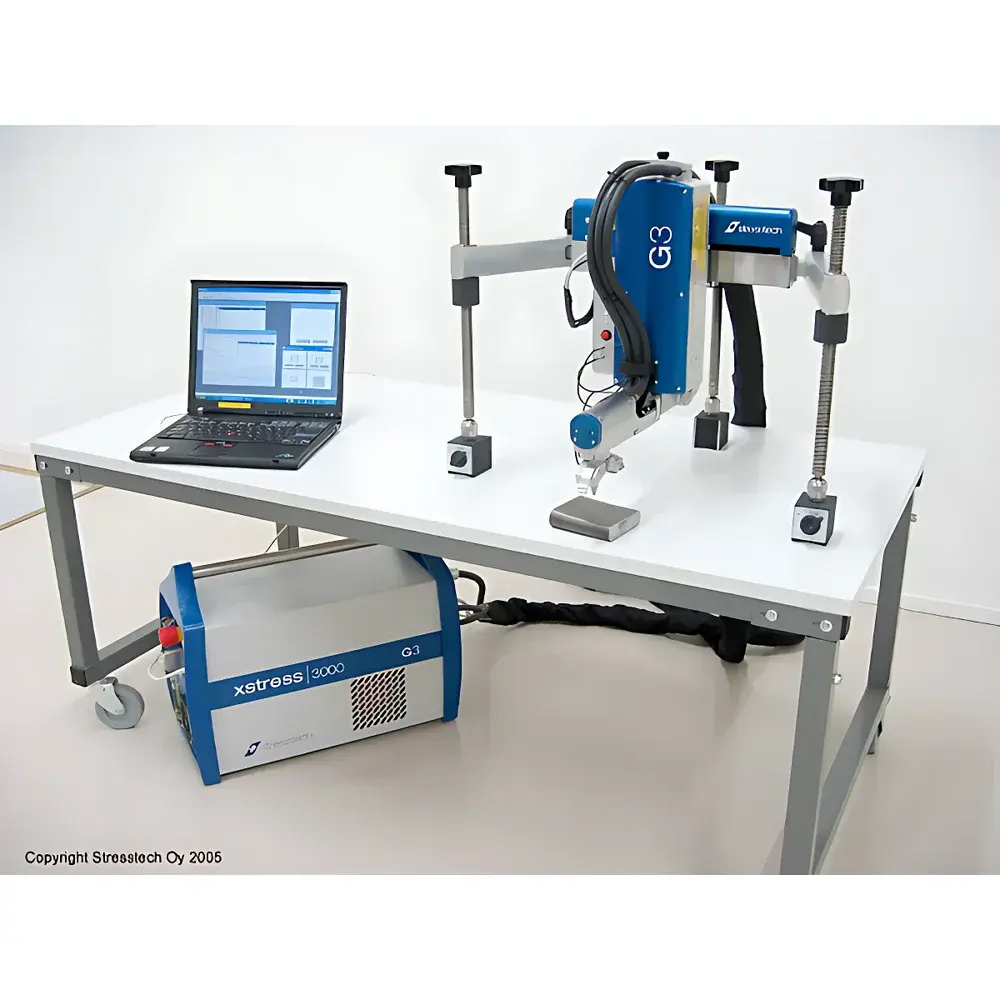
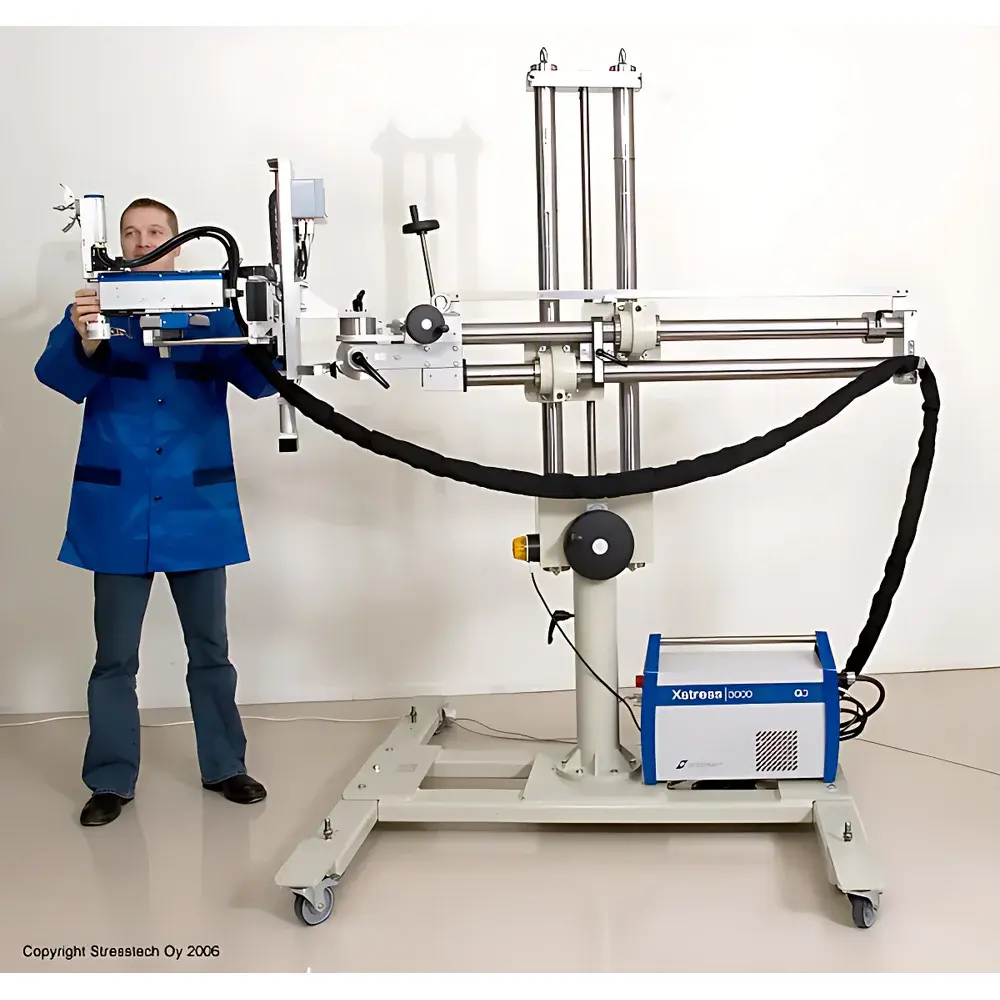
Stresstech xstress3000 X-ray Residual Stress Analyzer
| Brand | Stresstech Oy |
|---|---|
| Origin | Finland |
| Model | xstress3000 |
| Type | Portable X-ray Diffraction (XRD)-Based Residual Stress Analyzer |
| Compliance | ASTM E915, ISO 21432, EN 15305, SAE AMS 2569 |
| Measurement Principle | Sin²ψ Method with Monochromatic Cr-Kα Radiation |
| Detector | High-Sensitivity CCD or Image Plate (Configurable) |
| Goniometer | Precision Motorized θ–2θ Dual-Axis System |
| Sample Positioning | Manual or Optional Motorized XYZ Stage |
| Weight | <12 kg (Typical System Configuration) |
| Power Supply | 100–240 V AC, 50/60 Hz or Internal Battery (Optional) |
Overview
The Stresstech xstress3000 is a portable, laboratory-grade X-ray diffraction (XRD) system engineered for quantitative, non-destructive measurement of residual stress in crystalline metallic components. It operates on the well-established sin²ψ method, utilizing monochromatic Cr-Kα radiation (λ = 0.2291 nm) to determine lattice strain via precise angular displacement of Bragg diffraction peaks. By analyzing peak shifts across multiple tilt angles (ψ), the instrument calculates both surface and near-surface (up to ~20–50 µm depth, depending on material and radiation absorption) residual stress components—normal, shear, and biaxial—with high reproducibility and traceable uncertainty. Designed for industrial metrology rather than academic crystallography, the xstress3000 prioritizes robustness, field-deployability, and compliance with international standards governing residual stress assessment in safety-critical applications.
Key Features
- True portability: Compact footprint (<350 × 250 × 200 mm), integrated collimator-detector assembly, and optional battery operation enable on-site measurements at production floors, maintenance hangars, or remote field locations—without requiring vibration-isolated tables or climate-controlled rooms.
- Automated alignment and calibration: Built-in laser crosshair, motorized goniometer with sub-arcminute angular resolution, and software-guided sample centering reduce operator dependency and minimize setup time per measurement point to under 3 minutes.
- Multi-material capability: Pre-configured stress factor libraries for common alloys (e.g., AISI 4140, Ti-6Al-4V, Inconel 718, Al 2024-T3, stainless steels) and support for user-defined factors per ASTM E915 Annex A3.
- Dual detection options: Selectable high-dynamic-range CCD detector for rapid acquisition or phosphor image plate for higher sensitivity in low-diffracting materials or coarse-grained microstructures.
- Hardened mechanical architecture: IP54-rated enclosure, shock-absorbing transport case, and temperature-compensated optics ensure stable performance across ambient ranges from 5 °C to 40 °C.
Sample Compatibility & Compliance
The xstress3000 accommodates flat, curved, and contoured surfaces—including gears, bearing races, turbine blades, weld seams, additive-manufactured lattice structures, and thick-walled pressure vessels—via adjustable sample holders and curvature compensation algorithms. Surface preparation requirements are minimal: standard metallographic grinding (e.g., SiC paper up to 1200 grit) suffices; electropolishing is optional for highly stressed or deformed layers. All measurement protocols adhere to ASTM E915 (Standard Test Method for Verifying the Alignment of X-Ray Diffraction Instrumentation for Residual Stress Measurement), ISO 21432 (Non-destructive testing — X-ray diffraction methods for determining residual stresses), and EN 15305 (Non-destructive testing — Qualification and certification of NDT personnel — General principles). Data audit trails, electronic signatures, and report templates meet GLP and GMP documentation expectations for regulated sectors including aerospace (AS9100), nuclear (ASME Section XI), and medical device manufacturing.
Software & Data Management
Stresstech’s proprietary xstress software (v6.x) provides full control over acquisition parameters, real-time diffraction pattern visualization, automatic peak fitting (Pseudo-Voigt profile), and stress tensor calculation. It supports batch processing of multi-point maps, contour plotting, and export to CSV, XML, or industry-standard formats compatible with MATLAB, Python (NumPy/Pandas), and statistical process control (SPC) platforms. The software includes FDA 21 CFR Part 11-compliant modules for user access control, electronic signature logging, and immutable audit trails—enabling validated use in regulated quality systems. Raw diffraction images and metadata are stored with embedded calibration certificates and environmental logs (temperature, humidity, exposure time).
Applications
The xstress3000 serves as a primary metrology tool across sectors where residual stress directly impacts structural integrity and service life. In aerospace, it verifies stress states post-shot peening of landing gear components and validates heat-treatment uniformity in compressor disks. In automotive, it quantifies machining-induced stresses in crankshafts and camshafts prior to fatigue testing. For additive manufacturing, it characterizes layer-wise stress evolution in Ti-6Al-4V builds and identifies stress gradients across build plates. Energy applications include weld integrity assessment in nuclear piping, stress mapping of steam turbine rotors, and residual stress profiling in hydrogen embrittlement-prone pipeline steels. Academic and national labs utilize the system for fundamental studies of stress relaxation kinetics, phase transformation effects, and correlation between surface treatment parameters and subsurface stress distribution.
FAQ
What standards does the xstress3000 comply with for residual stress measurement?
ASTM E915, ISO 21432, EN 15305, and SAE AMS 2569—covering instrumentation verification, measurement procedure, and reporting requirements.
Can the system measure residual stress on curved or irregular surfaces?
Yes. The software incorporates geometric correction algorithms for cylindrical, spherical, and freeform surfaces using user-input radius-of-curvature or 3D scan data integration.
Is operator certification required to perform compliant measurements?
While no proprietary certification is mandated, personnel must be trained in ASTM E915 procedures; Stresstech offers ISO 17025-aligned training courses and third-party qualification support.
How deep into the material can residual stress be measured?
Penetration depth depends on material density and radiation energy: typically 10–50 µm for steel with Cr-Kα, up to 100 µm for aluminum alloys; depth profiling requires sequential electropolishing or layer removal per ASTM E915 Annex B.
Does the system support automated scanning for large-area stress mapping?
Yes—when paired with optional motorized XYZ stages and programmable measurement grids, the xstress3000 enables unattended multi-point mapping with positional repeatability better than ±5 µm.
Related Products





