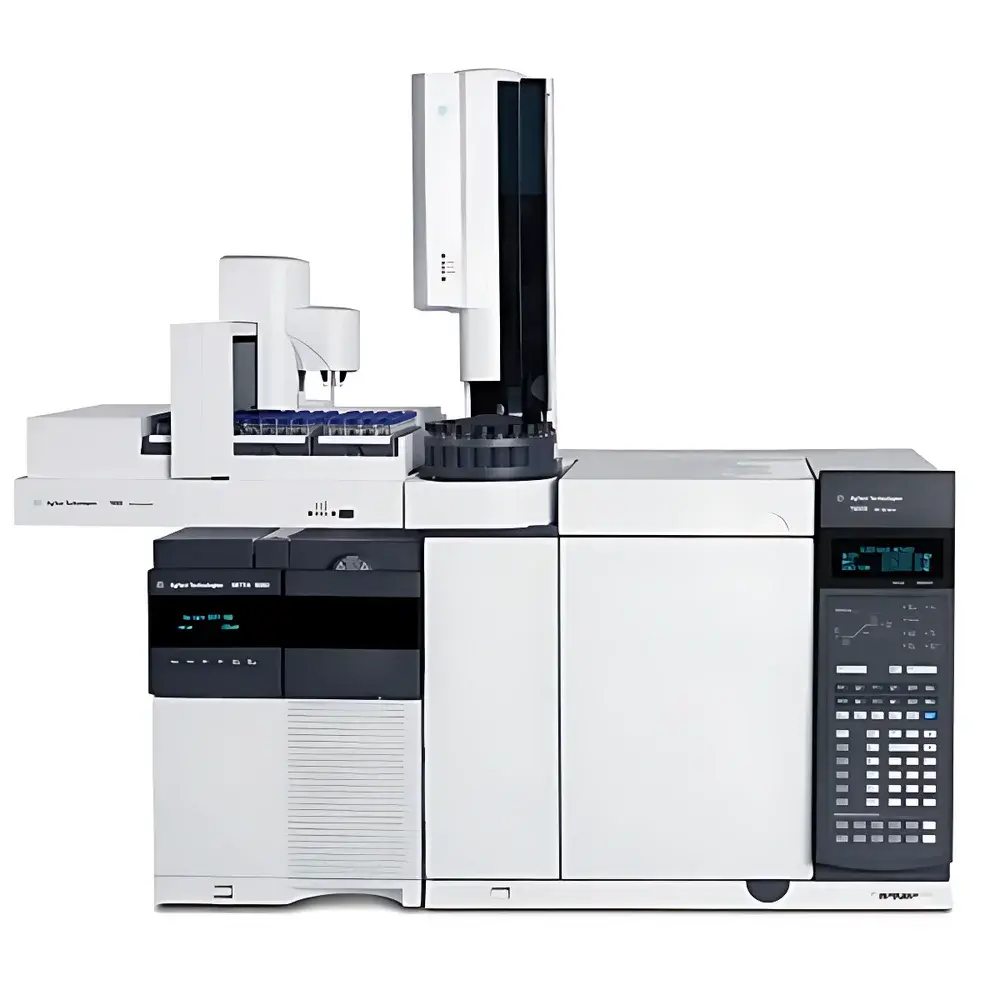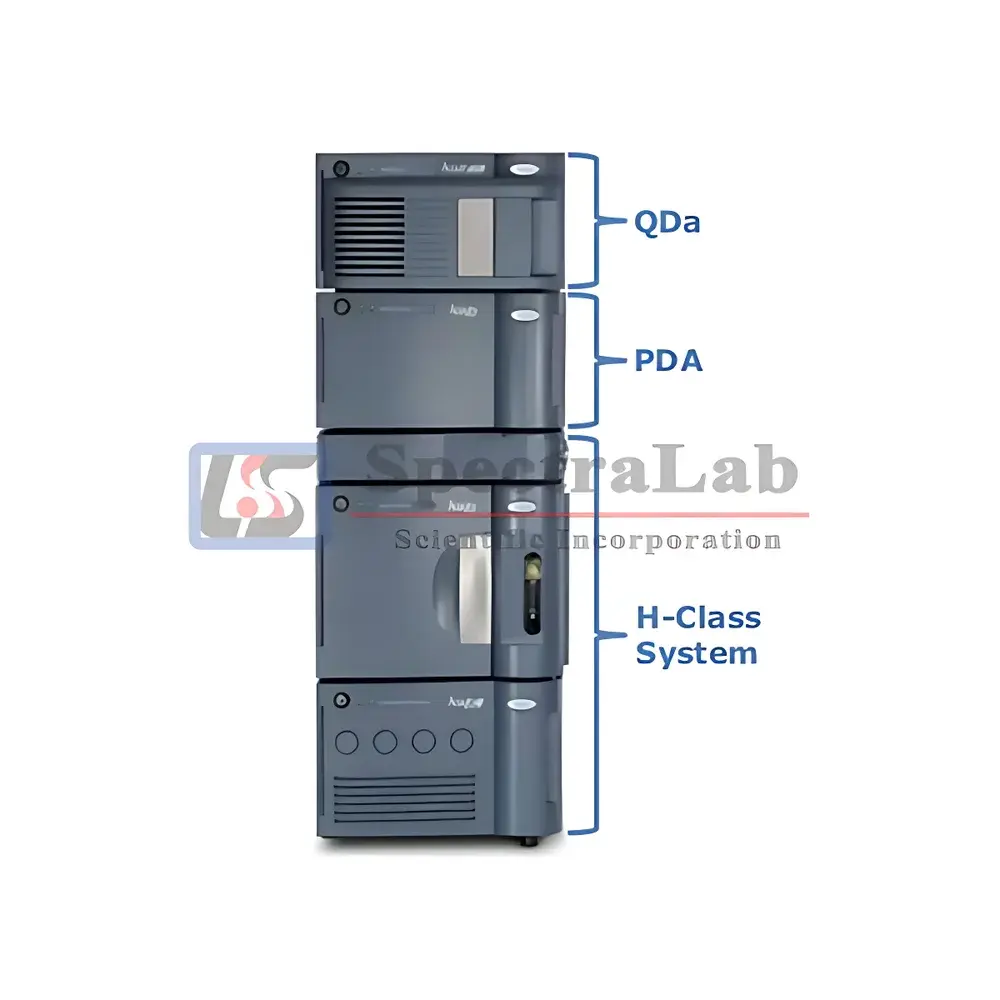
Waters ACQUITY H-Class UPLC System with QDA Mass Detector
| Brand | Waters |
|---|---|
| Origin | USA |
| Model | ACQUITY H-Class QDA |
| Detection Principle | Quadrupole Mass Spectrometry coupled with Ultra-Performance Liquid Chromatography (UPLC) |
| Sample Introduction | Flow-Through Needle Autosampler (SM-FTN-R) |
| Solvent Delivery | Quaternary Solvent Manager (QSM-R) |
| Column Management | Column Manager CM-A (4–90 °C, multi-zone) |
| Detector Configuration | PDA (186015032) + QDA MS (186006511) |
| Software Platform | Empower 3 Systems QT |
| Compliance Support | 21 CFR Part 11 audit trail, GLP/GMP-ready workflows |
| Warranty | 12 months limited hardware warranty |
| Instrument Age | <1 year operational use |
| Certification | Factory-tested and validated at SpectraLab Scientific |
Overview
The Waters ACQUITY H-Class UPLC System with QDA Mass Detector is a fully integrated, high-performance liquid chromatography–mass spectrometry (LC-MS) platform engineered for laboratories requiring seamless transition from legacy HPLC methods to UPLC-grade resolution, sensitivity, and throughput—without workflow disruption. Built on Waters’ proprietary UPLC technology, the system employs sub-2 µm particle-packed columns operated at pressures up to 15,000 psi, enabling superior peak capacity, reduced analysis time, and enhanced mass spectrometric detection efficiency. The QDA detector delivers unit-mass resolution quadrupole-based mass analysis with electrospray ionization (ESI) and atmospheric pressure chemical ionization (APCI) sources, supporting targeted quantitation, method validation, and compound identification in regulated and research environments. Unlike conventional HPLC systems, the H-Class architecture maintains full backward compatibility with existing HPLC methods while delivering UPLC performance through optimized fluidic design, low-dispersion flow paths, and thermally stabilized column management.
Key Features
- Quaternary Solvent Manager (QSM-R): Delivers precise, low-pulsation gradient formation across four solvent channels; optional solvent selection valve expands compatibility to nine solvents for complex method development.
- Flow-Through Needle Autosampler (SM-FTN-R): Utilizes positive-pressure needle sealing and low-volume flow path design to ensure 95% sample recovery—even under high-backpressure UPLC conditions.
- Column Manager CM-A: Features active solvent pre-heating, dual-zone temperature control (4–90 °C), and standardized thermal mass for inter-system method transfer reproducibility.
- Auto Blend Plus Technology: Dynamically adjusts solvent blending ratios online to achieve target pH, ionic strength, or organic modifier concentration—eliminating manual mobile phase preparation and reducing human error.
- SmartStart Gradient Synchronization: Coordinates gradient initiation with autosampler pre-injection steps to minimize cycle time without compromising retention time stability or peak shape integrity.
- Empower 3 Systems QT Software: Provides validated, 21 CFR Part 11-compliant data acquisition, processing, reporting, and electronic signature capabilities—including full audit trail, user role management, and instrument qualification templates.
Sample Compatibility & Compliance
The ACQUITY H-Class QDA supports broad sample applicability across pharmaceutical QC, biopharmaceutical characterization, environmental residue analysis, and clinical research. It accommodates aqueous, organic, and mixed-solvent matrices; handles proteins, peptides, small molecules, and polar metabolites via compatible column chemistries (e.g., BEH C18, HSS T3, CSH Fluoro-Phenyl). All hardware components meet ISO 9001 manufacturing standards and are designed for compliance with ICH Q2(R2), USP , ASTM D7877, and FDA guidance for bioanalytical method validation. The system’s firmware and Empower 3 software support full ALCOA+ data integrity principles and are routinely deployed in GLP and GMP-regulated laboratories undergoing internal and regulatory audits.
Software & Data Management
Empower 3 Systems QT serves as the central command interface for instrument control, sequence definition, real-time monitoring, and post-run processing. Its modular architecture enables customizable workflows for peak integration, calibration curve generation, impurity profiling, and mass spectral deconvolution. The software includes embedded Method Transfer Tools—such as the ACQUITY UPLC Column Calculator and Reverse-Phase Column Selection Guide—which automate parameter scaling (flow rate, gradient time, injection volume) when migrating HPLC methods to UPLC conditions. All raw data files (.raw) and processed results are stored in a secure, relational database with version-controlled backups, encrypted access, and configurable retention policies aligned with organizational SOPs.
Applications
This system is routinely deployed for: forced degradation studies of drug substances; stability-indicating assays per ICH Q5C; residual solvent analysis per USP ; peptide mapping in monoclonal antibody characterization; pesticide multiresidue screening in food matrices; and pharmacokinetic biomarker quantification in plasma using stable isotope-labeled internal standards. Its robustness and reproducibility make it suitable for routine release testing in commercial manufacturing environments as well as exploratory method development in discovery labs.
FAQ
Is this a refurbished or used instrument?
No—this is a factory-new ACQUITY H-Class QDA system, delivered with original Waters packaging, documentation, and full traceability. It has undergone functional verification at SpectraLab Scientific prior to shipment.
Does the system include validation documentation?
Yes—installation qualification (IQ), operational qualification (OQ), and performance qualification (PQ) protocols are available upon request. Empower 3 Systems QT is pre-configured with IQ/OQ templates compliant with ASTM E2500 and Annex 11.
Can legacy HPLC methods be directly transferred?
Yes—the Method Conversion Package provides automated scaling logic based on column dimensions, particle size, and flow dynamics. Retention time shifts are typically within ±0.2 min after conversion.
What service and support options are available post-warranty?
Extended service contracts, remote diagnostics, application support, and scheduled preventive maintenance are offered through Waters-certified field engineers and SpectraLab’s technical team.
Is the QDA detector capable of quantitative analysis in regulated environments?
Yes—the QDA meets sensitivity and linearity requirements for bioanalysis down to low pg/mL levels and supports internal standard calibration, matrix-matched curves, and incurred sample reanalysis (ISR) workflows required by FDA and EMA guidelines.
Related Products