
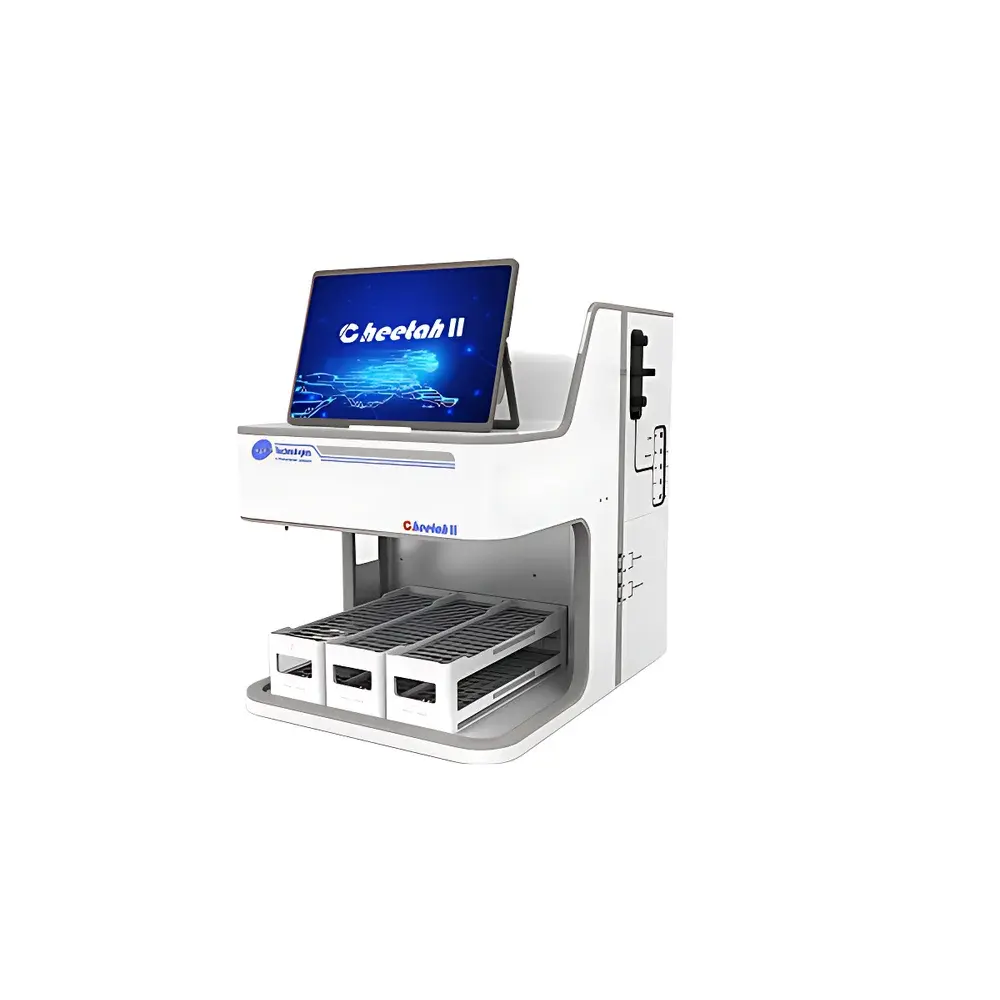
Agela CHEETAH II Medium-Pressure Flash Chromatography System
| Brand | Agela |
|---|---|
| Origin | Tianjin, China |
| Model | CHEETAH II |
| Instrument Type | Fast Liquid Chromatography (Flash) |
| Flow Rate Range | 1–200 mL/min |
| Maximum Operating Pressure | 200 psi |
| Sample Injection Positions | 1–100 |
| Injection Volume Ratio | 1–10% |
| Temperature Control | 25°C (ambient, non-thermostatted) |
| Wavelength Range | 200–800 nm |
| Data Acquisition Frequency | Not specified (system supports real-time UV/VIS spectral scanning) |
Overview
The Agela CHEETAH II Medium-Pressure Flash Chromatography System is an engineered solution for rapid, reproducible, and scalable purification of organic compounds, natural products, pharmaceutical intermediates, and synthetic peptides. Built upon proven medium-pressure liquid chromatography (MPLC) principles—specifically employing gradient-elution flash chromatography with positive displacement pumping—the CHEETAH II delivers robust performance in both analytical-scale method development and preparative-scale isolation (4–800 g columns). Unlike high-performance liquid chromatography (HPLC), which operates at >1,000 psi, this system operates within a controlled 200 psi pressure envelope, balancing resolution, speed, solvent economy, and column longevity. Its design prioritizes operational flexibility for research laboratories requiring seamless transition from TLC-based method scouting to gram-scale purification—without method re-optimization.
Key Features
- 12.1-inch capacitive touchscreen interface with intuitive, icon-driven workflow navigation—supporting full system control without external PC dependency
- Quaternary solvent delivery system enabling precise gradient formation across four independent solvent channels; gradients editable online or offline via drag-and-drop graphical editor
- Integrated full-spectrum PDA detector (200–800 nm) with real-time spectral acquisition and dynamic peak purity assessment using spectral overlay and threshold-based similarity algorithms
- Intelligent fraction collection with four modes: full-collection, peak-triggered, manual-triggered, and time/retention window-based collection; each peak mapped to a uniquely color-coded tube for visual traceability
- Universal sample introduction compatibility—supports both liquid injection (via loop or syringe) and dry-load solid-phase loading (e.g., sample adsorbed onto silica, then loaded as slurry or dry-packed)
- Solvent level and waste bottle sensors with automatic pump shutdown to prevent dry-run conditions and ensure operator safety
- Modular architecture accommodating optional accessories: autosampler (1–100-position tray), ELSD detector, and column oven (ambient-only base configuration)
Sample Compatibility & Compliance
The CHEETAH II accommodates diverse sample matrices—including polar/non-polar small molecules, heterocycles, glycosides, and moderately labile biomolecules—across reversed-phase (C18, C8, phenyl) and normal-phase (silica, amino, cyano) chemistries. It supports column dimensions from 10 mm to 80 mm ID and bed masses up to 80 g per run. The system complies with fundamental GLP documentation requirements: audit-trail-enabled software logs all method parameters, run timestamps, user IDs, and hardware events. While not certified for 21 CFR Part 11 out-of-the-box, its data export format (CSV, PDF, .agd) enables integration into validated LIMS environments. Method transfer from TLC is facilitated via built-in Rf-to-gradient correlation algorithms aligned with ASTM D6937 and USP chromatographic system suitability expectations.
Software & Data Management
The proprietary CHEETAH Control Suite provides a unified environment for method creation, real-time monitoring, spectral analysis, and report generation. All chromatograms and spectra are stored in a structured local database with metadata tagging (operator, date, column lot, solvent batch). Reports include integrated UV chromatograms, extracted wavelength traces, peak tables with retention time, area%, and purity scores, plus optional calibration curves. Export options include PDF (print-ready), CSV (for statistical analysis), and native .agd files (editable in post-processing mode). Role-based access control allows assignment of instrument operation, method editing, and data review permissions—supporting multi-user lab workflows under ISO/IEC 17025-aligned quality management systems.
Applications
- Rapid purification of reaction mixtures post-Suzuki, Heck, or amidation couplings
- Isolation of natural product fractions from crude plant extracts with minimal degradation
- Scale-up of hit-to-lead compounds in medicinal chemistry, supporting mg-to-g transitions
- TLC-guided method translation: input Rf values and solvent system to auto-generate initial gradient profiles
- Peak purity verification via spectral deconvolution—critical for ICH Q5A impurity characterization
- Method optimization for challenging separations involving co-eluting isomers or tautomers using variable-wavelength tracking
FAQ
Does the CHEETAH II support temperature-controlled column compartments?
No—the standard configuration maintains ambient temperature (25°C ± 3°C); an external column heater/cooler module is not available. For thermally sensitive separations, users should pre-equilibrate solvents and columns prior to injection.
Can I use the system for both normal-phase and reversed-phase chromatography?
Yes—hardware and software support dual-mode operation; switching requires only column and mobile phase changes, with gradient profiles adjustable accordingly.
What is the minimum detectable absorbance for the PDA detector?
The detector’s optical path length and noise floor are optimized for preparative-scale detection; typical LOD is ~0.005 AU at 254 nm under standard flow conditions (5 mL/min, 10 mm path cell).
Is method validation support included in the software?
The software includes tools for system suitability testing (SST)—peak asymmetry, resolution, and %RSD of retention time—but formal validation documentation templates must be generated externally per laboratory SOPs.
How does solid-phase loading improve separation fidelity compared to direct liquid injection?
Dry-loading mitigates solvent strength mismatch between sample solvent and initial mobile phase, reducing band distortion, fronting, and overloading artifacts—particularly critical for high-Rf compounds eluted early in gradient runs.
Related Products





