
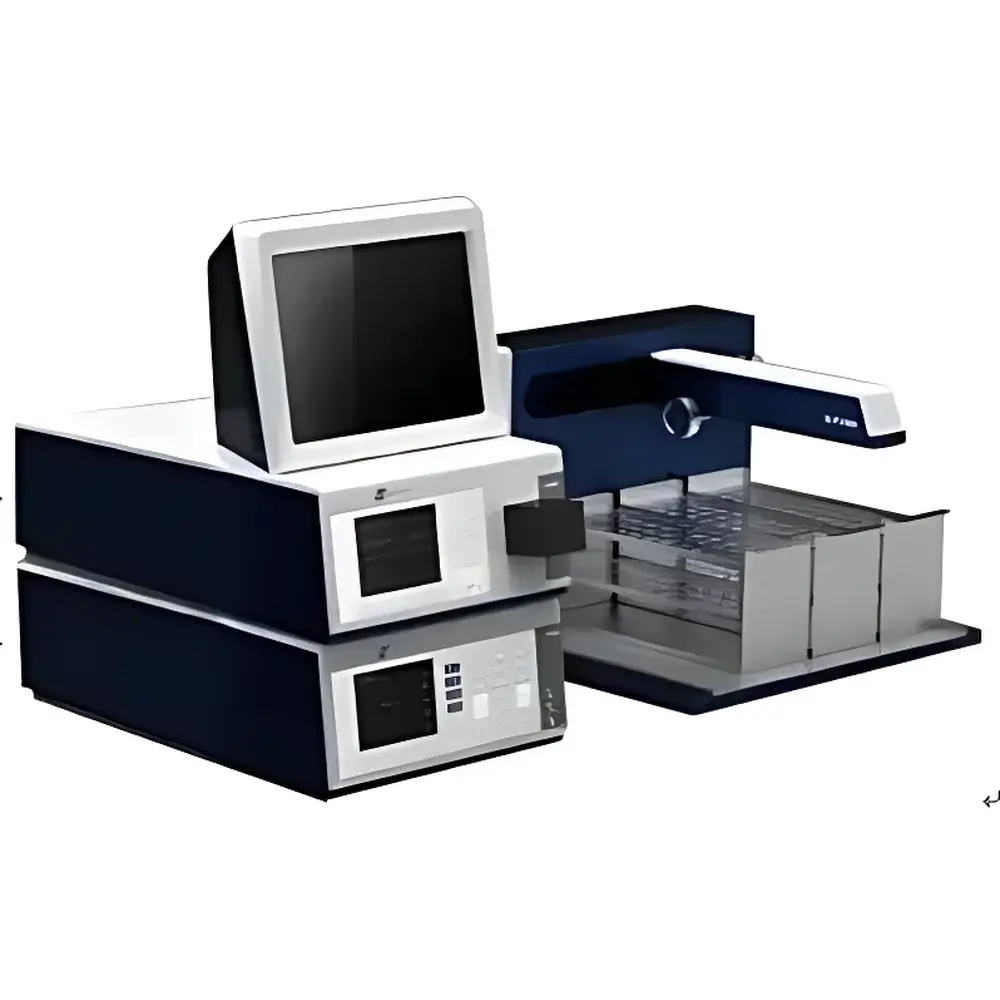
Agela FLEXA Modular Fast Purification System
| Brand | Agela |
|---|---|
| Origin | Tianjin, China |
| Manufacturer Type | Authorized Distributor |
| Region of Origin | Domestic (China) |
| Model | FLEXA |
| Price Range | USD 14,000 – 28,000 |
| Application Level | Laboratory-Scale |
| Instrument Type | Medium-to-Low Pressure Preparative Liquid Chromatography |
| Flow Rate Range | 1–100 mL/min (FLEXA GP100), 1–200 mL/min (FLEXA GP200), 1–30 L/min (FLEXA GP030) |
| Flow Accuracy | ±2% |
| Flow Precision (RSD) | ±2% |
| Maximum Operating Pressure | 200 psi |
| Wavelength Range | 200–400 nm (FL-UV2040), 200–800 nm (FL-UV2080/2080B) |
| Wavelength Accuracy | ±1 nm |
| Wavelength Reproducibility | ±1 nm |
| Baseline Noise | ≤3 × 10⁻⁴ AU |
| Data Acquisition Rate | 3 Hz |
| Gradient Composition Accuracy | ±1% |
| Gradient Modes | Binary, Linear, Isocratic, and Custom Profiles |
| Detector Channels | Dual-Wavelength Simultaneous Detection |
| UV Source | Deuterium Lamp (200–400 nm), Tungsten Lamp (400–800 nm) |
| Collection Vessels | 13 mm, 15 mm, 18 mm, 25 mm test tubes, and 100 mL Erlenmeyer flasks |
| Fraction Trigger Modes | Full Collection, Manual Trigger, Threshold-Based Peak Detection |
| Communication Interface | RS-232 |
Overview
The Agela FLEXA Modular Fast Purification System is a laboratory-scale, medium-to-low pressure preparative liquid chromatography platform engineered for reproducible, scalable compound isolation in research and development environments. Built upon robust industrial-grade components—including ceramic piston-free metering pumps and embedded industrial control architecture—the system implements classical liquid chromatographic separation principles under controlled flow and gradient conditions. It operates within a maximum pressure limit of 200 psi, supporting column dimensions typical of flash and medium-pressure purification (e.g., 10–100 mm ID columns packed with silica, C18, or specialized stationary phases). The system’s core function is the automated fractionation of complex mixtures—such as natural product extracts, synthetic reaction crude products, or biologically derived samples—based on differential retention and UV absorbance characteristics. Its design prioritizes operational safety, method transferability, and compatibility with standard laboratory workflows, making it suitable for routine use in academic labs, contract research organizations (CROs), and pharmaceutical process development units.
Key Features
- Modular architecture enables flexible configuration: pump modules (FLEXA GP100/GP200/GP030), dual-wavelength UV detectors (FL-UV2040/2080/2080B), and XYZ programmable fraction collectors (FL-C100) can be selected and combined per application requirements.
- Ceramic metering pump technology ensures long service life (>10,000 hours), minimal pulsation, and maintenance-free operation without check valves or seals prone to solvent degradation.
- Dual-wavelength UV detection supports simultaneous monitoring at two independent wavelengths—e.g., target analyte λmax and a secondary wavelength for co-eluting impurity tracking—enhancing peak assignment confidence and fraction purity assessment.
- Binary gradient capability with ±1% composition accuracy enables precise method development for challenging separations, including polarity-gradient elution across silica or reversed-phase media.
- Programmable X/Y-axis fraction collector accommodates standardized glassware (13–25 mm test tubes) and larger vessels (100 mL Erlenmeyer flasks), with adjustable rack positioning and real-time collection logic based on UV threshold, time, or user-defined peak integration.
- Embedded industrial PC running proprietary chromatography control software provides intuitive touchscreen interface, method storage, audit-trail-capable event logging, and export of raw data in ASCII-compatible formats for third-party analysis.
Sample Compatibility & Compliance
The FLEXA system is compatible with a broad range of sample matrices—including plant extracts, combinatorial synthesis libraries, peptide intermediates, and small-molecule APIs—provided they are soluble in common HPLC-grade solvents (e.g., hexane, ethyl acetate, methanol, acetonitrile, water, and aqueous buffers). Its detector optics and fluidic pathways are chemically inert to standard organic solvents and mildly acidic/basic mobile phases. While not certified for GMP manufacturing, the system supports GLP-aligned documentation practices: all method parameters, run logs, and fraction metadata are timestamped and stored locally with optional backup to network drives. Software-generated reports include instrument status, flow/pressure history, UV chromatograms, and collection mapping—facilitating internal validation and regulatory review per ISO/IEC 17025 or FDA-aligned quality systems.
Software & Data Management
The FLEXA Control Suite is a Windows-based, embedded application developed in-house for deterministic real-time instrument control. It supports method creation with up to 20 gradient steps, variable flow programming, and multi-channel UV signal processing. All acquisition parameters—including wavelength selection, gain, filter time constant, and baseline correction—are configurable and saved with each method. Raw chromatographic data (.dat files) contain full analog-to-digital conversion records at 3 Hz sampling frequency, enabling post-run reintegration and spectral deconvolution. Audit trails record operator login, method edits, start/stop events, and hardware alerts—meeting foundational requirements for 21 CFR Part 11 compliance when deployed with appropriate IT governance (e.g., electronic signatures, access controls, and data integrity policies).
Applications
- Natural product isolation: rapid fractionation of alkaloid-, flavonoid-, or terpenoid-rich botanical extracts using silica or diol columns with stepwise or linear solvent gradients.
- Organic synthesis purification: removal of unreacted starting materials, catalysts, or regioisomeric byproducts from crude reaction mixtures prior to NMR or MS characterization.
- Pharmaceutical R&D: parallel purification of compound libraries for SAR studies; support for early-stage API purification under non-GMP conditions.
- Bioconjugate handling: compatibility with bio-compatible UV detectors (FL-UV2080B) allows monitoring of protein-ligand conjugates or nucleotide analogs without denaturation.
- Method scouting & scale-up: identical hardware and control logic across FLEXA GP100/GP200 models enable seamless translation from analytical scouting to gram-scale purification.
FAQ
What column formats are supported by the FLEXA system?
Standard disposable flash cartridges (10–100 g), reusable stainless-steel columns (10–50 mm ID), and custom-packed glass columns are compatible—provided backpressure remains below 200 psi at the selected flow rate.
Can the system be integrated with third-party data systems?
Yes—ASCII-formatted chromatogram exports and RS-232 serial communication allow integration with LIMS or ELN platforms via custom middleware or vendor-provided drivers.
Is gradient delay volume compensated in method development?
The system does not include active gradient delay compensation; users must empirically determine dwell volume during method transfer and adjust gradient start times accordingly.
What maintenance is required for the ceramic pump modules?
No scheduled maintenance is required—ceramic pumping elements eliminate seal wear and solvent-induced corrosion. Routine checks include tubing integrity, purge valve function, and UV lamp intensity calibration every 6 months.
Does the software support IQ/OQ documentation templates?
Agela provides standard IQ/OQ protocol outlines aligned with ASTM E2500 and USP ; site-specific execution requires lab-based testing under qualified personnel supervision.





