
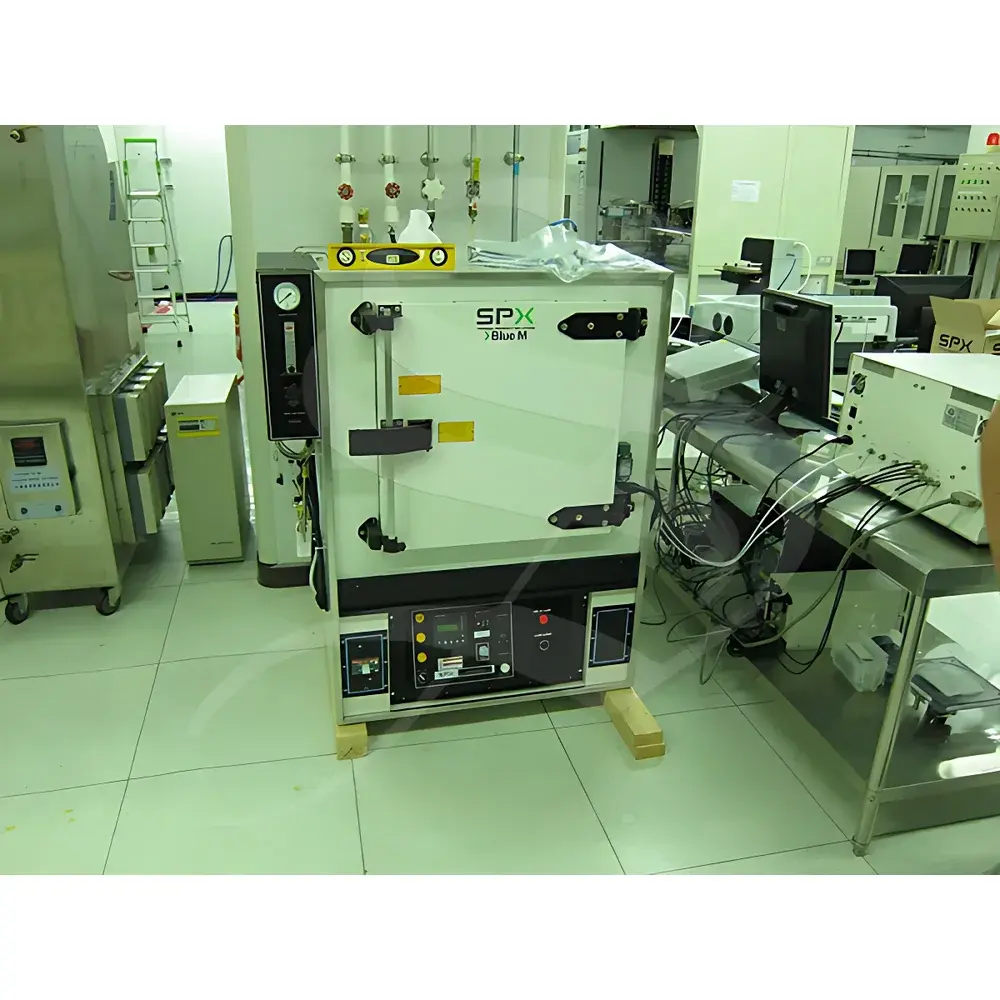
Blue M Inert Atmosphere Oven
| Brand | Blue M |
|---|---|
| Origin | USA |
| Model | Blue M Inert Atmosphere Oven |
| Instrument Type | Benchtop/Box-Type Laboratory Oven |
| Max Operating Temperature | 700 °C |
| Temperature Control Accuracy | ±0.5 °C |
| Heating Method | Forced-Air Convection |
| Internal Dimensions (W×D×H) | 20×18×20 to 48×24×36 in (508×457×508 to 1219×610×914 mm) |
| Insulation | 4-inch Mineral Wool |
| Door Seal | High-Performance Fiberglass Gasket |
| Temperature Range | Ambient +15 °C to 316 °C (for inert gas models) |
| Uniformity | ±1% (at ≤316 °C), ±2% (at 700 °C) |
| Resolution | 0.1 °C |
| Power Rating | 7.5 kW |
| Ramp Time to 300 °C | ≤60 min (no-load, exhaust closed) |
Overview
The Blue M Inert Atmosphere Oven is a precision-engineered laboratory oven designed for thermal processing under controlled, oxygen-free environments. Utilizing forced-air convection heating and a fully welded 304 stainless steel chamber, it maintains strict atmospheric integrity during operation—critical for applications requiring ultra-low oxygen or trace-element stability, such as semiconductor wafer annealing, catalyst activation, lithium-ion battery electrode drying, and moisture-sensitive material curing. Unlike standard convection ovens, this model integrates structural and sealing features specifically validated for inert gas purging (N₂, Ar, He) and vacuum-assisted atmosphere management. Its maximum operating temperature of 700 °C (in high-temperature configurations) supports both low-temperature inert stabilization and high-end thermal treatments, while the 4-inch mineral wool insulation ensures thermal efficiency and external surface safety per IEC 61000-3-2 and UL 61010-1 requirements.
Key Features
- Monolithic 304 stainless steel interior chamber with full-penetration welding—eliminates crevices where gas permeation or condensate accumulation could compromise inert integrity.
- Heavy-gauge 16-gauge cold-rolled steel outer casing with corrosion-resistant powder-coated finish for long-term lab durability.
- High-compression fiberglass door gasket system engineered to maintain seal integrity across repeated thermal cycles (–20 °C to 700 °C).
- Dual-stage inert gas inlet/outlet ports with integrated flow regulators and optional mass flow controller compatibility (MFC-ready).
- Safety-rated interlocked door switch that de-energizes heating elements upon door opening—preserving purge continuity and operator protection per ANSI Z21.11.2.
- Microprocessor-based PID controller with real-time temperature logging, programmable ramp/soak profiles, and configurable alarm thresholds (over-temperature, door-open, gas-flow loss).
Sample Compatibility & Compliance
This oven accommodates a broad range of sample forms—including crucibles, quartz boats, ceramic trays, and custom fixtures—within internal volumes ranging from 1.6 to 24 ft³ (0.045 to 0.68 m³). Chamber dimensions are modularly scalable to support ISO/IEC 17025-compliant calibration traceability and ASTM E220-22 reference thermocouple placement. All inert gas variants comply with OSHA 1910.1200 (Hazard Communication) for handling compressed gases and meet GLP/GMP environmental monitoring prerequisites when integrated with validated purge protocols. Optional documentation packages include Factory Acceptance Test (FAT) reports, IQ/OQ templates, and 21 CFR Part 11–compliant audit trails when paired with Blue M’s DataLogger Pro software.
Software & Data Management
The oven interfaces via RS-485 or optional Ethernet with Blue M’s DataLogger Pro v4.2—a validated data acquisition platform supporting multi-channel thermocouple inputs (Type K, T, or N), real-time gas flow monitoring, and timestamped event logging. Data exports comply with ASTM E2500-13 for raw data integrity and support CSV, PDF, and XML formats for LIMS integration. Electronic signatures, user role-based access control, and automatic backup to network drives fulfill FDA 21 CFR Part 11 requirements for regulated environments. Firmware updates are delivered via secure HTTPS and include version-controlled change logs aligned with IEC 62304 medical device software lifecycle standards.
Applications
- Pre- and post-sintering atmosphere control for metal-organic frameworks (MOFs) and battery cathode materials.
- Low-oxygen annealing of photovoltaic thin films (CIGS, perovskite precursors) to prevent oxidation-induced phase segregation.
- Controlled dehydration of hygroscopic pharmaceutical intermediates under nitrogen blanket—validated per USP and .
- Thermal aging studies of polymer composites in inert atmospheres to isolate oxidative degradation mechanisms (ASTM D3045).
- Calibration and conditioning of reference standards for metrology labs requiring stable thermal gradients and minimal ambient interference.
FAQ
What inert gases are compatible with this oven?
Nitrogen (N₂), argon (Ar), helium (He), and forming gas (N₂/H₂) mixtures are supported. Hydrogen use requires optional explosion-proof configuration (Class I, Division 1, Group D) and third-party hazardous location certification.
Can the oven operate under vacuum in addition to inert gas purging?
Yes—models equipped with vacuum-rated door seals and optional vacuum port adapters support operation down to 10⁻² Torr when paired with a compatible mechanical vacuum pump and pressure controller.
Is temperature uniformity verified at point-of-use or only at sensor location?
Uniformity is measured per ASTM E2203 using nine calibrated thermocouples placed on a grid within the working zone; test reports include spatial deviation maps referenced to the chamber’s geometric center.
How is gas flow rate monitored and controlled during operation?
Standard units include dual needle valves for inlet/outlet regulation. Optional integrated thermal mass flow meters (±1% FS accuracy) provide analog 4–20 mA output and digital Modbus RTU feedback for closed-loop control.
Does the oven support automated purge cycle programming?
Yes—the controller includes pre-programmed purge sequences (e.g., “3x volume exchange + dwell”) with timer-based valve actuation, flow validation, and alarm escalation if target O₂ levels (measured via optional inline O₂ analyzer) are not achieved.



