
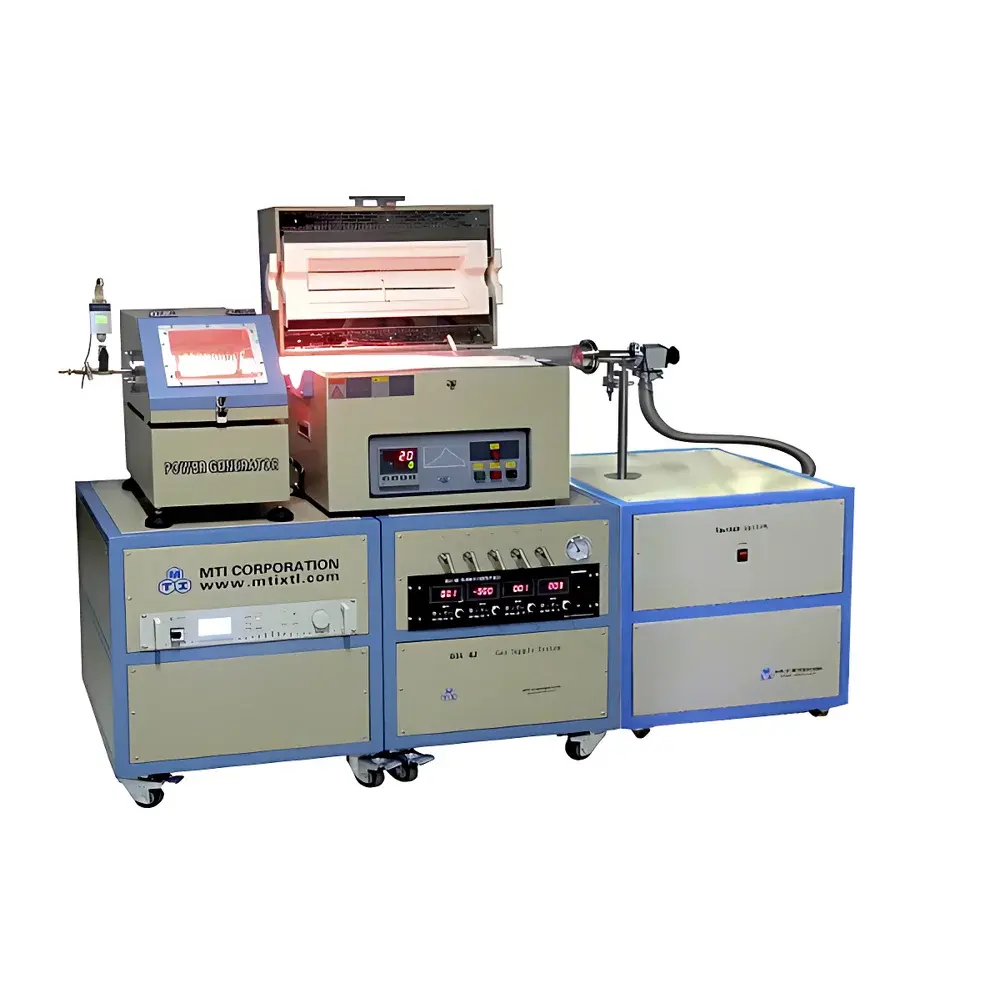
Kojin OTF-1200X-50-4CLV-PE 4-Channel Plasma-Enhanced Chemical Vapor Deposition (PECVD) Tube Furnace System
| Brand | Kojin |
|---|---|
| Origin | Anhui, China |
| Model | OTF-1200X-50-4CLV-PE |
| Maximum Temperature | 1200 °C |
| Temperature Control Accuracy | ±1 °C |
| Heating Zone Length | 440 mm |
| Uniform Temperature Zone Length | 150 mm |
| Tube Dimensions (ID × OD × L) | 44 mm × 50 mm × 1000 mm |
| Heating Method | Resistive Wire |
| Rated Power | 3 kW |
| RF Power Supply Output | 50–500 W (adjustable ±1%), Frequency: 13.56 MHz (stability ±0.005%), Noise Level: ≤55 dB(A) |
| Vacuum Level | ≤1×10⁻³ Torr (with KF25 vacuum system) |
| Mass Flow Controllers | 7-channel, 0–200 sccm range, accuracy ±0.02% |
| Gas Inlet | Dual-ferrule compression fittings (ISO-K standard) |
| Cooling | Air-cooled RF generator |
| Certifications | CE, UL/MET/CSA compliant (>24 V components), TUV/CAS certification available upon request |
Overview
The Kojin OTF-1200X-50-4CLV-PE is a fully integrated, open-type plasma-enhanced chemical vapor deposition (PECVD) tube furnace system engineered for low-temperature thin-film synthesis under controlled reactive atmospheres. Unlike conventional thermal CVD, this system leverages high-density glow-discharge plasma (electron density: 10⁹–10¹² cm⁻³) to activate precursor gases—enabling film growth at substrate temperatures as low as 100–300 °C while maintaining stoichiometric fidelity and structural integrity. The core architecture combines a high-stability 1200 °C resistive tube furnace with a 13.56 MHz RF plasma source, precision gas delivery (4 independent channels + 3 auxiliary lines), and a high-vacuum pumping station. Internal alumina coating on the furnace chamber enhances thermal emissivity and extends service life by mitigating thermal degradation of refractory insulation. Designed for reproducible process development in R&D laboratories, the system supports both batch and sequential deposition protocols across silicon wafers, glass substrates, flexible polymers, and nanostructured templates.
Key Features
- Four independently controllable gas inlet channels with integrated mass flow controllers (MFCs), enabling precise stoichiometric tuning of multi-precursor chemistries (e.g., SiH₄/NH₃ for SiNₓ, CH₄/H₂ for diamond-like carbon)
- RF plasma module featuring 50–500 W output power, frequency stability ±0.005%, and built-in impedance matching network for consistent plasma ignition and maintenance across pressure ranges (1–100 mTorr)
- High-purity fused quartz tube (OD 50 mm, ID 44 mm, L 1000 mm) rated for continuous operation up to 1100 °C; optional tube diameters (Φ60/Φ80 mm) available for scalability
- 30-segment programmable temperature controller with ramp/soak profiles, real-time PID auto-tuning, and data logging via RS485/USB interface
- KF25 vacuum manifold with stainless-steel bellows, fine-adjustment needle valves, and corrosion-resistant digital vacuum gauge (range: 3.8×10⁻⁵–1125 Torr, gas-independent calibration)
- Comprehensive safety architecture: overpressure interlock (0.02 MPa threshold), atmospheric-pressure hold logic above 1000 °C, and automatic RF shutdown during vacuum loss or cooling failure
Sample Compatibility & Compliance
The system accommodates substrates up to 4-inch diameter wafers or 100 mm × 100 mm planar samples, with uniform heating across a 150 mm isothermal zone. Quartz tube compatibility extends to halogenated, hydride, and organometallic precursors (e.g., TiCl₄, Al(CH₃)₃) when used with appropriate gas-handling protocols. All electrical subsystems comply with CE Directive 2014/30/EU (EMC) and 2014/35/EU (LVD); components operating above 24 V meet UL 61010-1, CSA C22.2 No. 61010-1, and MET Laboratories standards. Optional documentation packages support GLP/GMP audit readiness, including IQ/OQ protocols, calibration certificates for MFCs and thermocouples (Type S, ±0.5 °C), and traceable vacuum gauge verification per ISO 20484. The patented modular design (ZL-2011-2-0355777.1) allows field-upgradable configurations without compromising vacuum integrity.
Software & Data Management
Temperature and plasma parameters are managed via a dedicated industrial HMI panel with local data storage (≥10,000 cycle history). Optional PC-based software (Windows/Linux compatible) provides synchronized acquisition of MFC setpoints, actual flows, RF forward/reflected power, vacuum pressure, and thermocouple readings at 1 Hz resolution. Export formats include CSV and HDF5 for integration with MATLAB, Python (Pandas), or LabVIEW environments. Audit trail functionality meets FDA 21 CFR Part 11 requirements when deployed with user authentication, electronic signatures, and immutable log archiving. Process recipes can be version-controlled, locked against unauthorized modification, and exported/imported as encrypted XML files.
Applications
This PECVD system is routinely employed in academic and industrial research for depositing functional thin films including silicon nitride (SiNₓ) anti-reflective coatings, hydrogenated amorphous silicon (a-Si:H) for photovoltaic absorber layers, titanium nitride (TiN) diffusion barriers, and graphene oxide reduction layers. It supports process optimization studies aligned with ASTM F398 (thin-film stress measurement), ISO 14644-1 (cleanroom-compatible gas handling), and USP (particulate contamination control in pharmaceutical-grade coatings). Cross-disciplinary use cases span microelectronics packaging, MEMS passivation, catalytic electrode fabrication, and biomaterial surface functionalization.
FAQ
What is the maximum safe operating pressure inside the quartz tube?
The absolute maximum internal pressure is 0.02 MPa (2 bar gauge). Exceeding this requires mechanical reinforcement or alternative tube materials.
Can the system operate under high vacuum (<10⁻⁴ Torr) during plasma ignition?
No. Plasma generation requires a minimum pressure of ~1 mTorr for stable glow discharge. The system’s operational vacuum range is 1–100 mTorr for PECVD processes.
Is the RF generator water-cooled?
No—it uses forced-air cooling with redundant thermal cutoffs. Water cooling is available as an optional upgrade for extended high-power (>400 W) duty cycles.
What maintenance intervals are recommended for vacuum components?
KF25 seals should be inspected every 200 operating hours; needle valve grease replenishment is advised every 500 hours. The digital vacuum gauge requires annual recalibration against a NIST-traceable standard.
Does the system support remote monitoring via Ethernet or Wi-Fi?
Yes—optional Ethernet/IP module enables Modbus TCP communication for integration into facility-wide SCADA systems. Wi-Fi connectivity is not supported due to RF interference concerns with the 13.56 MHz plasma source.



