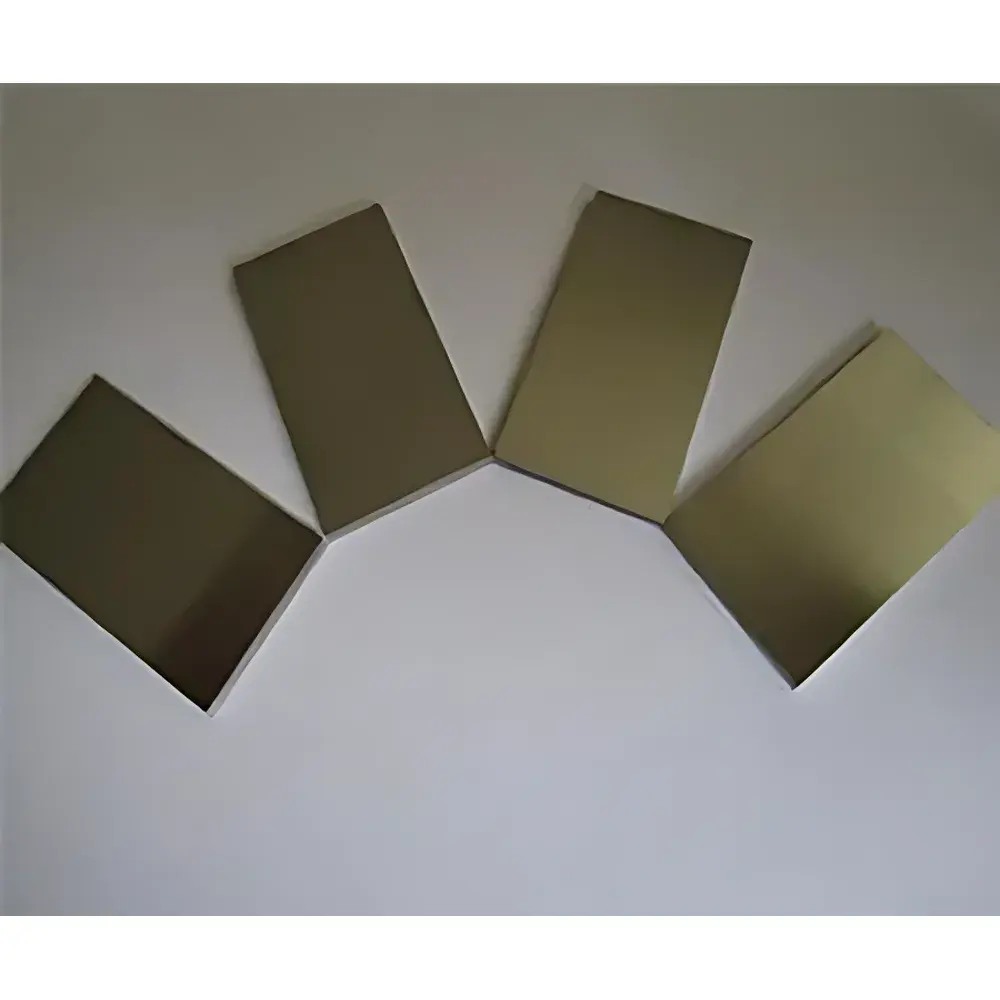
Iridium (Y) Sheet
| Brand | Hefei Kejing |
|---|---|
| Origin | Anhui, China |
| Manufacturer Type | Authorized Distributor |
| Origin Classification | Domestic |
| Model | Iridium (Y) Sheet |
| Pricing | Upon Request |
| Standard Dimensions | 10 × 10 × 1.0 mm |
| Packaging | Vacuum-sealed in Class 100 cleanroom bags, processed in Class 1000 cleanroom environment |
| Storage Requirement | Store under vacuum to prevent oxidation |
Overview
The Iridium (Y) Sheet is a high-purity metallic substrate engineered for demanding applications in ultra-high vacuum (UHV) systems, thin-film deposition processes, and high-temperature catalytic research. Despite the nomenclature “(Y)” in the model designation—which reflects internal cataloging convention rather than yttrium alloying—the material is composed of elemental iridium (Ir, CAS No. 7439-88-5), a platinum-group metal renowned for its exceptional corrosion resistance, high melting point (2446 °C), and chemical inertness in oxidizing and acidic environments. This sheet is not a sensor or active instrument but a precision-engineered functional component used as a sputtering target, crucible liner, or calibration reference substrate in analytical and materials science instrumentation—including X-ray photoelectron spectroscopy (XPS), secondary ion mass spectrometry (SIMS), and physical vapor deposition (PVD) systems.
Key Features
- High-purity iridium base material with trace impurity control suitable for UHV-compatible applications
- Dimensional stability across thermal cycling due to low coefficient of thermal expansion (6.4 × 10⁻⁶ K⁻¹)
- Standard thickness tolerance of ±0.05 mm, surface roughness Ra < 0.2 µm (as-measured post-polishing)
- Vacuum-compatible packaging: double-bagged in Class 100 cleanroom polyethylene bags, sealed under ≤10⁻² mbar vacuum
- Custom fabrication available—including laser cutting, hole drilling, and edge chamfering—to meet OEM integration requirements
Sample Compatibility & Compliance
This iridium sheet exhibits compatibility with standard semiconductor-grade handling protocols and is routinely employed in Class 100–Class 10 cleanroom environments. While not certified to ISO 9001 or ASTM F2439 (for sputtering targets) by default, documentation packages—including material test reports (MTRs) with ICP-MS trace element analysis—can be supplied upon request. The product conforms to RoHS Directive 2011/65/EU and is exempt from REACH Annex XIV restrictions due to iridium’s status as a non-substance-of-very-high-concern (SVHC) under current ECHA evaluation. For GMP-regulated thin-film manufacturing (e.g., medical device coatings), full traceability—including lot-specific heat treatment records and residual gas analysis (RGA) data—is available under controlled supply agreements.
Software & Data Management
As a passive material component, the Iridium (Y) Sheet does not incorporate embedded firmware, connectivity interfaces, or proprietary software. However, it integrates seamlessly into instrument workflows governed by industry-standard data management frameworks. When used as a sputtering target, its lot number and dimensional specifications can be logged into laboratory information management systems (LIMS) such as LabWare LIMS or Thermo Fisher SampleManager. Traceability metadata—including cleanroom processing logs, vacuum seal integrity timestamps, and supplier MTR references—supports audit readiness for GLP (Good Laboratory Practice) and FDA 21 CFR Part 11 compliance where electronic records are maintained.
Applications
- Sputter deposition of iridium films for oxygen evolution reaction (OER) electrocatalysts in PEM electrolyzers
- Substrate for epitaxial growth of complex oxides (e.g., SrTiO₃, YBCO) via pulsed laser deposition (PLD)
- Reference material in XPS depth profiling calibration due to stable Ir 4f binding energy (60.8 eV for Ir⁰)
- Crucible liner in high-temperature crystal growth furnaces operating above 2000 °C under inert or reducing atmospheres
- Beam stop or collimator component in synchrotron beamline instrumentation requiring minimal X-ray absorption and thermal distortion
FAQ
Is this material actually doped with yttrium (Y)?
No. The “(Y)” in the model identifier is an internal inventory code assigned by Hefei Kejing and does not denote yttrium content. The sheet consists of >99.95% pure elemental iridium.
Can the sheet be annealed without degradation?
Yes—iridium retains structural integrity up to 2200 °C in hydrogen or argon; however, annealing in air above 600 °C must be avoided to prevent surface oxide formation.
What surface finish options are available?
Standard finish is single-side electropolished; double-side polishing, mirror finish (Ra < 0.05 µm), or custom etching patterns are available upon engineering review.
Do you provide certificates of conformance (CoC) or material test reports (MTR)?
Yes—MTRs including ICP-MS elemental analysis, density verification, and dimensional inspection reports are issued per lot and provided digitally with shipment.
How should the sheet be handled during glovebox transfer?
Use titanium or ceramic tweezers; avoid contact with stainless steel tools to prevent iron contamination. Transfer must occur under inert gas (Ar or N₂) purge to maintain surface integrity.