合肥科晶 Terfenol-D GMM (Giant Magnetostrictive Material)
| Brand | Hefei Kejing |
|---|---|
| Origin | Anhui, China |
| Manufacturer Type | Authorized Distributor |
| Origin Category | Domestic (PRC) |
| Model | Terfenol-D GMM |
| Pricing | Available Upon Request |
| Typical Strain Output | 1500–2000 ppm under Low Magnetic Field (< 200 kA/m) |
| Composition | Tb₀.₃ Dy₀.₇ Fe₁.₉₂ (standard stoichiometry) |
| Density | ~9.2 g/cm³ |
| Curie Temperature | ~380 °C |
| Saturation Magnetostriction (λₛ) | ≥1600 ppm |
| Electrical Resistivity | ~70 µΩ·cm |
| Young’s Modulus | ~50–70 GPa |
Overview
The Hefei Kejing Terfenol-D Giant Magnetostrictive Material (GMM) is a high-performance rare-earth-based magnetostrictive alloy engineered for precision actuation, sensing, and energy conversion applications in demanding industrial and research environments. Composed primarily of terbium (Tb), dysprosium (Dy), and iron (Fe) in optimized stoichiometric ratios—typically Tb0.3Dy0.7Fe1.92—Terfenol-D exhibits exceptional magnetostrictive response under moderate magnetic fields (≤200 kA/m), delivering longitudinal strain outputs of 1500–2000 ppm. This performance exceeds conventional piezoceramics by 5–8× and nickel-based magnetostrictives by 40–50×, establishing it as the benchmark material for high-force, low-hysteresis, wide-bandwidth transduction where mechanical displacement must be tightly coupled to magnetic excitation.
Key Features
- High Strain Output: Achieves ≥1600 ppm saturation magnetostriction (λs) with excellent linearity in the 0–150 kA/m field range—ideal for closed-loop position control and dynamic vibration cancellation.
- Robust Thermal Stability: Maintains structural integrity and functional performance up to its Curie temperature (~380 °C), enabling operation in elevated-temperature environments such as aerospace hydraulic actuators or downhole oilfield tools.
- Controlled Microstructure: Supplied in fully dense, vacuum-induction-melted (VIM) and hot-isostatically-pressed (HIP) rod or pre-machined billet form, minimizing porosity and ensuring reproducible mechanical and magnetic hysteresis behavior.
- High Mechanical Stiffness: Young’s modulus of 50–70 GPa provides superior force-to-displacement ratio compared to soft magnetic alloys—critical for high-bandwidth (>20 kHz) ultrasonic transducers and sonar projectors.
- Engineered Resistivity: Electrical resistivity of ~70 µΩ·cm mitigates eddy current losses at frequencies up to several tens of kHz, supporting efficient broadband excitation without active cooling.
Sample Compatibility & Compliance
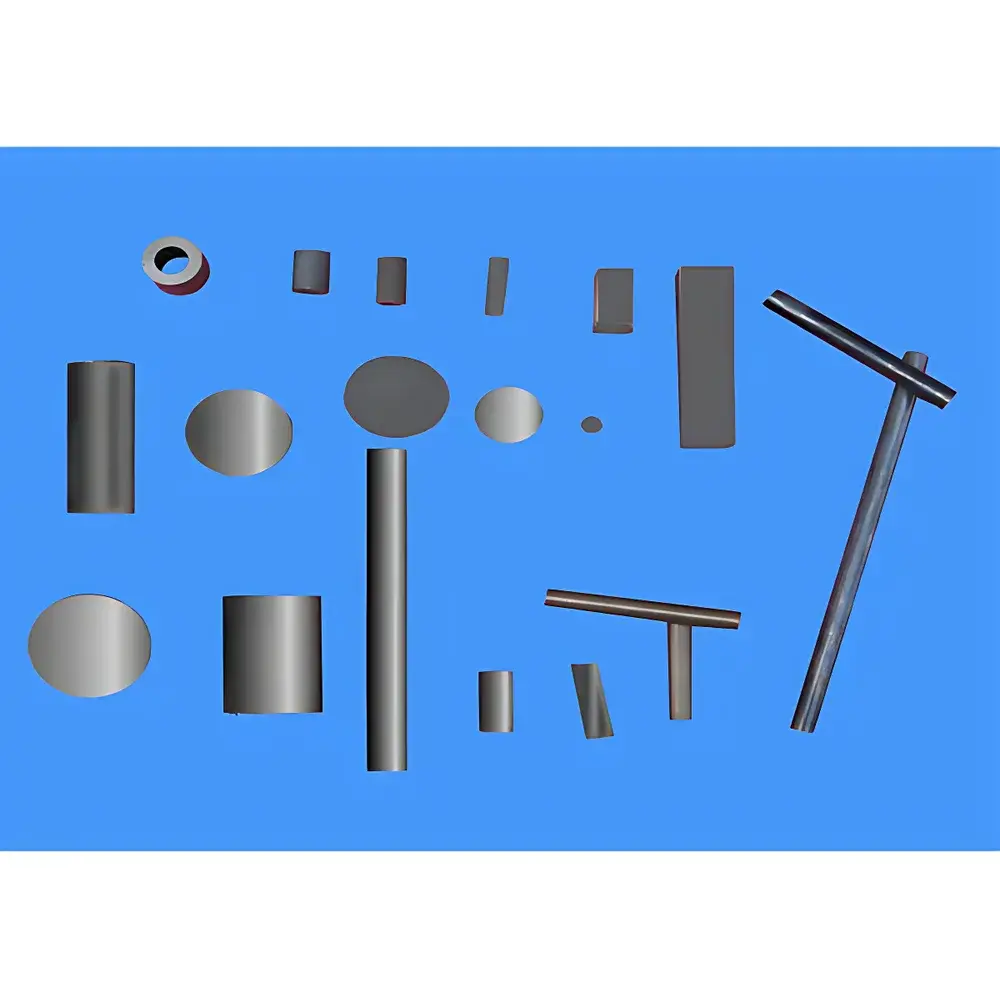
Hefei Kejing Terfenol-D GMM is supplied as ASTM F2628-compliant raw material in standard diameters (6–25 mm) and lengths (up to 150 mm), compatible with industry-standard machining (EDM, diamond grinding), bonding (epoxy, diffusion welding), and prestressing methodologies. Each batch undergoes full traceability documentation including composition verification via ICP-OES, density measurement per ASTM B962, and magnetostrictive calibration using calibrated Helmholtz coils and laser Doppler vibrometry. The material conforms to ISO 17025-accredited testing protocols and supports GLP-compliant qualification for defense, medical device, and aerospace subsystem integration.
Software & Data Management
While Terfenol-D itself is a passive functional material, Hefei Kejing provides comprehensive technical support documentation—including magnetization curves (B-H and λ-H), dynamic loss spectra (tan δ vs. frequency), and prestress-dependent strain hysteresis maps—for integration into finite element modeling (FEM) platforms such as COMSOL Multiphysics® and ANSYS®. All characterization datasets are delivered in standardized .csv and .mat formats, compatible with MATLAB®-based control algorithm development and real-time hardware-in-the-loop (HIL) simulation workflows. Traceable calibration certificates include uncertainty budgets per ISO/IEC 17025 requirements.
Applications
- High-power underwater acoustic transducers and naval sonar arrays requiring >180 dB re 1 µPa @ 1 m output.
- Precision micro-positioning stages and adaptive optics deformable mirrors in semiconductor lithography and space telescope systems.
- Active vibration damping modules for gas turbine engine mounts and precision metrology platforms.
- Energy harvesting devices converting low-frequency mechanical vibrations (e.g., industrial machinery, railway infrastructure) into usable electrical power.
- Non-contact torque and stress sensors embedded in rotating shafts or composite structural health monitoring systems.
FAQ
What is the recommended prestress range for optimal Terfenol-D performance?
Optimal dynamic operation requires axial compressive prestress between 15–30 MPa—applied via hardened steel end caps or integrated spring stacks—to suppress tensile cracking and maximize strain linearity.
Can Terfenol-D be used in vacuum or cryogenic environments?
Yes. Its low outgassing rate and minimal thermal contraction mismatch with stainless steel or Invar housings make it suitable for UHV (<10⁻⁷ Pa) and cryogenic (4–77 K) applications, provided magnetic bias fields are maintained.
Is custom geometry machining available?
Hefei Kejing offers CNC turning, EDM wire-cutting, and surface grinding services for customer-defined geometries—including stepped rods, annular rings, and multi-pole laminated stacks—with dimensional tolerances down to ±2 µm.
How does Terfenol-D compare to Galfenol (Fe-Ga) in terms of hysteresis and tensile strength?
Terfenol-D exhibits higher strain but greater hysteresis (10–15% strain loop width) versus Galfenol (3–5%); however, its tensile strength (~200 MPa) is significantly lower than Galfenol’s (~400 MPa), necessitating careful mechanical encapsulation design.
Do you provide magnetic circuit design support?
Yes—Hefei Kejing collaborates with end users to model flux paths, optimize pole piece geometry, and select appropriate bias magnets (NdFeB or SmCo) to achieve target field uniformity and minimize demagnetization risk during cyclic operation.