
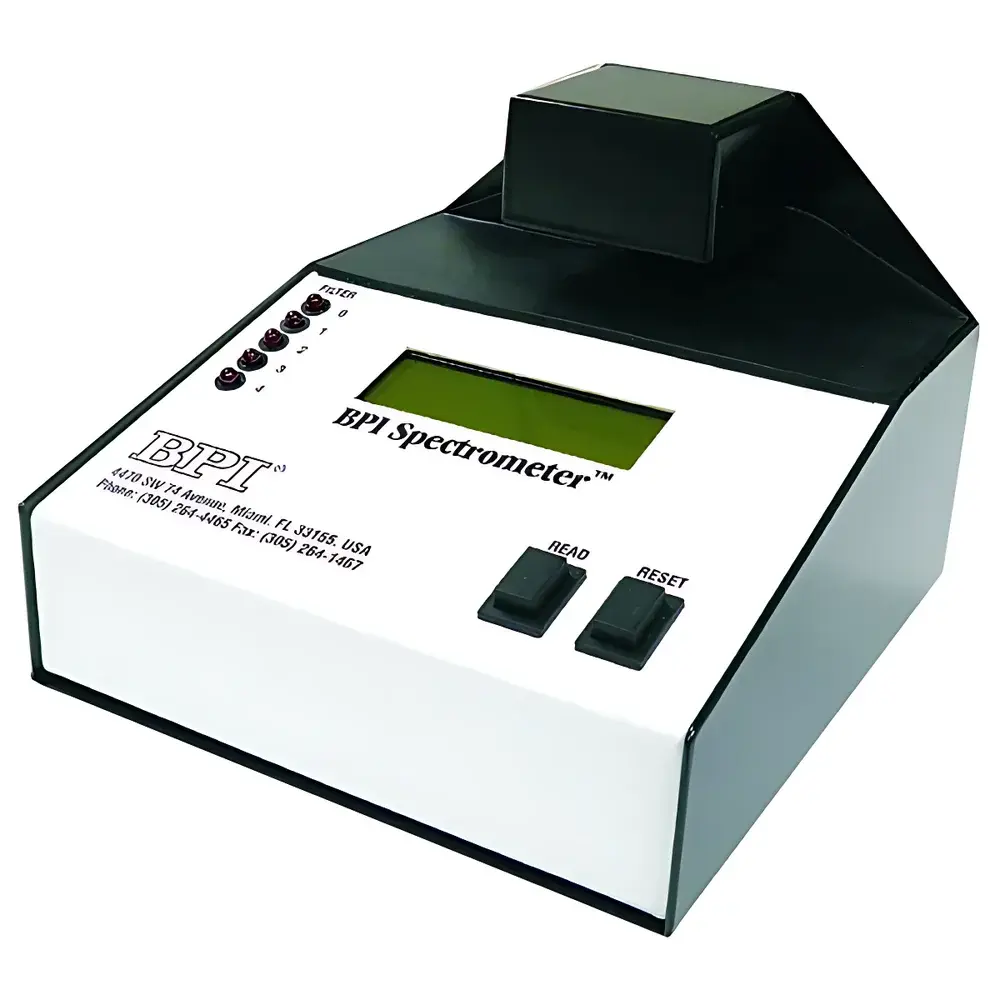
HunterLab BPI Spectrophotometer for Lens and Glass Color Measurement
| Brand | HunterLab |
|---|---|
| Origin | USA |
| Manufacturer Type | Authorized Distributor |
| Import Status | Imported |
| Model | BPI Spectrophotometer |
| Price Range | USD $1,200 – $25,000 |
| Application System | Universal |
| Grating Configuration | Single-grating monochromator platform |
| Wavelength Range | 350 nm – 710 nm |
| Spectral Resolution | <10 nm (FWHM) |
| Dimensions | 6.75″ L × 6.25″ W × 5″ H |
| Weight | 8.5 lb |
| Power Supply | 110 V AC, 50/60 Hz, 1 A |
| Operating System Requirement | Microsoft Windows |
| Interface | USB 2.0 |
| Data Output | CIELAB (L*, a*, b*), Visible Transmittance (Tv), UVA Transmittance (315–400 nm) |
Overview
The HunterLab BPI Spectrophotometer is a compact, benchtop grating-based spectrophotometer engineered specifically for quantitative color and spectral transmittance analysis of optical substrates—including ophthalmic lenses, automotive glazing, architectural glass, and coated transparent polymers. Operating on the principle of single-beam, fixed-grating monochromator architecture, it delivers high-reproducibility visible-region spectral data from 350 nm to 710 nm with optical resolution better than 10 nm (FWHM). Unlike general-purpose spectrometers, the BPI integrates a stabilized tungsten-halogen light source and calibrated silicon photodiode detector optimized for photometric accuracy across the CIE 1931 standard observer function. Its primary metrological outputs include CIE L*a*b* color coordinates, total visible transmittance (Tv), and UVA transmittance (315–400 nm), enabling objective assessment of hue, lightness, chroma, and regulatory compliance—particularly relevant for traffic signal visibility standards (e.g., U.S. FHWA MUTCD Section 2A.09 and EN 12899-1:2007).
Key Features
- Integrated illumination and detection path with factory-calibrated reference white tile and air-zero baseline compensation
- USB 2.0 interface compatible with Windows 7 through Windows 11; no external power supply or auxiliary optics required
- On-device LCD display showing real-time L*, a*, b*, Tv, and UVA% values—enabling rapid pass/fail verification without PC connection
- Optical design compliant with ASTM E308-23 and ISO/CIE 11664-4:2019 for colorimetric computation
- Rugged aluminum housing rated for continuous operation in QC laboratory environments (IP20, 15–30°C, <80% RH non-condensing)
- Self-diagnostics and automated warm-up stabilization routine ensuring measurement repeatability within ±0.1 ΔE*ab (CIELAB) over 8-hour shifts
Sample Compatibility & Compliance
The BPI accommodates flat, rigid transparent samples up to 6 mm thick and 75 mm × 75 mm in dimension—ideal for finished lenses, plano glass coupons, and laminated safety glazing. Sample positioning is facilitated by a precision-machined aperture mask (12.7 mm diameter) that defines the measured area and minimizes edge scatter. The instrument supports full traceability per ISO/IEC 17025:2017 requirements when operated under documented SOPs, and its spectral output meets the minimum performance criteria specified in ANSI Z80.3-2023 (ophthalmic lenses) and EN 1836:2019 (sunglasses). For regulatory submissions, raw spectral data (.csv) and metadata (date/time, operator ID, calibration stamp) are exportable to support GLP/GMP audit trails.
Software & Data Management
HunterLab’s proprietary BPI Control Software (v4.2+) provides full instrument control, spectral visualization, and comparative analysis. Users may overlay multiple transmittance curves on a single plot, compute ΔE*ab between samples, and generate PDF reports compliant with internal quality records retention policies. All measurements are stored in an encrypted local SQLite database with optional ODBC connectivity for integration into LIMS platforms. Audit logging captures user login, parameter changes, calibration events, and data exports—fully aligned with FDA 21 CFR Part 11 requirements when configured with electronic signatures and role-based access controls.
Applications
- Batch-to-batch color consistency verification of tinted prescription lenses and photochromic materials
- Validation of anti-reflective coating uniformity via spectral shift analysis at 400–450 nm
- Regulatory testing for traffic signal lens compliance (luminance factor, dominant wavelength, excitation purity per SAE J578)
- Development of custom-tint formulations using delta-L*a*b* feedback to match master standards
- UVA blocking efficacy evaluation for UV-protective eyewear per ISO 8980-3:2020
- Quality gate screening in lens manufacturing lines—integrated via digital I/O triggers (optional)
FAQ
Does the BPI require annual recalibration?
Yes—HunterLab recommends traceable recalibration every 12 months using NIST-traceable standards; certificate includes uncertainty budget per ISO/IEC 17025.
Can the BPI measure curved or aspheric lenses?
It is designed for flat or gently curved samples with minimal deviation (<0.5 D surface power); strongly curved lenses require custom fixturing and empirical correction.
Is the software validated for pharmaceutical use?
While not pre-validated for FDA submission, the software architecture supports IQ/OQ/PQ protocols and complies with Annex 11 and ALCOA+ data integrity principles.
What is the measurement repeatability for Tv under controlled conditions?
±0.2% absolute transmittance (k = 2) across 10 repeated measurements of a certified CR-39 reference lens at 23°C.
Does the BPI support reflectance mode?
No—it operates exclusively in transmission geometry; reflectance-capable models (e.g., HunterLab UltraScan VIS) are available separately.





