
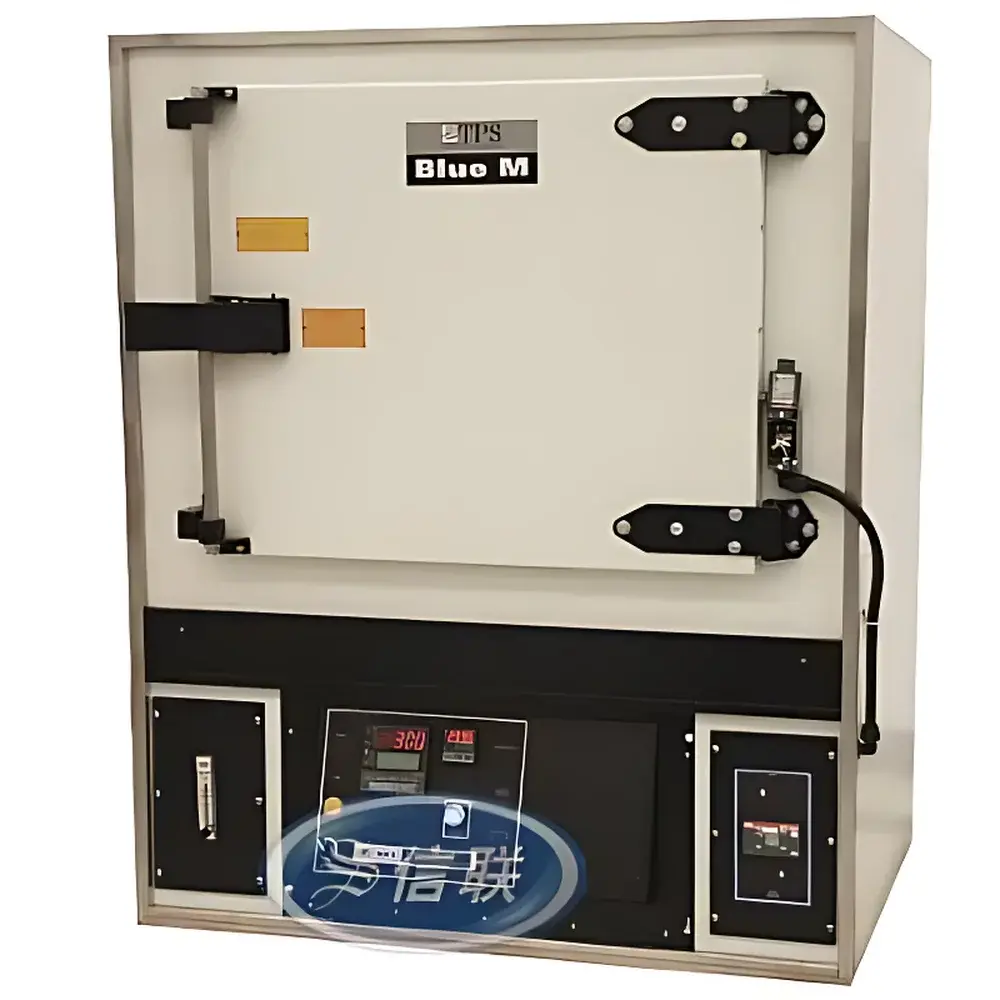
Blue M 146 Series Standard Mechanical Convection Oven
| Brand | Blue M |
|---|---|
| Origin | USA |
| Model | 146 Series |
| Temperature Range | Ambient +15°C to 350°C |
| Temperature Uniformity | ±1% |
| Control Accuracy | ±0.5°C |
| Resolution | ±0.1°C |
| Chamber Material | Fully welded 304 stainless steel |
| Insulation | 4-inch mineral wool |
| Heating Method | Forced-air mechanical convection |
| External Dimensions | 40×34×57 in to 68×40×82 in |
| Internal Dimensions | 20×18×20 in to 48×24×36 in |
| Internal Volume | 1.6–24 ft³ |
| Electrical Options | 208/240/480 VAC, single- or three-phase, 50/60 Hz |
Overview
The Blue M 146 Series Standard Mechanical Convection Oven is a precision-engineered laboratory and industrial thermal processing system designed for repeatable, uniform heating across demanding applications including annealing, stress relief, binder burnout, ceramic sintering, and high-temperature curing. Built by Blue M—a subsidiary of Lunaire Environmental, Inc.—this series leverages over six decades of thermal equipment expertise to deliver robust performance in R&D labs, QC environments, and pilot-scale manufacturing. Its core operating principle relies on mechanically driven forced-air circulation via a rear-mounted blower and optimized internal airflow baffling, ensuring rapid thermal equilibration and minimal spatial temperature deviation. The oven operates within a validated temperature range of ambient +15°C to 350°C (650°F), with typical ramp rates achieving 300°C in under 60 minutes under no-load, closed-exhaust conditions—critical for process qualification and thermal profile reproducibility.
Key Features
- Heavy-gauge steel exterior cabinet (minimum 16-gauge) with durable powder-coated finish for long-term corrosion resistance and structural integrity
- Fully welded 304 stainless steel chamber—gas-tight construction prevents infiltration of ambient air into insulation layers and eliminates trace gas migration during inert or controlled-atmosphere operation
- 4-inch thick high-density mineral wool insulation, minimizing heat loss and supporting energy-efficient operation at elevated temperatures
- Patented Blue M fiberglass door gasket design ensures consistent compression sealing across the full perimeter, maintaining chamber integrity during thermal cycling
- Integrated safety interlock switch de-energizes heating elements upon door opening, preserving process purity and operator safety per ANSI Z21.56 and UL 746C requirements
- Standard configuration supports both inert gas purging and vacuum-compatible modifications (optional), enabling compatibility with nitrogen, argon, or forming gas environments
- Modular electrical architecture accommodates single- and three-phase inputs (208 VAC, 240 VAC, 480 VAC) with scalable power ratings from 3.0 kW to 61 kW, permitting seamless integration into diverse facility infrastructures
Sample Compatibility & Compliance
The 146 Series accommodates a broad spectrum of sample geometries and material classes—including metal substrates, ceramic green bodies, polymer composites, coated foils, and electronic assemblies—within internal volumes ranging from 1.6 ft³ (model 146-10) to 24 ft³ (model 146-1046). Chamber dimensions are engineered to support industry-standard trays, crucibles, and fixtures without airflow obstruction. All models comply with ASTM E145-22 (Standard Specification for Gravity-Convection and Forced-Ventilation Ovens) for temperature uniformity validation and meet essential requirements of ISO 17025 for calibration traceability when paired with NIST-traceable thermocouples. Optional configurations support GLP/GMP audit readiness, including 21 CFR Part 11–compliant electronic recordkeeping when integrated with Blue M’s optional data acquisition module.
Software & Data Management
While the base 146 Series utilizes a dedicated microprocessor-based PID controller with dual-setpoint capability (process + overtemperature limit), optional upgrades include the Blue M SmartLink™ interface—a USB- and Ethernet-enabled platform enabling real-time temperature logging, remote parameter adjustment, and automated report generation in CSV or PDF format. All logged data includes timestamp, setpoint, actual chamber temperature, and alarm status, with configurable audit trails that satisfy FDA-regulated documentation standards. Firmware updates are performed via secure firmware image upload, and controller calibration certificates are provided with each unit shipment.
Applications
- Thermal debinding and catalytic burnout of metal injection molded (MIM) components
- Pre-sintering heat treatment of advanced ceramics and technical oxides
- Curing of aerospace-grade adhesives and composite prepregs under controlled atmosphere
- Stress-relief annealing of machined aluminum and stainless steel tooling
- Coating cross-linking and solvent evaporation in coil coating and flat-panel display manufacturing
- Accelerated aging studies per IEC 60068-2-2 and MIL-STD-810H thermal shock protocols
- Residual moisture removal from pharmaceutical excipients prior to lyophilization
FAQ
What is the maximum operating temperature for the standard 146 Series model?
The standard Blue M 146 Series mechanical convection oven is rated for continuous operation up to 350°C (650°F). Higher-temperature variants—including the 704°C Ultra-Temp line—are available under separate model designations.
Can this oven be used under inert gas or vacuum conditions?
Yes. The fully welded 304 stainless steel chamber and gas-tight door seal support inert gas purging (N₂, Ar) as standard. Vacuum-rated versions with reinforced construction and specialized feedthroughs are offered as factory-configured options.
Is temperature uniformity validated per ASTM E145?
Yes. Each oven undergoes factory uniformity mapping at 100°C, 200°C, and 300°C using nine calibrated thermocouples per ASTM E145 Annex A3. A Certificate of Uniformity is supplied with shipment.
How is overtemperature protection implemented?
A redundant, independently wired mechanical limit switch (set 25°C above max process temperature) interrupts power to the heating circuit if the primary PID controller fails—meeting UL 746C Class 1, Division 2 hazardous location prerequisites.
What maintenance intervals are recommended for the blower assembly?
The sealed, maintenance-free blower motor requires no scheduled lubrication. Annual inspection of fan blade balance and gasket compression is advised; replacement parts are stocked globally with ≤72-hour lead time for critical components.



