
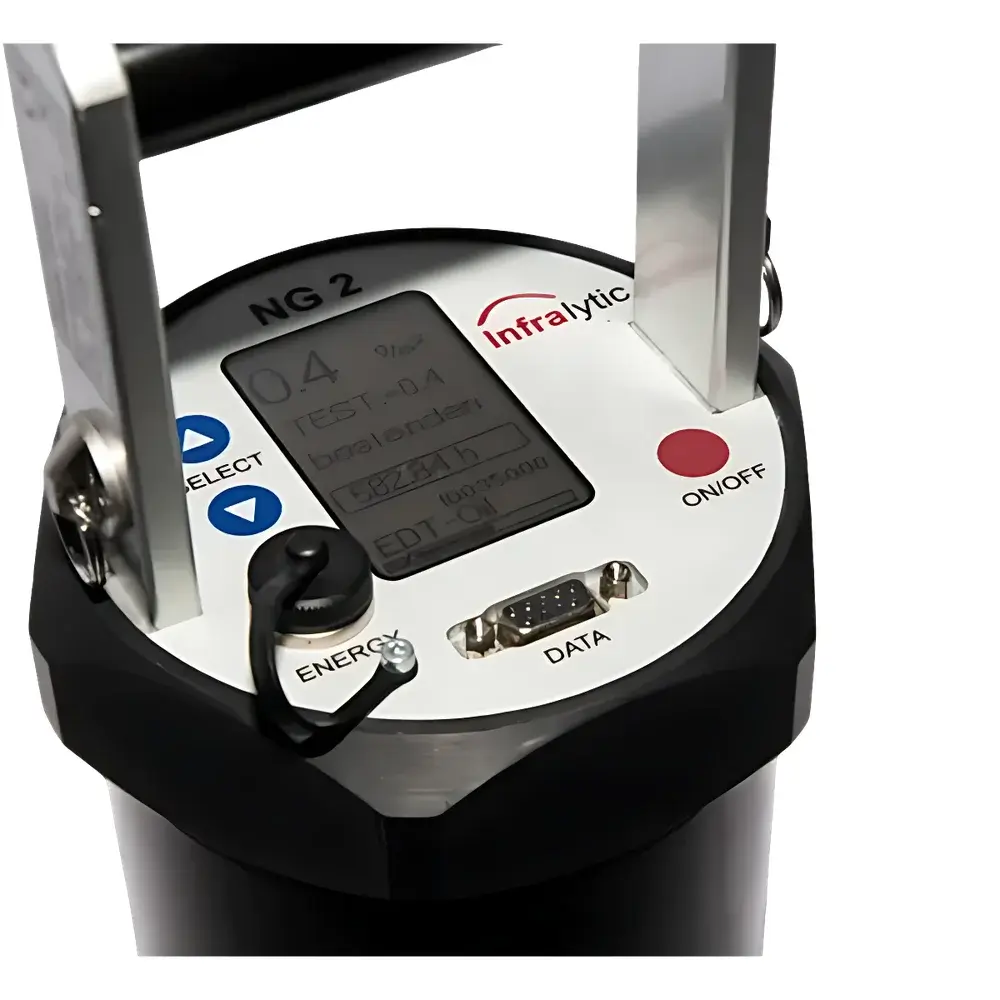
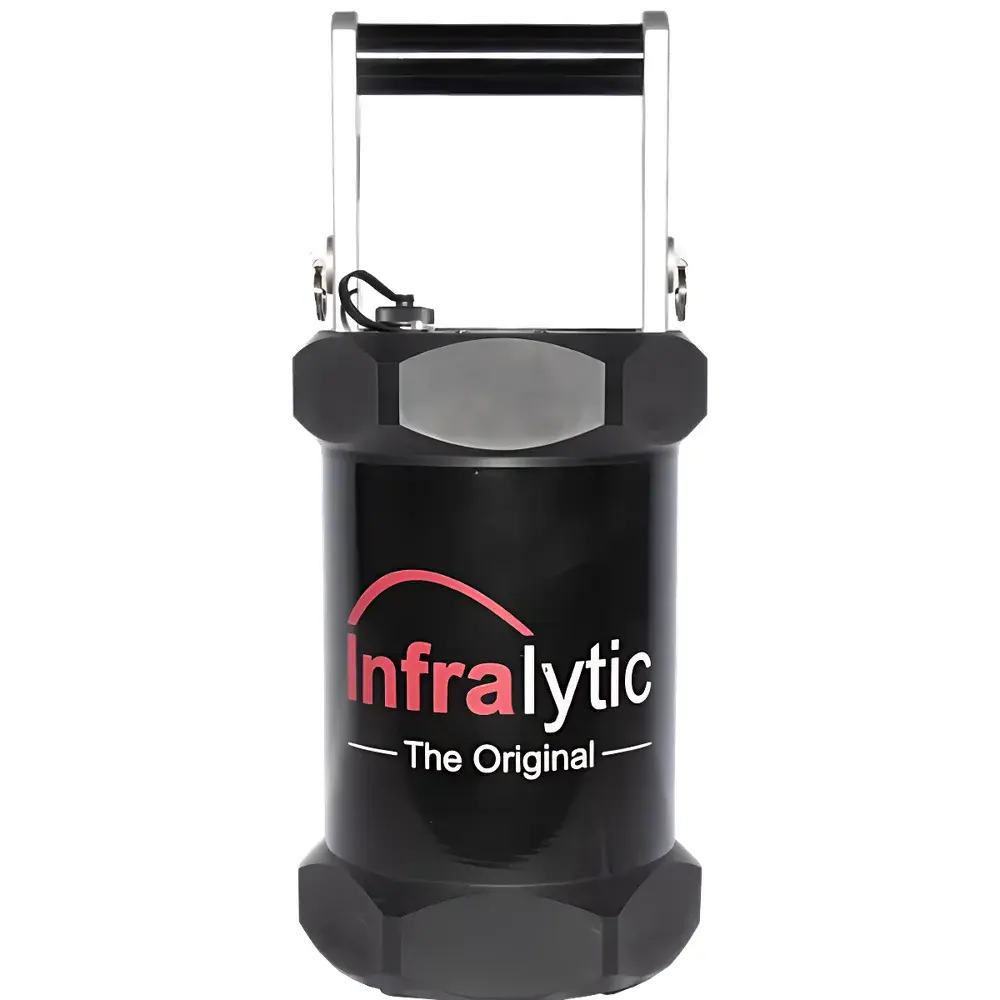
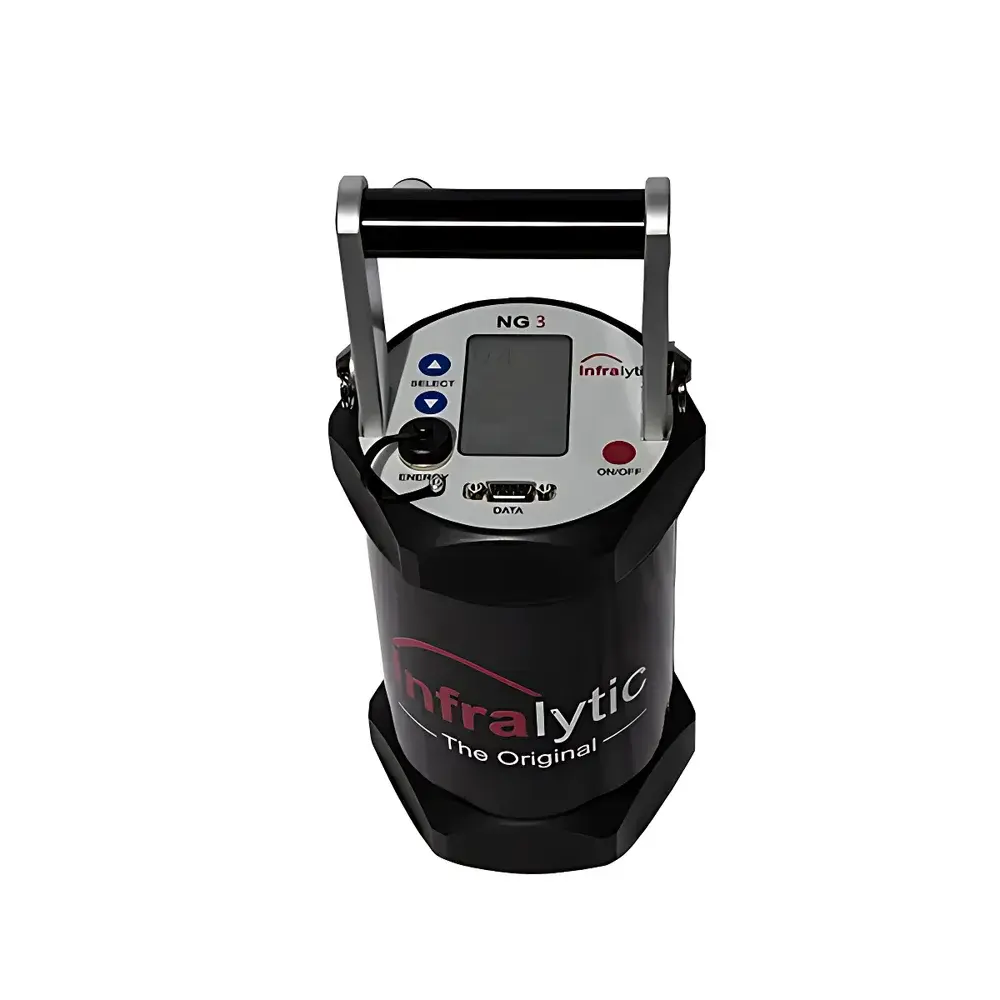
Infralytic NG-02 Online Steel Strip Oil Film Thickness Monitor
| Brand | Infralytic |
|---|---|
| Origin | Germany |
| Model | NG-02 |
| Measurement Principle | Near-Infrared (NIR) Absorption Spectroscopy |
| Measurement Range | 0.05–6 g/m² |
| Accuracy | ±0.015 g/m² (0.02–0.3 g/m²), ±0.2 g/m² (0.3–2 g/m²), ±10% of reading (>2 g/m²) |
| Repeatability | <0.0010 g/m² |
| Resolution | 0.001 g/m² |
| Measurement Distance | 8 mm (±2 mm tolerance) |
| Operating Temperature | 0°C to 45°C |
| IP Rating | IP65 |
| Sample Surface Compatibility | Cold-rolled steel, hot-dip galvanized (HDG), electrogalvanized (EG), phosphated EG, annealed galvannealed (GA), aluminum (polished & EDT), ZnMg-coated, aluzinc |
| Lubricant Compatibility | Mineral oils, thixotropic mineral oils, hot-melt adhesives, waxes, and other organic lubricants (with custom calibration) |
| Power Supply | Internal rechargeable battery (≥12 h operation) |
| Data Documentation | Integrated photo-capture via smartphone interface |
| Auto-validation | Onboard self-check and drift compensation |
| Rolling Direction Detection | Real-time automatic recognition |
Overview
The Infralytic NG-02 Online Steel Strip Oil Film Thickness Monitor is an industrial-grade, non-contact infrared spectroscopic measurement system engineered for continuous, real-time quantification of lubricant mass per unit area (g/m²) on moving metallic substrates in coil processing lines. Unlike conventional gravimetric or beta-backscatter methods, the NG-02 employs proprietary near-infrared (NIR) absorption spectroscopy—calibrated against molecular vibrational signatures of hydrocarbon-based lubricants—to deliver trace-level thickness resolution without physical contact, surface disruption, or radioactive sources. Its optical architecture is optimized for high-speed strip applications (up to 1,200 m/min), with fixed-focus optics and dynamic compensation for strip vibration, lateral runout, and thermal drift. Designed for integration into cold rolling, pickling, galvanizing, and stamping production environments, the NG-02 operates independently of ambient lighting and is insensitive to dust, oil mist, or moderate condensation—key advantages in harsh metalworking settings where measurement continuity directly impacts coating uniformity, press lubrication reliability, and downstream corrosion resistance.
Key Features
- Non-destructive, non-contact NIR spectroscopy enabling continuous inline monitoring without process interruption or sensor wear
- Onboard automatic validation routine with reference-based drift correction—performed at user-defined intervals or triggered by environmental thresholds
- Real-time rolling direction detection via integrated edge-tracking algorithm, ensuring correct spatial alignment of measurement footprints across bi-directional line operation
- Smartphone-integrated documentation: time-stamped photos of strip surface and live measurement overlay captured directly via Bluetooth-connected mobile app (iOS/Android)
- Long-duration battery operation (≥12 hours on single charge) with hot-swappable Li-ion modules—eliminating dependency on line power infrastructure during commissioning or maintenance windows
- Ruggedized IP65 enclosure rated for exposure to coolant splashes, metal fines, and temperature gradients typical in galvanizing and temper mill zones
- Preloaded calibration libraries for six standard substrate-lubricant combinations: bare cold-rolled steel, hot-dip galvanized (HDG), electrogalvanized (EG), phosphated EG, galvannealed (GA), and polished aluminum (EDT)
Sample Compatibility & Compliance
The NG-02 is validated for quantitative analysis on conductive metallic surfaces including cold-rolled carbon steel, hot-dip galvanized (Zn), electrogalvanized (Zn), galvannealed (Zn-Fe), aluminum (including EDT-treated), and ZnMg-alloy coated strips. It supports lubricants ranging from low-viscosity mineral oils to high-molecular-weight waxes and thermoplastic hot-melt adhesives—provided spectral response is characterized during factory or site-specific calibration. All calibrations adhere to ISO 8503-2 (surface profile) and ISO 2812-3 (coating thickness by optical methods) metrological frameworks. The system’s measurement traceability chain is maintained through NIST-traceable reference standards supplied with each instrument. For regulated manufacturing environments, audit logs—including calibration history, operator ID, timestamped measurements, and photo evidence—are exportable in CSV and PDF formats compliant with FDA 21 CFR Part 11 requirements when paired with Infralytic’s optional SecureLog™ software module.
Software & Data Management
The NG-02 interfaces with Infralytic’s web-native ControlCenter NG platform via Ethernet or Wi-Fi. This browser-based application enables remote configuration, multi-point trend analysis, SPC charting (X̄-R, Cpk), and alarm threshold management (e.g., out-of-spec oil film deviation >±5% for >3 sec). Raw spectral data (absorbance vs. wavelength, 1200–2200 nm) is archived with full metadata (strip speed, tension, temperature, operator ID). Integration with MES/SCADA systems is supported via OPC UA and Modbus TCP protocols. All data transfers are encrypted using TLS 1.2; local storage uses AES-256 encryption. Firmware updates are delivered over-the-air with cryptographic signature verification to ensure integrity and version control.
Applications
- Real-time optimization of oil applicator settings in cold rolling mills to minimize overspray while maintaining press-forming performance
- Verification of lubricant uniformity post-skin-pass annealing—critical for preventing die scoring and improving drawability in automotive body panel production
- In-process monitoring during electrolytic cleaning and phosphate conversion coating lines to detect residual oil interference prior to chemical treatment
- Quality gate validation prior to shipment—ensuring compliance with OEM specifications such as VDA 235-102 (oil film mass tolerance) and GMW14872 (lubricant type and thickness verification)
- Root-cause analysis of surface defects (e.g., stretcher strains, orange peel, galling) correlated with localized oil film deviations
- Supporting Industry 4.0 initiatives through seamless linkage of oil thickness KPIs to digital twin models of stamping line performance
FAQ
Does the NG-02 require periodic recalibration with physical reference standards?
Yes—while onboard auto-validation maintains short-term stability, traceable recalibration using certified oil-coated reference strips is recommended every 90 days or after major maintenance events, per ISO/IEC 17025 guidelines.
Can the NG-02 distinguish between different types of lubricants on the same substrate?
It can differentiate lubricant classes (e.g., mineral oil vs. wax) when pre-trained spectral libraries are loaded, but identification requires supervised chemometric modeling—not included in base firmware.
Is the measurement affected by surface roughness or oxide layers?
The NIR algorithm incorporates substrate-specific scattering compensation; validated performance holds for Ra ≤ 1.6 µm and native oxide thicknesses <5 nm—typical of mill-finished steel and aluminum.
What is the minimum strip width the NG-02 can reliably measure?
The optical footprint is 12 mm × 12 mm; reliable measurement requires ≥25 mm strip width to ensure stable beam geometry and edge exclusion.
How is measurement uncertainty reported in compliance documentation?
Uncertainty budgets follow GUM (JCGM 100:2008) methodology and include contributions from spectral noise, temperature drift, distance variation, and reference standard uncertainty—fully documented in the Certificate of Conformance shipped with each unit.



