
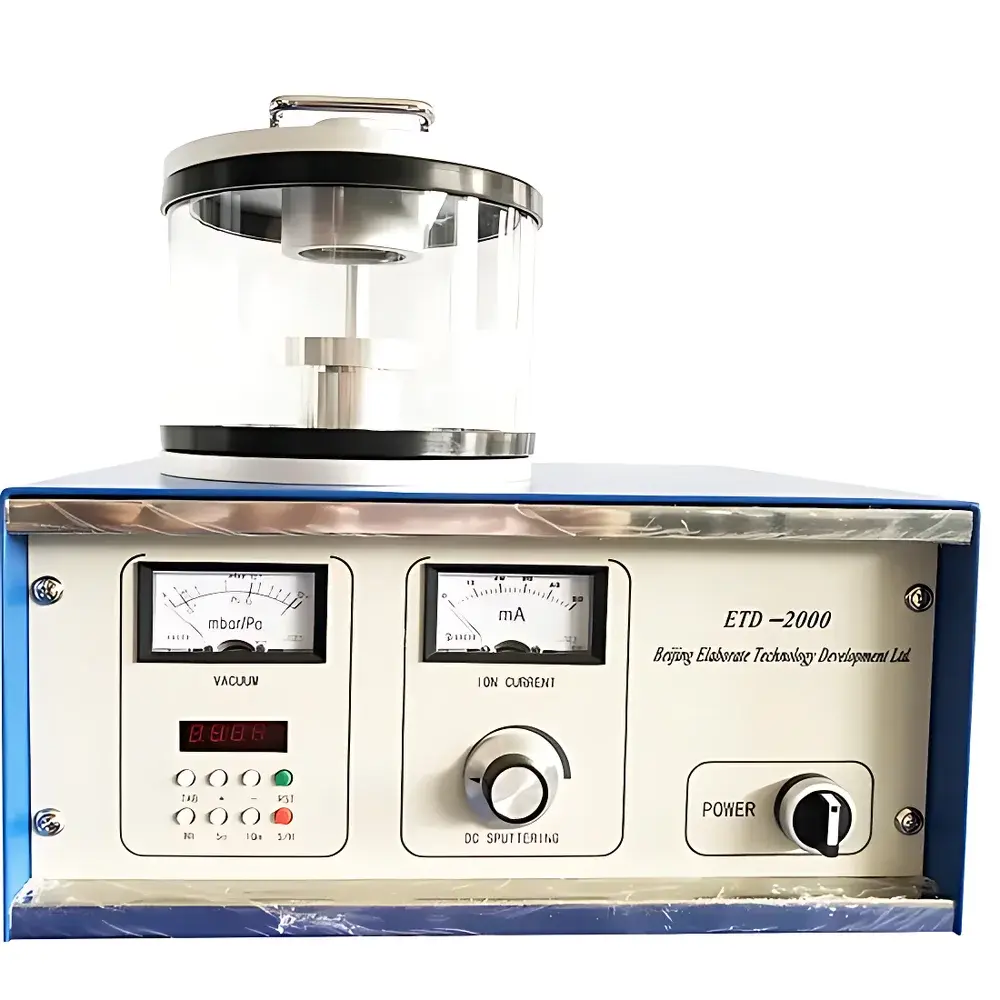
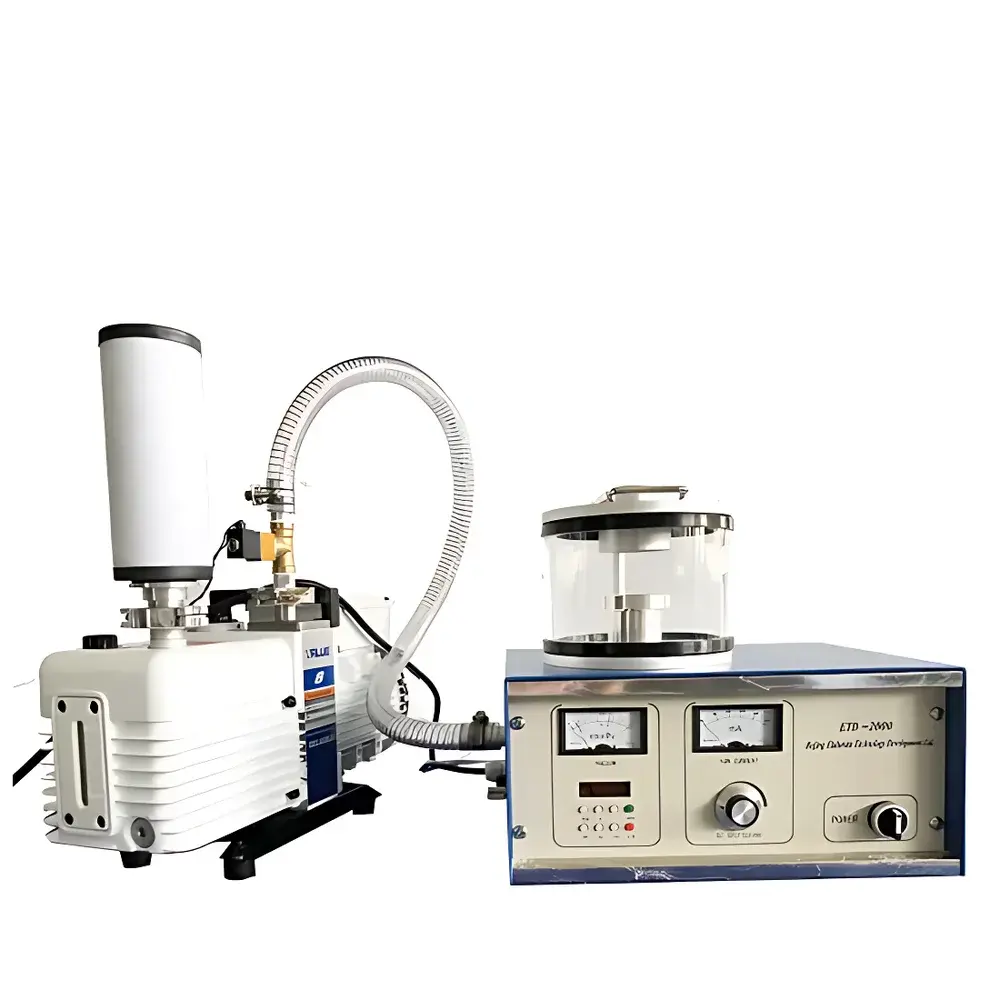
VPI ETD-2000 Ion Sputter Coater
| Brand | VPI (BoYuan Micro-Nano) |
|---|---|
| Origin | Beijing, China |
| Model | ETD-2000 |
| Target Material | Gold (Au), 50 mm diameter × 0.1 mm thickness |
| Control Method | Manual |
| Chamber Dimensions | Ø160 mm × 120 mm (H) |
| Sample Stage | Ø50–70 mm, vertically adjustable |
| Sputtering Gases | Multiple inert gases (e.g., Ar, N₂, Kr) |
| Maximum DC Voltage | −1600 V |
| Ion Current Range | 0–50 mA |
| Ultimate Vacuum | ≤ 4 × 10⁻² mbar |
| Timer Range | 0–3600 s |
| Pumping System | VRD-8 rotary vane pump (2 L/s) |
| Input Power | 220 V AC, 50 Hz (110 V option available) |
| Overall Dimensions | 305 mm × 365 mm × 325 mm (W × D × H) |
| Sealing | Ceramic high-voltage feedthroughs + vacuum-grade rubber edge seal |
Overview
The VPI ETD-2000 Ion Sputter Coater is a manually operated, benchtop DC magnetron sputtering system engineered for reliable, repeatable conductive coating of non-conductive or beam-sensitive specimens prior to scanning electron microscopy (SEM) analysis. It operates on the principle of glow discharge plasma generation in a low-pressure inert gas environment (typically argon), where energetic ions bombard a metallic cathode (target), ejecting atoms that subsequently condense as a uniform, nanoscale conductive film onto the grounded sample surface. This physical vapor deposition (PVD) process enables precise control over film morphology, grain size, and thickness—critical parameters influencing secondary electron yield, charging mitigation, and imaging fidelity in high-resolution SEM. Designed around robust vacuum integrity and operator safety, the ETD-2000 integrates vacuum interlock circuitry, ceramic-insulated high-voltage connections, and a borosilicate glass chamber rated for sustained operation at ≤ 4 × 10⁻² mbar.
Key Features
- Manually adjustable ion current (0–50 mA) and fine-tuned vacuum regulation via micrometer needle valve—enabling empirical optimization of sputter rate, grain nucleation density, and film continuity.
- Dual-stage vacuum architecture with integrated VRD-8 rotary vane pump (2 L/s), delivering stable base pressure and rapid pump-down cycles suitable for routine lab throughput.
- Modular target holder accommodating standard 50 mm diameter, 0.1 mm thick targets—including Au (standard), Pt, Ir, Ag, Cr, Al, and Cu—with optional multi-target adapters for sequential or alloyed deposition.
- Vertically adjustable sample stage (Ø50–70 mm range) with centering capability—ensuring consistent standoff distance and angular uniformity across heterogeneous or irregularly shaped specimens.
- Digital timer (0–3600 s) with pause/resume functionality for real-time visual inspection of coating progression without breaking vacuum or resetting parameters.
- Vacuum-rated elastomeric edge seal and ceramic high-voltage feedthroughs—designed for long-term mechanical stability, electrical isolation, and resistance to outgassing under repeated thermal cycling.
Sample Compatibility & Compliance
The ETD-2000 supports a broad spectrum of electron-beam-sensitive and electrically insulating samples, including biological tissues (e.g., freeze-dried plant sections, insect cuticles), polymers (PET, PMMA, epoxy resins), ceramics, geological thin sections, and emerging semiconductor substrates. Its low-energy, low-heat sputtering regime minimizes thermal damage and beam-induced artifact formation—making it suitable for cryo-SEM preparation workflows when paired with appropriate cold stages. The system complies with general laboratory safety standards for Class II low-voltage DC plasma equipment (IEC 61010-1). While not certified to GLP or ISO/IEC 17025 out-of-the-box, its manual parameter logging capability (current, time, observed pressure) supports traceability in regulated environments when integrated into documented SOPs.
Software & Data Management
The ETD-2000 is hardware-controlled with no embedded microprocessor or digital interface; all operational parameters are set and monitored via analog gauges (vacuum gauge, ion current meter) and a front-panel digital timer. This design prioritizes electromagnetic compatibility (EMC) in proximity to sensitive SEM instrumentation and eliminates firmware-related obsolescence or cybersecurity concerns. Users maintain full audit trail integrity by recording settings in lab notebooks or LIMS-integrated spreadsheets. For laboratories requiring electronic recordkeeping compliant with FDA 21 CFR Part 11, external USB data loggers may be connected to the timer output and analog meter signals—enabling timestamped capture of sputter duration, current drift, and chamber pressure profiles per run.
Applications
- Routine SEM sample preparation for charge dissipation on insulators—reducing edge brightening, image distortion, and detector saturation.
- High-fidelity topographic imaging of delicate biological ultrastructure, where carbon evaporation may cause shrinkage or gold sputtering offers superior secondary electron yield.
- Preparation of cross-sectional TEM lamellae requiring conductive capping to prevent FIB-induced charging during milling.
- Deposition of reference layers for energy-dispersive X-ray spectroscopy (EDS) quantification—leveraging known Au or Pt stoichiometry for k-factor calibration.
- Prototyping of nanostructured coatings for material science studies, including grain-size-dependent conductivity measurements and oxidation resistance screening.
FAQ
What target materials are compatible with the ETD-2000?
Standard configuration includes a 50 mm × 0.1 mm gold (Au) target. Optional targets include platinum (Pt), iridium (Ir), silver (Ag), chromium (Cr), aluminum (Al), and copper (Cu)—all conforming to ASTM F2629 specifications for sputtering-grade purity (≥99.99%).
Can the ETD-2000 operate with reactive gases such as oxygen or nitrogen?
Yes—the system supports multiple inert and reactive sputtering gases (Ar, N₂, Kr, O₂) via its φ3 mm gas inlet port; however, reactive sputtering requires careful parameter optimization and post-process chamber cleaning to avoid target oxidation or arcing.
Is the sample stage rotationally symmetric or motorized?
No—the stage is manually positioned and vertically adjustable only; rotational symmetry is maintained via concentric chamber geometry and central electrode alignment, ensuring radial coating uniformity within ±5% across Ø50 mm substrates.
What vacuum pump oil maintenance schedule is recommended?
With typical usage (≤10 cycles/day), VRD-8 pump oil should be replaced every 3–6 months or after 200 hours of cumulative operation—per manufacturer guidelines—to preserve ultimate vacuum performance and minimize hydrocarbon backstreaming.
Does the ETD-2000 support automated process scripting or remote control?
No—it is intentionally designed as a manual, analog-operated instrument to ensure operational transparency, reduce failure points, and maintain compatibility with EM facility electromagnetic environments.



