
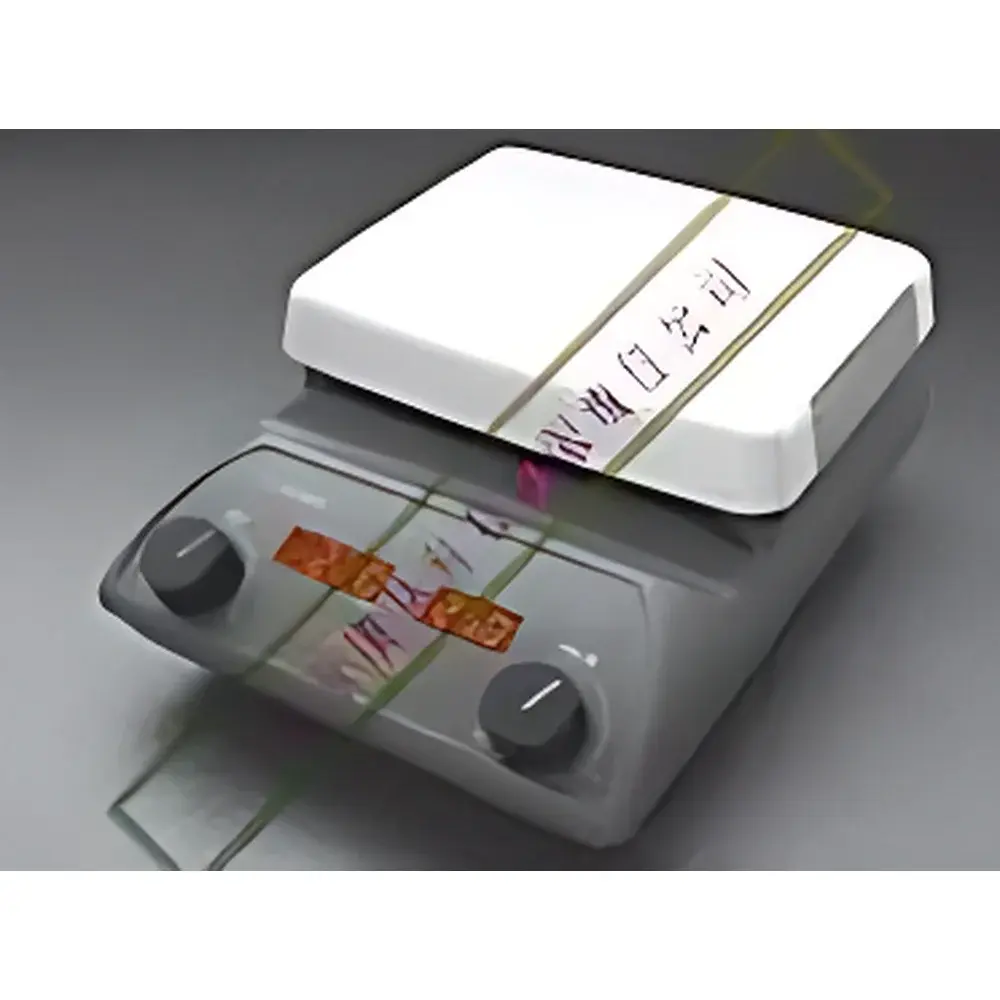
Corning PC-420 and PC-620D Digital Magnetic Hotplate Stirrers
| Brand | Corning |
|---|---|
| Origin | USA |
| Model | PC-420 / PC-620D |
| Heating Surface | 5" × 7" (12.7 × 17.8 cm) or 10" × 10" (25.4 × 25.4 cm) |
| Max Temperature | 550 °C |
| Stirring Speed Range | 60–1150 rpm |
| Heating Plate Material | Pyroceram® glass-ceramic |
| Safety Features | Overheat Protection, Independent Thermal Cut-off, Surface Over-Temp LED Indicator |
| Compliance | UL 61010-1, cULus Listed |
| Height | 12.2 cm (4.875 in) |
Overview
The Corning PC-420 and PC-620D Digital Magnetic Hotplate Stirrers are precision-engineered laboratory instruments designed for reliable, repeatable heating and stirring of samples across diverse chemical, pharmaceutical, and materials science applications. Utilizing a closed-loop microprocessor control system, these units maintain setpoint accuracy under variable load conditions—including aqueous solutions, viscous media, and semi-solid suspensions—by dynamically adjusting motor torque and heater power output. The core measurement and control architecture is built around dual independent feedback loops: one for surface temperature regulation via embedded thermistor sensing, and another for rotational speed stabilization using Hall-effect RPM monitoring. This architecture ensures stable thermal profiles and consistent agitation performance even during extended operation or when sample viscosity changes significantly over time. The devices operate without magnetic interference from the Pyroceram® glass-ceramic top plate—a critical feature for compatibility with sensitive instrumentation and adjacent electromagnetic equipment.
Key Features
- Pyroceram® glass-ceramic heating surface offering exceptional thermal uniformity, high chemical resistance, non-porous cleanability, and immunity to magnetic field distortion.
- Dual digital LED displays showing real-time temperature (±1 °C resolution) and stirring speed (±10 rpm resolution), with blinking indicators during ramp-up to setpoints.
- Microprocessor-based closed-loop control enabling automatic compensation for thermal mass, solvent evaporation, and solution viscosity shifts.
- Adjustable heating range from 5 °C to 550 °C; stirring speed continuously tunable from 60 to 1150 rpm with enhanced magnetic coupling for robust stir bar engagement.
- Two platform size options: compact 5″ × 7″ (12.7 × 17.8 cm, 226 cm²) and large-format 10″ × 10″ (25.4 × 25.4 cm, 645 cm²) configurations to accommodate varied vessel footprints.
- Integrated safety architecture including surface overtemperature detection (>60 °C), redundant thermal cut-off circuitry, and optional external probe interlock (Cat. No. 6795PR) that disables heating if the probe is not immersed.
- Low-profile design (12.2 cm height) optimized for fume hood integration and space-constrained benchtop environments; compatible with Corning support stands (Cat. No. 440129) for multi-instrument mounting.
Sample Compatibility & Compliance
These hotplate stirrers are validated for use with borosilicate glass, stainless steel, and PTFE-coated reaction vessels up to 4 L capacity. The inert Pyroceram® surface resists attack from strong acids (e.g., concentrated HNO₃, H₂SO₄), bases (e.g., 50% NaOH), and organic solvents, supporting GLP-compliant cleaning protocols. Units comply with UL 61010-1 and CAN/CSA C22.2 No. 61010-1 for electrical safety in laboratory environments. When paired with the optional external temperature controller (Cat. No. 6795PR), the system supports ASTM E2473-21 (Standard Practice for Calibration of Thermometers Used in Laboratory Applications) traceable temperature control within the vessel, meeting requirements for method validation under ISO/IEC 17025 and FDA 21 CFR Part 11 when integrated into electronic lab notebook (ELN) workflows with audit-trail enabled software.
Software & Data Management
While the PC-420 and PC-620D operate as standalone analog-digital hybrid instruments, their external temperature controller (Cat. No. 6795PR) provides analog voltage output (0–5 V DC) proportional to measured temperature—enabling connection to data acquisition systems (DAQ), programmable logic controllers (PLCs), or third-party SCADA platforms. The controller’s LED display logs peak temperature and maximum RPM achieved during a session, supporting manual batch record documentation. For regulated environments, users may integrate the unit into validated process control systems where setpoint changes, run duration, and fault events are captured via external I/O interfaces. No proprietary firmware or cloud connectivity is embedded; all control logic resides in hardened analog circuitry and ASIC-based microcontrollers to ensure deterministic response and long-term calibration stability.
Applications
- Controlled synthesis of metal-organic frameworks (MOFs) requiring precise thermal ramping and homogeneous nucleation.
- Buffer preparation and reagent dissolution in QC/QA labs where temperature-dependent solubility must be maintained within ±2 °C.
- Viscosity-sensitive emulsion formulation, where consistent shear input prevents phase separation during heating.
- Accelerated stability testing per ICH Q1A(R2), using elevated temperatures (up to 550 °C surface) to simulate long-term degradation pathways in solid dosage forms.
- Preparation of nanoparticle dispersions, where magnetic coupling strength and thermal homogeneity minimize agglomeration.
- Teaching laboratories conducting calorimetry experiments, leveraging the dual-display interface for real-time correlation of energy input and rotational work.
FAQ
What is the difference between the PC-420 and PC-620D models?
The PC-420 features a single 5″ × 7″ heating surface and basic digital controls. The PC-620D offers the larger 10″ × 10″ platform, higher thermal inertia for improved uniformity at elevated setpoints, and enhanced motor torque for high-viscosity applications.
Can the external temperature controller (Cat. No. 6795PR) be used with both models?
Yes—the 6795PR is compatible with all Corning digital hotplate stirrers rated PC-420D and above, providing direct immersion-based temperature feedback and active control within the sample vessel.
Is calibration documentation available for ISO/IEC 17025 compliance?
Corning provides factory calibration certificates traceable to NIST standards for temperature and speed verification. Users must perform periodic in-house verification using certified reference thermometers and tachometers per their quality management system.
Does the unit support continuous operation at 550 °C?
Continuous operation at maximum surface temperature is permitted only with appropriate ventilation and vessel loading per Corning Technical Bulletin TB-PC420-EN. Sustained use above 450 °C requires derating of duty cycle to preserve long-term heater element integrity.
How does the microprocessor compensate for changing solution viscosity?
By continuously comparing actual RPM (measured via Hall sensor) against setpoint, the controller modulates motor current in real time to maintain target shear rate—without requiring manual speed adjustment as viscosity increases during heating or reaction progression.



