
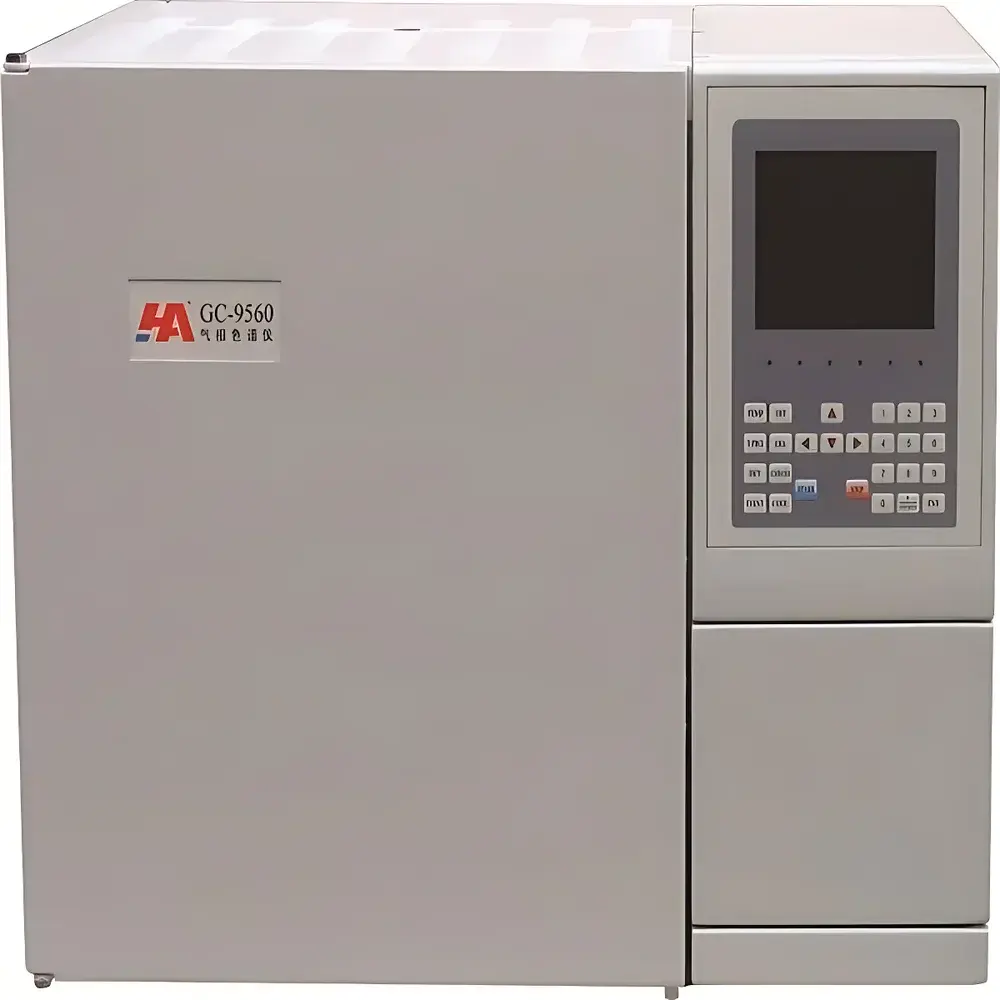
Gas Chromatograph GC-9560-HD for Oxygenates, Benzene, Toluene and Dimethoxymethane in Gasoline
| [Brand | Huai Ai |
|---|---|
| Origin | Shanghai, China |
| Manufacturer Type | OEM Manufacturer |
| Regional Category | Domestic (China) |
| Model | GC-9560-HD |
| Instrument Type | Laboratory Gas Chromatograph |
| Application Field | Power Industry-Specific |
| Temperature Control Range | Ambient to 400 °C |
| Maximum Ramp Rate | 40 °C/min |
| Cooling Rate | 350 °C to 50 °C |
| Carrier Gas Flow Range & Control | 0–500 mL/min |
| Carrier Gas Pressure Range & Control | 0–0.4 MPa |
| Injector Maximum Operating Temperature | 400 °C |
| Injector Pressure Setting Range | 0–0.4 MPa |
| Injector Total Flow Setting Range | 0–800 mL/min] |
Overview
The GC-9560-HD is a dedicated laboratory gas chromatograph engineered for the precise, simultaneous quantification of oxygenated compounds—including methanol, ethanol, tertiary butanol (TBA), methyl tert-butyl ether (MTBE), ethyl tert-butyl ether (ETBE), diisopropyl ether (DIPE), and dimethoxymethane (DMM)—alongside aromatic hydrocarbons (benzene, toluene, xylenes) and total oxygen content in finished gasoline and gasoline blends (e.g., E10, M85). It operates on the principle of capillary gas chromatography with dual-valve multidimensional separation, enabling high-resolution discrimination between co-eluting analytes—particularly critical for resolving DMM from TBA, which exhibit near-identical retention times under conventional single-column methods and cause systematic underreporting of oxygenate concentration. The system meets the fundamental hardware and operational requirements specified in SH/T 0663, SH/T 0693, SH/T 0713, and SH/T 0741, and supports full compliance with the regulatory limits defined in GB 17930, GB 18351, and GB/T 22030.
Key Features
- Dual multi-port valve configuration (6-port + 10-port) for heart-cutting and back-flushing, eliminating interference from C4–C5 aliphatics and enabling baseline separation of DMM and TBA without derivatization or sample pre-treatment.
- High-stability oven with programmable temperature ramping up to 40 °C/min and rapid cooling capability (350 °C → 50 °C in <12 min), ensuring method reproducibility across high-throughput QC environments.
- Independently controlled split/splitless injector with pressure and flow regulation (0–0.4 MPa; 0–800 mL/min total flow), optimized for volatile fuel matrix injection and minimizing thermal degradation of labile oxygenates.
- Integrated carrier gas control module supporting nitrogen, hydrogen, or helium with real-time digital pressure/flow feedback and automatic leak compensation.
- Robust architecture designed for continuous operation in power plant laboratories, refinery QC labs, and third-party testing facilities handling >50 gasoline samples per day.
Sample Compatibility & Compliance
The GC-9560-HD is validated for direct analysis of unleaded gasoline (RON 90, 93, 97), ethanol-blended gasoline (E10), and methanol-blended gasoline (M85), with detection ranges aligned to national standards: benzene (0.01–50 vol%), toluene (0.01–30 vol%), methanol/ethanol (0.01–30 vol%), DMM (0.01–10 vol%), and total oxygen (0.01–2.7 wt%). All method parameters—including column selection (Y-600 dedicated gasoline phase), temperature programs, and valve timing—are pre-configured to satisfy SH/T 0713 (benzene/toluene), SH/T 0663 (oxygenates), and SH/T 0693 (aromatics). Data acquisition and reporting comply with GLP documentation requirements, and optional audit-trail-enabled software modules support FDA 21 CFR Part 11 readiness for regulated laboratories.
Software & Data Management
The dedicated “Vehicle Fuel Chromatography Workstation” provides automated calibration curve generation (linear, quadratic, or multi-point weighted), peak integration using adaptive baseline algorithms, and batch processing for sequential sample analysis. Quantitative results are reported in accordance with ASTM D4815 and ISO 22854 frameworks, with built-in validation checks for retention time windows, peak symmetry (tailing factor 10:1 at LOQ). Raw data files (.cdf) are stored with embedded instrument metadata (oven temp, valve events, detector settings), and export formats include CSV, PDF, and XML for LIMS integration. Optional network licensing enables centralized method management across multiple GC-9560-HD units in distributed lab networks.
Applications
- Regulatory compliance testing for gasoline manufacturers and distributors against GB 17930 (prohibition of DMM, aniline, halogens, phosphorus, silicon).
- QC release testing of E10 batches for ethanol content deviation (±2.0% v/v) and benzene limit enforcement (<1.0% v/v).
- Root-cause investigation of engine stalling or vapor lock linked to inaccurate oxygenate quantification due to DMM–TBA co-elution.
- Method transfer and verification studies between refinery labs and provincial metrology institutes.
- Supporting R&D of next-generation oxygenated additives by providing trace-level resolution and repeatability (RSD <1.5% for benzene at 0.5% v/v, n=6).
FAQ
Does the GC-9560-HD meet ASTM D4815 or EN 15376 requirements for oxygenate analysis?
Yes—the dual-valve configuration and Y-600 column deliver equivalent or superior resolution to ASTM D4815’s specified PLOT Al2O3/KCl column for C1–C5 oxygenates, and method validation reports are available upon request.
Can the system analyze both benzene/toluene and oxygenates in a single run?
Yes—method SH/T 0713 + SH/T 0663 is fully integrated into the workstation; no hardware reconfiguration or column change is required between analyses.
Is hydrogen carrier gas supported for FID operation?
Yes—carrier gas module supports high-purity H2 (≥99.999%) with pressure stability ±0.002 MPa over 24 h, meeting FID sensitivity and noise specifications per SH/T 0713.
What consumables require routine replacement?
Typical maintenance intervals: inlet liner (every 100 injections), septum (every 50 injections), O-rings (quarterly), and Y-600 column (12–18 months under normal use); all part numbers are documented in the user manual.
Is remote diagnostics and firmware update capability included?
Yes—the instrument supports secure SSH-based remote access for troubleshooting, and firmware updates are delivered via encrypted USB key or authenticated HTTPS download.





