
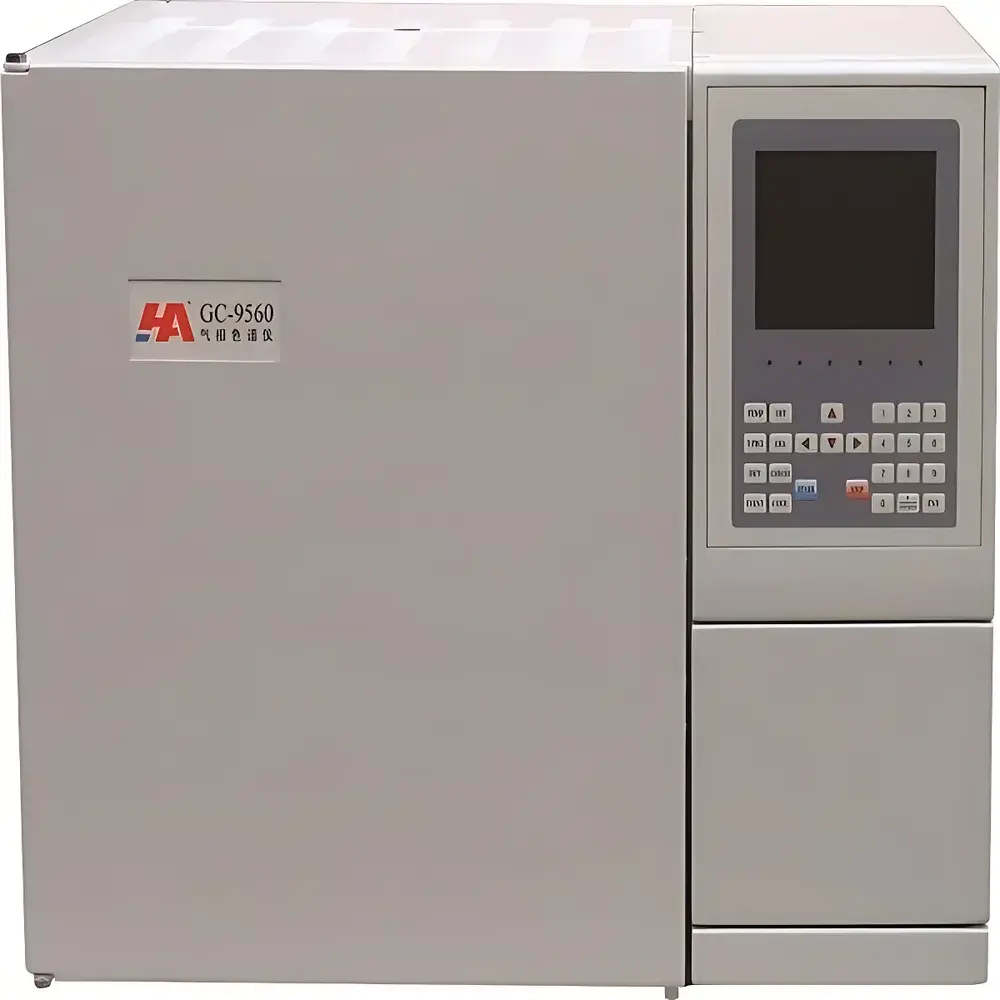
Huai Ai Chromatography GC-9560-PDD High-Purity Gas Analysis System
| Brand | Huai Ai |
|---|---|
| Origin | Shanghai, China |
| Manufacturer Type | Direct Manufacturer |
| Regional Category | Domestic (China) |
| Model | GC-9560-PDD |
| Instrument Type | Laboratory Gas Chromatograph |
| Application Domain | Dedicated High-Purity & Electronic Specialty Gas Analysis |
| Oven Temperature Range | +8 °C to 400 °C |
| Oven Ramp Rate | 0.1–40 °C/min |
| Oven Cooling Rate | ~7 min (400 °C → 50 °C) |
| Carrier Gas Flow Range & Control | 0–1000 mL/min |
| Carrier Gas Pressure Range & Control | 0–500 psi |
| Injector Maximum Operating Temperature | 400 °C |
| Injector Pressure Setpoint Range | 0–500 psi |
| Injector Total Flow Setpoint Range | 0–1000 mL/min |
Overview
The Huai Ai Chromatography GC-9560-PDD High-Purity Gas Analysis System is a purpose-built laboratory gas chromatograph engineered for trace-level impurity detection in ultra-high-purity (UHP) industrial gases and electronic specialty gases. It employs pulsed discharge helium ionization detection (PDHID), a universal, non-destructive, and highly sensitive detection principle capable of sub-ppb (parts-per-quadrillion) quantification of permanent gases—including H2, O2, N2, CH4, CO, CO2, Ne, Kr, Xe, He, Ar—as well as reactive species such as NH3, HCl, BF3, SiH4, NF3, and SF6. Unlike conventional TCD or FID systems, PDHID delivers consistent response factors across analytes and exhibits negligible baseline drift under stable helium carrier conditions—critical for long-duration, high-reproducibility UHP gas monitoring. The system integrates a proprietary four-valve, five-column heart-cutting and back-flush architecture, enabling comprehensive multi-component separation from a single injection without column overloading or co-elution artifacts.
Key Features
- Integrated PDHID detector with <100 fA baseline noise and <0.5 pA detection limit (for H2 in He matrix), calibrated per ASTM D7504 and ISO 8573-5 protocols
- Four independently temperature-controlled column ovens accommodating diverse stationary phases (e.g., 5Å molecular sieve, HayeSep D, Porapak Q, ShinCarbon ST) with individual ramp/hold programming
- VICI吹扫型十通阀 (Purge-type 10-port valves) with integrated helium guard gas circuitry—eliminating ambient air ingress during valve actuation and reducing blank contributions to ≤50 ppt O2 equivalent
- HP-2 helium purifier (VICI) featuring dual-zone thermal activation (200–350 °C), removing H2, O2, N2, CO, CO2, CH4, H2O, NO, NH3, CF4 to ≤10 ppb residual concentration
- Dead-volume-free sampling valve with continuous helium purge path and electropolished 316L stainless-steel internal surfaces (Ra ≤ 0.2 µm)
- Pressure-compensated injection system correcting for buoyancy-driven flow discrepancies between sample matrix (e.g., H2) and calibration standard (He-diluted), ensuring stoichiometric equivalence per USP
- Two-stage all-stainless-steel carrier gas regulator with <0.05 psi pressure stability and <10 µL internal dead volume
- Optional electronic gas handling module including vacuum-assisted purge cycles, gold-plated Swagelok® fittings, and programmable solenoid sequencing via GC-9560V4.0 software
Sample Compatibility & Compliance
The GC-9560-PDD is validated for analysis of gases conforming to national and international standards, including GB/T 7445–1995 (hydrogen), GB/T 14599–2008 (oxygen), GB/T 8979–2008 (nitrogen), GB/T 4842–2006 (argon), GB/T 4844.3–1995 (helium), GB/T 16942–2009 (electronic-grade H2), GB/T 16945–2009 (Ar), GB/T 14602–1993 (HCl), GB/T 15909–2009 (SiH4), and GB/T 21287–2007 (NF3). Its hardware and software architecture support GLP/GMP-compliant operation: audit trails, user access levels, electronic signatures, and raw data integrity are enforced in accordance with FDA 21 CFR Part 11 requirements. All wetted surfaces comply with SEMI F57-0304 (ultra-clean surface finish) and ASTM A269 TP316L specifications.
Software & Data Management
GC-9560V4.0 Chromatography Workstation provides full instrument control, method development, peak integration, and compliance reporting. It supports time-based valve sequencing, multi-oven temperature profiling, and real-time pressure/flow feedback loops. Data files are stored in vendor-neutral .cdf format (compatible with OpenLab CDS and Chromeleon), with embedded metadata including instrument ID, operator, calibration history, and environmental conditions. Quantitative reports include LOD/LOQ calculation per ICH Q2(R2), relative standard deviation (RSD) for replicate injections, and uncertainty propagation based on calibration curve residuals. Audit trail logs record all parameter changes, sequence modifications, and report exports with timestamped user attribution.
Applications
- Quality control of bulk and cylinder gases for semiconductor fabrication (e.g., monitoring O2/H2O in Ar for ALD processes)
- Verification of purity specifications for photovoltaic-grade silane and phosphine
- Residual air contaminant screening in medical oxygen and nitrogen supply chains
- Leak detection and outgassing characterization in vacuum system validation
- Stability testing of fluorinated gases (SF6, NF3) under elevated temperature storage conditions
- Trace hydrocarbon profiling in hydrogen fuel cell feedstock per ISO 8573-8
FAQ
What detection limit can be achieved for oxygen in ultra-high-purity helium?
Typical instrumental detection limit is 5–10 ppt O2 (signal-to-noise ≥3) when using HP-2 purified helium carrier and optimized column/detector configuration.
Is the system compliant with FDA 21 CFR Part 11 for regulated laboratories?
Yes—GC-9560V4.0 implements role-based authentication, electronic signatures, immutable audit trails, and data encryption meeting Part 11 Annex 11 requirements.
Can the system analyze corrosive gases such as HCl or Cl2 without degradation?
With the optional electronic gas module (316L electropolished lines, gold-sealed fittings, and inertized flow paths), routine analysis of HCl, Cl2, and BF3 is supported; column deactivation protocols and post-run bake-out routines are included in the method library.
How is carrier gas purity verified prior to analysis?
The HP-2 purifier includes integrated pressure decay test functionality and optional inline residual gas analyzer (RGA) port for periodic verification of outlet purity against certified reference standards.
Does the system support unattended operation for extended purity monitoring campaigns?
Yes—up to 999 sequential injections with automated valve regeneration, column bake-out, and system leak-check routines scheduled via GC-9560V4.0’s event-driven scheduler.
Related Products






