
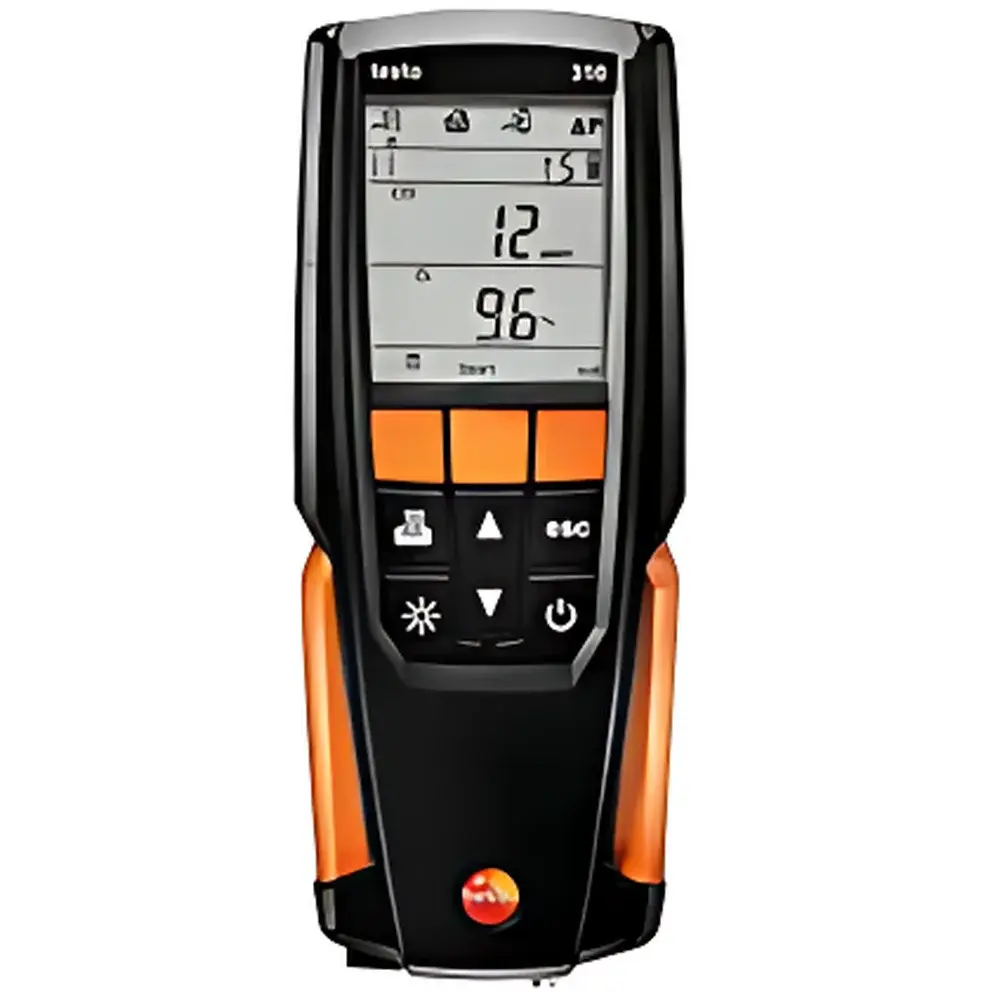
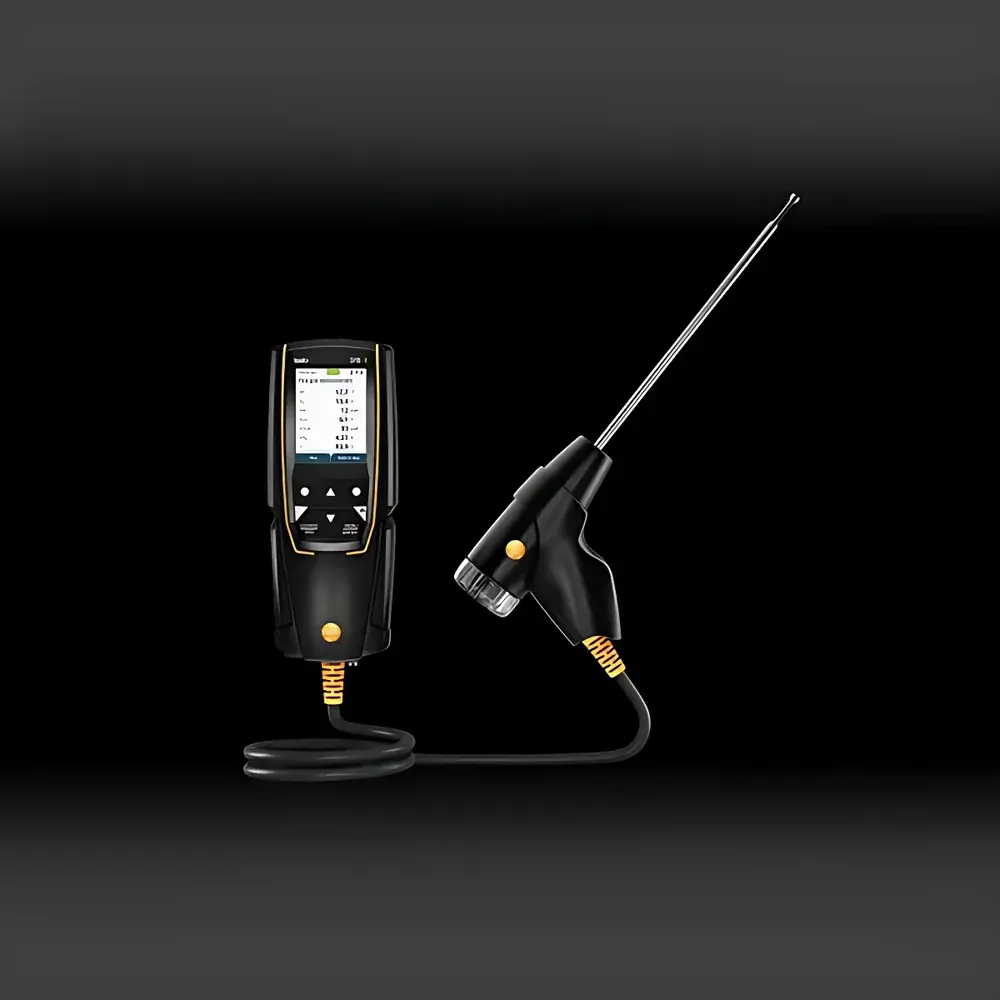
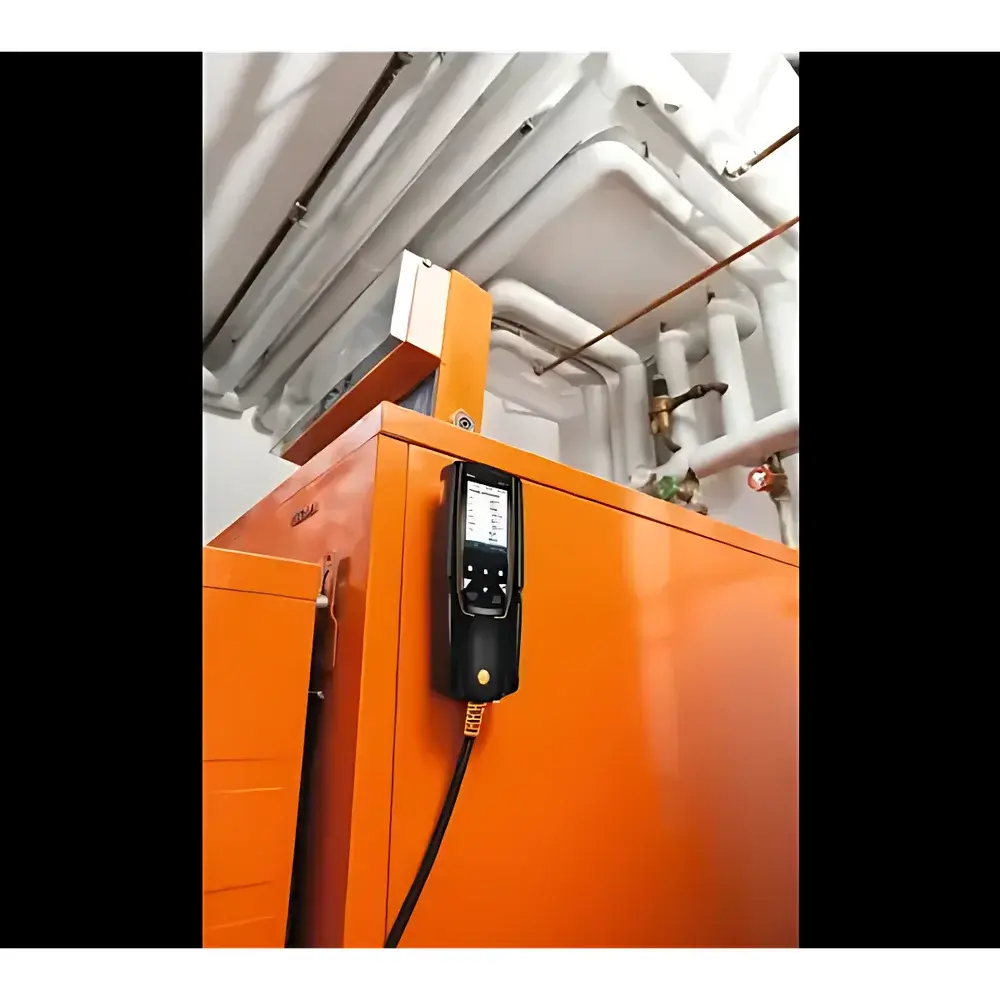
Testo 310 Portable Flue Gas Analyzer
| Brand | Testo |
|---|---|
| Origin | Germany |
| Model | 310 |
| Instrument Type | Portable Flue Gas Analyzer |
| Measurement Range (O₂, CO, CO₂) | 0–21 Vol.% |
| Repeatability | ±0.1 Vol.% O₂ (typical) |
| Response Time (t₉₀) | ≤30 s |
| Zero Stability | <0.05 Vol.% O₂ drift over 8 h |
| Measured Gases | O₂, CO, CO₂ |
| Pressure Measurement Range | ±100 hPa |
| Temperature Range | 0–100 °C |
| Display | Backlit LCD |
| Data Interface | Infrared (IrDA) |
| Power Supply | Rechargeable Li-ion battery |
| Probe Length (standard) | 180 mm |
| Optional Extended Probe | 254 mm (Order No. 0563 3120) |
| Compliance | CE, RoHS, EN 50191, EN 61010-1 |
Overview
The Testo 310 Portable Flue Gas Analyzer is an engineered solution for routine flue gas diagnostics in residential and light commercial heating systems. Designed in accordance with the fundamental principles of electrochemical gas sensing and differential pressure measurement, the device delivers reliable, field-deployable quantification of combustion efficiency parameters—including oxygen (O₂), carbon monoxide (CO), and carbon dioxide (CO₂)—alongside ambient temperature and draft pressure. Its compact, handheld architecture integrates calibrated electrochemical sensors for O₂ and CO, an infrared-based CO₂ sensor, and a piezoresistive differential pressure transducer—all housed in a robust, IP54-rated enclosure. The analyzer operates on a stable lithium-ion power system and is optimized for on-site use under variable lighting conditions via its high-contrast backlit LCD display.
Key Features
- Four guided measurement workflows: flue gas analysis, draft pressure assessment, ambient CO monitoring, and differential pressure testing—each structured to align with standard HVAC commissioning protocols.
- Integrated magnetic mounting system on the rear housing enables hands-free operation when affixed to ferromagnetic surfaces such as boiler casings or ductwork.
- Automatic zero calibration sequence completed in under 30 seconds—minimizing downtime during sequential measurements across multiple burners or zones.
- Removable condensate trap with quick-release design allows for rapid emptying without disassembly; compatible with standard service intervals per EN 15316-4-2 maintenance guidelines.
- Tool-free dust filter replacement—ten pre-installed filters included—ensuring uninterrupted particulate protection for sensor integrity during extended field campaigns.
- Infrared (IrDA) communication interface compliant with IrDA 1.1 standards for direct wireless transfer of measurement logs to the optional testo 805i thermal printer or testo Smart Probes app (via IR-to-BT bridge).
Sample Compatibility & Compliance
The Testo 310 is validated for use with dry, non-corrosive flue gases from oil-, gas-, and biomass-fired heating appliances operating below 400 °C flue gas temperature. It complies with European safety and electromagnetic compatibility directives (EN 61010-1, EN 50191) and conforms to RoHS 2011/65/EU material restrictions. While not certified for continuous emissions monitoring (CEMS) under EN 14181, it meets functional requirements for periodic inspection per DIN V 18599-10 and serves as a primary verification tool in accordance with German TA Luft Annex 21 and UK BS EN 12953-10 for small-scale combustion installations. All delivered units include factory calibration certificates traceable to national standards for O₂, CO, hPa, and °C.
Software & Data Management
Data capture is managed locally on-device with timestamped storage of up to 250 measurement sets. Raw values—including O₂ %, CO ppm, CO₂ %, differential pressure (hPa), and probe tip temperature (°C)—are stored with unit consistency and no interpolation. Export occurs exclusively via IrDA; no onboard Bluetooth, Wi-Fi, or cloud connectivity is implemented—preserving data sovereignty and simplifying audit readiness in regulated environments. Calibration history, zero events, and battery status are logged internally and retrievable during post-measurement review. The instrument supports GLP-aligned documentation practices through manual annotation of test location, operator ID, and equipment ID prior to each measurement series.
Applications
- Routine efficiency verification of condensing and non-condensing boilers during annual service inspections.
- Draft and spillage testing of chimney systems in accordance with NFPA 54 and CIBSE TM26 protocols.
- Combustion optimization for low-NOₓ burners where CO/O₂ ratio analysis informs air-fuel adjustment.
- Ambient CO screening in boiler rooms and mechanical plant spaces to verify ventilation adequacy per ASHRAE Standard 62.1.
- Differential pressure checks across heat exchangers, dampers, and flue baffles to identify flow restrictions or blockages.
- Pre-commissioning validation of gas-fired space heaters, water heaters, and pellet stoves prior to handover.
FAQ
Does the Testo 310 require annual recalibration?
Yes—electrochemical sensors exhibit gradual drift; Testo recommends full recalibration every 12 months or after 2,000 hours of cumulative operation, whichever occurs first, using certified span gases traceable to NIST or PTB standards.
Can the device measure NO or SO₂?
No—the Testo 310 is configured exclusively for O₂, CO, and CO₂. For multi-gas applications including NOₓ or SO₂, consider the Testo 350 or Testo 400 series analyzers.
Is the infrared interface compatible with modern smartphones?
Not natively—IrDA requires line-of-sight and legacy hardware support. Use the testo IR adapter (0554 0010) to bridge to iOS/Android devices running the testo Smart Probes app.
What is the maximum allowable flue gas temperature at the probe tip?
The standard 180 mm probe is rated to 400 °C continuously; prolonged exposure above this threshold may accelerate thermocouple aging and compromise CO sensor stability.
How is compliance with ISO/IEC 17025 addressed in calibration reporting?
Factory calibration reports include uncertainty budgets, environmental conditions during calibration, and metrological traceability statements—but full ISO/IEC 17025 accreditation applies only to third-party labs performing field recalibrations, not to the device itself.
Related Products







