
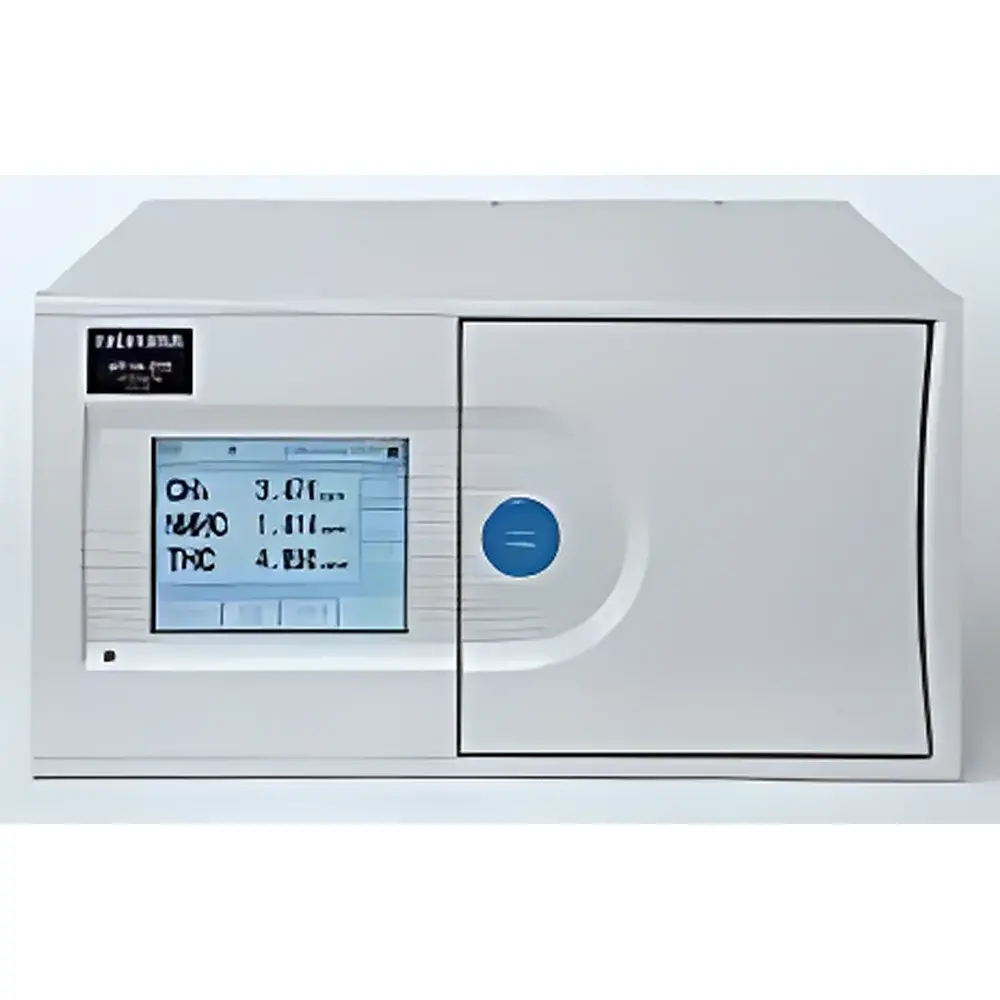
HORIBA APHA-370 THC and Methane Analyzer for Ambient Air Monitoring
| Brand | HORIBA |
|---|---|
| Origin | Japan |
| Model | APHA-370 |
| Measurement Principle | Flame Ionization Detection (FID) with Selective Combustion Technology |
| Target Analytes | CH₄, NMHC, THC (expressed as ppmC) |
| Standard Range | 0–5 / 10 / 20 / 50 ppmC |
| Optional Range | 0–100 ppmC (4 selectable spans, span ratio ≤10) |
| Detection Limit | 0.050 ppmC (2σ, for ranges ≤5 ppmC) or 0.5% F.S. (2σ, for ranges >5 ppmC) |
| Repeatability | ±1.0% F.S. |
| Linearity | ±2.0% F.S. |
| Zero Drift | ±0.1 ppmC/day or ±2.0% F.S./day (whichever is greater) |
| Span Drift | ±2.0% F.S./day |
| Response Time (T90) | ≤60 s |
| Sample Flow Rate | ~0.9 L/min |
| Output Signals | 0–1 V, 0–10 V, 4–20 mA (user-specified) |
| Operating Temperature | 5–40 °C |
| Power Supply | 100–240 VAC, 50/60 Hz (configurable) |
| Dimensions | 430 W × 550 D × 221 H mm |
| Weight | ~33 kg |
| Display Language Options | English, German, French, Japanese |
| Data Storage | CF card (optional) |
| Network Interface | Ethernet/LAN (optional) |
Overview
The HORIBA APHA-370 is a high-performance, continuous ambient air monitoring analyzer engineered specifically for the quantitative determination of total hydrocarbons (THC), methane (CH₄), and non-methane hydrocarbons (NMHC) in atmospheric environments. It integrates flame ionization detection (FID) with proprietary selective catalytic combustion technology—enabling simultaneous, zero-drift-free measurement of all three parameters using a single detector architecture. Unlike conventional dual-FID or subtraction-based NMHC analyzers, the APHA-370 eliminates reliance on mathematical correction or inter-channel calibration drift compensation. Its core design employs two integrated catalytic units: one for generating purified reference gas (zero air) and combustion-supporting air, and another optimized for selective oxidation of NMHC while preserving CH₄ integrity. This dual-catalyst configuration ensures long-term baseline stability and metrological traceability under unattended operation—a critical requirement for regulatory-grade air quality networks compliant with EPA Method 25A, ISO 8573-5, and EN 14662.
Key Features
- Single-detector architecture combining FID sensitivity with selective catalytic oxidation—eliminates zero-point drift and cross-interference between CH₄ and NMHC
- Integrated catalytic zero-air generator and combustion air purifier—no external zero-gas cylinders required
- Auto-ranging capability across four user-selectable spans (0–5 to 0–100 ppmC), configurable via front panel or remote command
- Real-time dynamic averaging and instantaneous output options (via analog or digital interfaces)
- Onboard CF card slot for autonomous data logging (time-stamped concentration values, diagnostic flags, calibration logs)
- Multi-language UI (English, German, French, Japanese) with configurable alarm thresholds and maintenance scheduling
- Compact benchtop form factor (430 × 550 × 221 mm) with internal sampling pump, flow control, and hydrogen fuel management
- Compliant with electromagnetic compatibility standards (IEC 61326-1) and safety requirements (IEC 61010-1)
Sample Compatibility & Compliance
The APHA-370 is designed for direct integration into automatic air quality monitoring stations (AQMS) operating under ambient conditions (5–40 °C, non-condensing). It accepts raw ambient air samples without pre-filtration beyond standard particulate removal (e.g., 2.5 µm cyclone or Teflon membrane filter). The analyzer meets performance criteria specified in U.S. EPA Reference Method 25A for THC/NMHC measurement and aligns with European technical specifications for continuous emission monitoring systems (CEMS) per EN 15267-3. Its internal diagnostics—including zero-calibration error detection, flame-out monitoring, catalyst temperature validation, and FID bias voltage tracking—support GLP/GMP-aligned audit trails. All firmware and calibration records are timestamped and exportable for regulatory submission (e.g., to state implementation plans or EU E-PRTR reporting portals).
Software & Data Management
Data acquisition and system control are supported via built-in RS-232C serial interface and optional Ethernet port, enabling seamless integration with SCADA platforms, central data loggers, or cloud-based environmental information systems (EIS). The instrument supports Modbus RTU/TCP protocols for interoperability with third-party HMIs. Calibration history, alarm events, and sensor health metrics are stored locally on removable CF cards (up to 32 GB), with file formats compatible with common spreadsheet and statistical analysis tools (CSV, TXT). Remote firmware updates and parameter reconfiguration are possible through secure Telnet or HTTP sessions—subject to role-based access control when deployed in multi-user network environments. Audit logs record all operator actions (e.g., span adjustments, zero checks, range changes) with user ID and timestamp, satisfying FDA 21 CFR Part 11 electronic record requirements when configured with digital signature capability.
Applications
- Urban and regional ambient air quality monitoring networks (AQMNs) for regulatory compliance reporting
- Industrial fence-line monitoring at petrochemical facilities, landfills, and wastewater treatment plants
- Mobile laboratory deployments for source apportionment studies and VOC speciation support
- Research applications requiring high-temporal-resolution THC time-series (e.g., photochemical modeling input)
- Calibration verification of other hydrocarbon analyzers using certified reference materials (CRMs) traceable to NIST SRM 1861
- Baseline monitoring in national parks and protected areas under the U.S. Clean Air Act’s Prevention of Significant Deterioration (PSD) program
FAQ
What auxiliary gases are required for operation?
Only high-purity hydrogen (H₂, ≥99.999%) is required as fuel gas. All other functions—including zero-air generation and combustion air purification—are performed internally via catalytic reactors. No compressed zero-air or span gas cylinders are needed for routine operation.
How is NMHC calculated without subtraction error?
The APHA-370 measures CH₄ directly in one catalytic path, and total hydrocarbons (THC) in a parallel path where NMHC is selectively oxidized before FID detection. NMHC is derived as the difference between THC and CH₄—both measured simultaneously under identical thermal and flow conditions, minimizing time-dependent drift effects inherent in sequential measurement methods.
Can the instrument be integrated into an existing AQMS with Modbus protocol?
Yes. When equipped with the optional Ethernet module, the APHA-370 supports Modbus TCP/IP natively. Analog outputs (4–20 mA or 0–10 V) can also be assigned to any combination of CH₄, NMHC, or THC channels with configurable scaling and filtering.
Is field calibration supported without removing the unit from service?
Full zero and span calibration—including catalytic reactor conditioning—can be executed remotely or via front-panel menu. Built-in leak-check routines and flow verification diagnostics reduce downtime during scheduled maintenance intervals.
What data security features are available for network-connected units?
Firmware v3.2+ supports TLS 1.2 encryption for web-based configuration, password-protected user levels (operator, engineer, administrator), and encrypted CF card data export. Audit logs capture all configuration changes and calibration events with SHA-256 hashing for integrity verification.







