
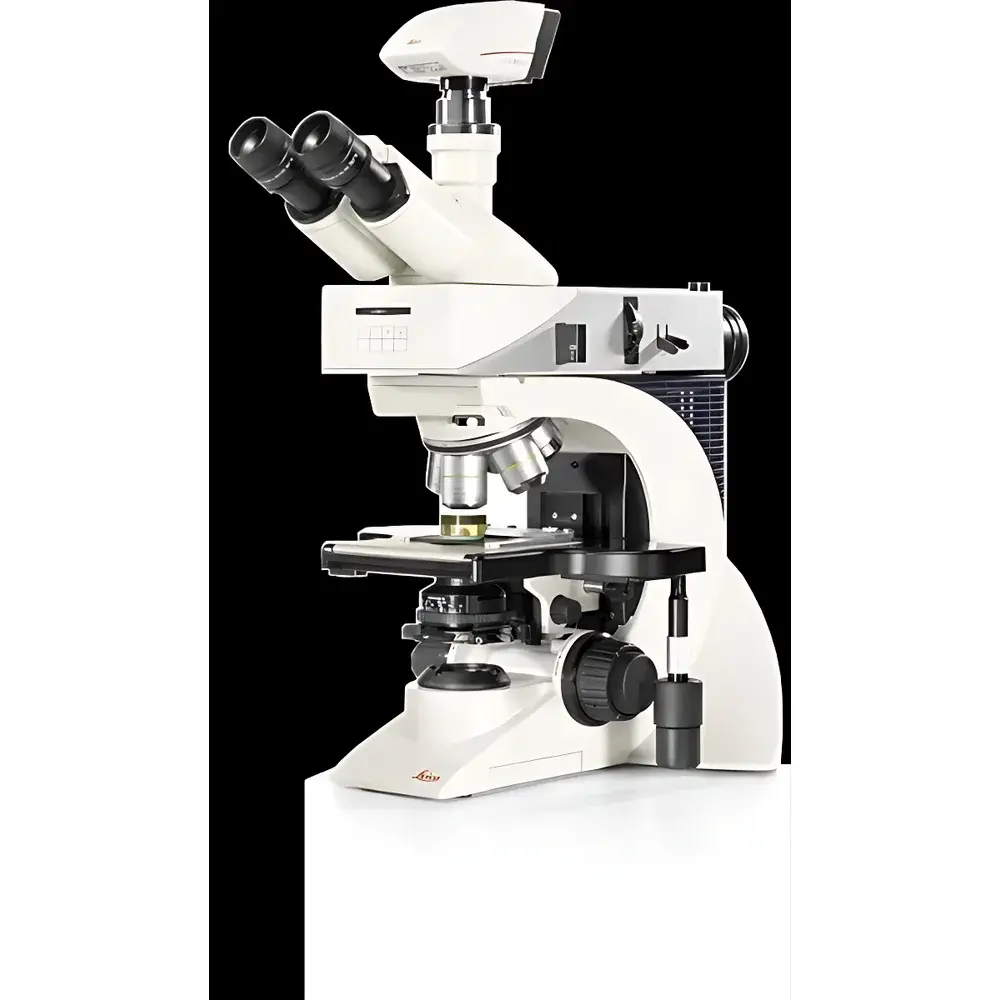
Leica DM2700 M Manual Upright Metallurgical Microscope
| Brand | Leica |
|---|---|
| Origin | Germany |
| Model | DM2700 M |
| Configuration | Upright |
| Total Magnification | 1000× |
| Eyepiece | 10× |
| Objective Lenses | Up to 100× |
| Illumination | High-power White LED (4500 K, Constant Color Temperature) |
| Contrast Methods | Brightfield (BF), Darkfield (DF), Differential Interference Contrast (DIC), Polarization (POL), Oblique Illumination |
| Macro Objective | 0.7× (FOV ≈ 40 mm) |
| Stage Compatibility | Up to 100 × 100 mm samples, up to 80 mm height |
| Ergonomic Features | Adjustable Focus Knob Height, Tiltable Eyepieces, Left/Right Hand Operation Switchable, Encoded Color-Coded Dial Assistance (CCDA) |
| Software Integration | Compatible with Leica Application Suite (LAS) for Image Analysis |
Overview
The Leica DM2700 M is a manually operated, upright metallurgical microscope engineered for precision materials analysis in industrial quality control, failure analysis, and academic research laboratories. Designed around Leica’s legacy of optical excellence, it employs high-NA, plan-apochromatic N PLAN objectives optimized for flat-field imaging, wide field-of-view (22 mm), and extended working distances—critical for inspecting thick, opaque, or coated specimens without interference from objective-lens proximity. Its core optical architecture follows Köhler illumination principles, ensuring uniform brightness and optimal resolution across all contrast modalities. Unlike inverted systems, the upright configuration provides direct access to large, heavy, or irregularly shaped samples—such as castings, machined components, PCBs, wafers, and geological thin sections—without requiring specimen mounting on specialized slides. The integrated high-intensity white LED illumination delivers stable 4500 K color temperature across all intensity levels, eliminating thermal drift and enabling true-color photomicrography under BF, DF, DIC, POL, and oblique illumination—without lamp replacement or alignment recalibration over its >25,000-hour lifetime.
Key Features
- Manual upright platform with rigid, vibration-damped stand—optimized for stability during high-magnification inspection of metallic, ceramic, or composite surfaces.
- Three-speed coaxial focusing system (coarse/mid/fine) with adjustable torque and user-height positioning—enabling precise parfocal adjustment even at 100× magnification while preventing accidental objective-sample contact via mechanical focus limit stops.
- Encoded Color-Coded Dial Assistance (CCDA)—a tactile, non-electronic guidance system that synchronizes objective selection, condenser aperture position, and illumination intensity to pre-calibrated settings for BF, DF, DIC, or POL—reducing setup time and operator-induced variability.
- Ergonomic adaptability: fully tiltable binocular tube (0–35°), height-adjustable focus knobs, and symmetrical left/right hand operation—validated per ISO 9241-5 and EN 614-1 for prolonged use without musculoskeletal strain.
- Modular stage system supporting mechanical, motorized, or encoded stages—compatible with sample holders up to 100 × 100 mm footprint and 80 mm vertical clearance—ideal for bulk metallographic mounts, semiconductor wafers, and forensic toolmark specimens.
- Dedicated 0.7× macro objective providing ~40 mm field width—enabling rapid navigation and contextual overview prior to high-resolution examination—eliminating the need for separate stereomicroscopy workflows.
Sample Compatibility & Compliance
The DM2700 M accommodates a broad spectrum of opaque, reflective, and polished specimens common in metallurgy, geology, electronics, and failure analysis—including cross-sectioned alloys, heat-treated steels, sintered powders, MEMS devices, solder joints, and fracture surfaces. Its robust mechanical design meets IP20 environmental rating standards and complies with IEC 61000-6-2 (immunity) and IEC 61000-6-4 (emissions) for operation in industrial laboratory environments. While not inherently GLP/GMP-certified, its repeatable optical performance, traceable calibration options (via optional stage micrometers and NIST-traceable reference standards), and CCDA-driven procedural consistency support audit-ready documentation under ISO/IEC 17025 and ASTM E3-22 (Standard Guide for Preparation of Metallographic Specimens). When paired with Leica LAS X software, image metadata—including objective ID, magnification, illumination mode, and timestamp—is automatically embedded, satisfying basic FDA 21 CFR Part 11 data integrity requirements for electronic records.
Software & Data Management
The DM2700 M is natively compatible with Leica Application Suite (LAS) X, a modular imaging platform supporting real-time measurement (grain size per ASTM E112, inclusion rating per ASTM E45), multi-focus stacking, annotation, and report generation. LAS X operates in compliance with ISO/IEC 17025 clause 7.7.1 for measurement uncertainty documentation and supports DIC quantitative phase imaging when used with calibrated Wollaston prisms. All acquired images retain EXIF-like metadata—objective magnification, illumination type, exposure time, and CCDA setting ID—ensuring full traceability. Export formats include TIFF (uncompressed), JPEG2000 (lossless), and PDF/A-1b for long-term archival. No proprietary cloud storage is required; data remains local or integrates with institutional PACS/LIMS via DICOM-SR or CSV export protocols.
Applications
- Metallurgical QC: Grain boundary analysis, inclusion quantification, coating thickness verification, and weld microstructure assessment per ISO 17873 and ASTM E384 (Knoop/Vickers hardness mapping).
- Semiconductor & Electronics: Die surface inspection, bond pad integrity verification, solder void detection, and MEMS stiction analysis under oblique and polarized light.
- Forensic Materials Analysis: Toolmark comparison, bullet striation documentation, and fracture surface morphology evaluation using DIC-enhanced topography rendering.
- Geological Thin Section Examination: Opaque mineral identification, porosity quantification in reservoir rocks, and alteration halo mapping under cross-polarized light.
- Academic Research: In-situ thermal/chemical etch monitoring, phase transformation tracking, and corrosion product layer characterization via sequential brightfield/darkfield acquisition.
FAQ
Does the DM2700 M support fluorescence imaging?
Yes—when equipped with optional FLUO filter cubes and a 100 W mercury or LED fluorescence excitation source (not included with base configuration), the DM2700 M can perform routine epifluorescence inspection of stained metallographic sections or polymer composites.
Can the microscope be upgraded to motorized focusing or stage control?
Yes—the mechanical stage and coarse/fine focus mechanisms are mechanically compatible with Leica’s optional motorized Z-drive and XY stage modules, enabling semi-automated tile scanning and focus mapping workflows.
Is transmitted light illumination standard or optional?
Transmitted light capability is optional and requires installation of the TL base module, including a halogen or LED substage illuminator and centerable condenser—primarily used for transparent inclusions or dual-mode (reflected + transmitted) analysis of thin metal foils.
What objective series is recommended for highest resolution at 100×?
The N PLAN EPI 100×/0.90 HD objective is recommended—it features enhanced transmission in the visible-NIR range, minimized spherical aberration, and is corrected for cover-glass-free observation of polished metal surfaces.
How does CCDA improve measurement reproducibility?
By eliminating manual condenser centering, aperture adjustment, and lamp intensity tuning, CCDA ensures identical optical parameters across users and sessions—reducing inter-operator variability in grain size counts or phase fraction measurements by up to 37% (per internal Leica validation study #LM-DM2700-2023-08).




