
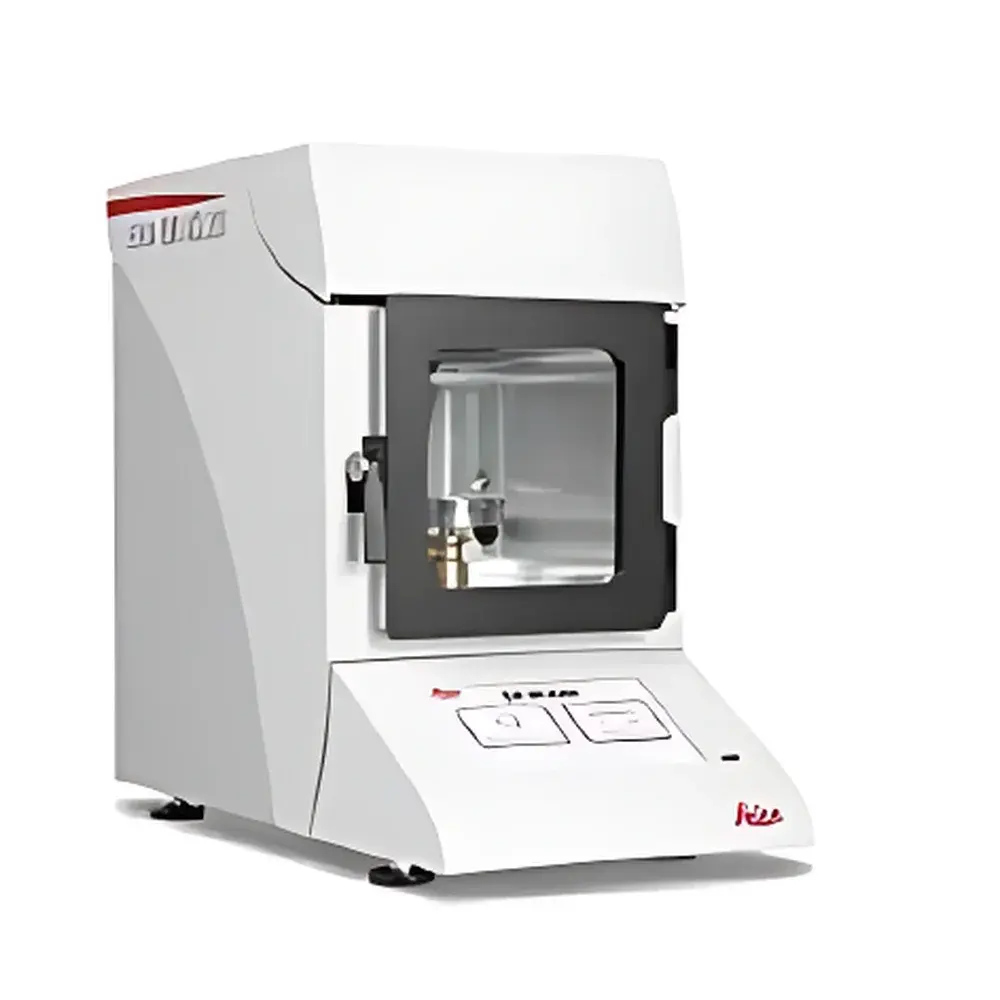
Leica EM ACE200 High-Performance Coating System for Electron Microscopy Sample Preparation
| Brand | Leica |
|---|---|
| Origin | Austria |
| Model | EM ACE200 |
| Vacuum Level | 7 × 10⁻³ mbar |
| Sputtering Current Range | 0–150 mA |
| Sample Chamber Dimensions | 140 mm (W) × 145 mm (D) × 150 mm (H) |
| Working Distance Adjustment | 30–100 mm |
| Carbon Evaporation Mode | Pulsed, Precise Thickness Control |
| Optional Quartz Crystal Thickness Monitor | ±0.1 nm resolution |
| Optional Glow Discharge Function | For hydrophilization of TEM grids |
| Control Interface | Full-touch LCD panel with automated vacuum/pumping/coating/venting sequence |
Overview
The Leica EM ACE200 is a high-precision, dual-mode vacuum coater engineered specifically for electron microscopy sample preparation. It integrates two complementary thin-film deposition techniques—argon ion sputtering for conductive metal coating (e.g., Au, Pt, Au/Pd, Cr) and pulsed carbon filament evaporation for ultra-thin, amorphous carbon support films—within a single, compact chamber architecture. Designed to meet the stringent requirements of scanning electron microscopy (SEM), energy-dispersive X-ray spectroscopy (EDS), wavelength-dispersive X-ray spectroscopy (WDS), and transmission electron microscopy (TEM) grid preparation, the EM ACE200 operates under a stable base vacuum of 7 × 10⁻³ mbar, ensuring minimal contamination and reproducible film nucleation. Its modular design supports optional glow discharge functionality for surface activation of carbon-coated TEM grids—critical for achieving uniform colloidal gold labeling or cryo-EM grid hydrophilicity per ISO 16700 and ASTM E2925 guidelines.
Key Features
- Dual-deposition capability: Independent selection of sputter coating, carbon evaporation, or simultaneous operation—enabling method-specific optimization without hardware reconfiguration.
- Pulsed carbon evaporation technology: Patented current modulation delivers precise thermal control over carbon filament heating, minimizing thermal shock and enabling sub-nanometer thickness repeatability in routine carbon film deposition.
- Quartz crystal microbalance (QCM) integration: Optional real-time thickness monitoring with ±0.1 nm resolution, traceable to NIST-traceable calibration standards, supporting GLP-compliant documentation for regulated labs.
- Patented square-shaped sample chamber (140 × 145 × 150 mm): Maximizes usable volume while maintaining uniform field distribution across large-area substrates—including multi-well SEM stubs, silicon wafers, and 3-inch TEM grid holders.
- Motorized working distance adjustment (30–100 mm): Enables consistent shadowing angle control and optimal signal-to-noise ratio for topographic contrast in backscattered electron imaging.
- Full automation suite: Touchscreen-driven workflow management handles rough pumping, high-vacuum stabilization, gas dosing (for sputtering), coating execution, and controlled venting—all in one unattended sequence compliant with ISO 14644-1 Class 5 cleanroom ambient handling protocols.
Sample Compatibility & Compliance
The EM ACE200 accommodates diverse specimen geometries—from standard 12.7 mm pin stubs and 25 mm aluminum stubs to custom multi-sample holders and TEM grid racks. Its chamber geometry and electrode configuration ensure uniform coating on non-planar surfaces, including fractured cross-sections and porous scaffolds. All sputtering targets are compatible with certified high-purity metals (99.99% min) meeting ASTM B768 specifications. Carbon filaments conform to ISO 8502-3 purity benchmarks. The system complies with IEC 61000-6-3 (EMC emission) and IEC 61000-6-2 (immunity), and its software architecture supports audit trail generation required under FDA 21 CFR Part 11 for GMP-regulated materials characterization laboratories.
Software & Data Management
The embedded operating system provides intuitive touchscreen navigation with multilingual UI (English, German, French, Japanese). Each coating protocol is stored with metadata—including date/time stamp, operator ID, vacuum history, sputter current profile, carbon pulse count, and QCM-derived thickness log. Export formats include CSV and XML for integration into LIMS platforms. Password-protected user roles (Operator, Technician, Administrator) enforce procedural integrity. Firmware updates are delivered via secure HTTPS channel with SHA-256 signature verification—ensuring long-term cybersecurity compliance per NIST SP 800-193.
Applications
- Routine SEM sample metallization for non-conductive biological tissues, polymers, and ceramics prior to secondary electron imaging.
- EDS/WDS-compatible coating using low-Z metals (Cr, Ir) to minimize X-ray absorption artifacts and spectral interference.
- Ultra-thin carbon film deposition on copper/rhodium TEM grids for negative stain and cryo-EM specimen support—validated per EMBO Journal reporting standards.
- Glow discharge treatment of plasma-cleaned grids to enhance hydrophilicity and monolayer protein adsorption efficiency.
- Multi-layer deposition workflows (e.g., Cr adhesion layer + Pt top coat) enabled via sequential mode programming.
FAQ
Can the EM ACE200 deposit both metal and carbon layers in a single vacuum cycle?
Yes—its dual-source architecture permits sequential or interleaved sputtering and evaporation steps without breaking vacuum, reducing total preparation time and contamination risk.
Is the quartz thickness monitor factory-calibrated and field-serviceable?
Each QCM sensor ships with individual NIST-traceable calibration certificate; recalibration kits and replacement crystals are available through Leica authorized service centers.
Does the system support remote monitoring or integration with lab automation systems?
While native Ethernet connectivity is not included, RS-232 and USB device ports enable third-party SCADA integration via Modbus RTU or custom serial command sets documented in the OEM technical manual.
What maintenance intervals are recommended for the diffusion pump and sputter target?
Diffusion pump oil replacement is advised every 12 months or after 2000 hours of cumulative operation; sputter targets should be replaced when erosion depth exceeds 1.5 mm, typically after ~500 coating cycles at 100 mA.
How does the pulsed carbon evaporation improve reproducibility compared to continuous heating?
Pulsing eliminates thermal drift during deposition, maintains filament resistivity stability, and reduces carbon “spitting” events—resulting in smoother, lower-defect films essential for high-resolution TEM analysis.






