
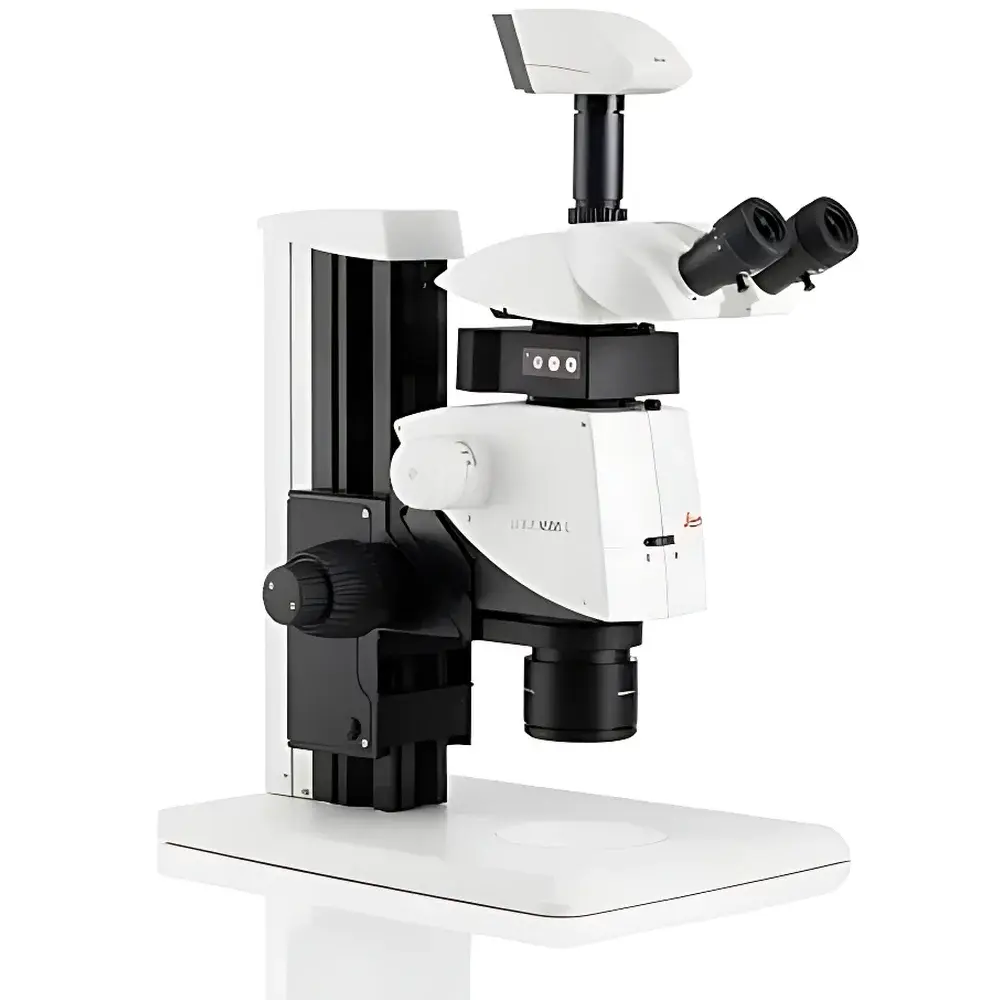
Leica LED5000 CXI Coaxial Illumination System
| Brand | Leica |
|---|---|
| Origin | Germany |
| Model | LED5000 CXI |
| Light Source | Dual integrated high-CRI white LEDs |
| Color Temperature | 6500 K |
| Rated Lifetime | 50,000 hours |
| Compatibility | Leica stereo microscopes (e.g., M205 A, M205 C, M165 C) |
| Software Integration | Fully compatible with Leica LAS X and LAS v4.x |
| Compliance | CE, IEC 61000-6-3, IEC 61000-6-4, RoHS |
Overview
The Leica LED5000 CXI Coaxial Illumination System is an engineered optical illumination module designed specifically for high-resolution stereo microscopy applications requiring precise, shadow-free surface visualization. It employs coaxial illumination geometry—where light is directed parallel to the optical axis and reflected directly back through the objective—enabling uniform, glare-minimized illumination of reflective, low-contrast, or highly structured specimens such as polished metals, semiconductor wafers, solder joints, PCB traces, and precision machined components. Unlike traditional oblique or ring-light configurations, coaxial illumination eliminates directional shadows and enhances topographic contrast by accentuating surface texture and edge definition without altering sample appearance through angular bias. The system delivers consistent 6500 K daylight-balanced illumination, eliminating the yellow spectral shift inherent in halogen-based coaxial systems and ensuring accurate color fidelity critical for documentation, quality control, and comparative analysis.
Key Features
- Dual-integrated high-color-rendering-index (CRI >90) white LEDs provide stable, flicker-free illumination across the full intensity range—no warm-up time, no color drift, and zero need for manual white balance adjustment.
- Engineered for ergonomic sustainability: 50,000-hour LED lifetime at nominal output ensures long-term photometric stability and eliminates routine lamp replacement, reducing both operational downtime and consumables cost.
- Compact, self-contained design integrates directly into Leica stereo microscope stands (M205 series, M165 C), removing dependency on external fiber-optic illuminators or bulky power supplies—reducing benchtop footprint by up to 30% in multi-instrument workstations.
- Digitally controllable intensity via hardware dial or software interface; supports fine-grained analog dimming (0–100%) with linear response and repeatable setting recall.
- Optically optimized light path includes collimating optics and beam-splitting dichroic coatings to maintain Köhler illumination principles, ensuring even field illumination and minimal vignetting—even at maximum magnification.
Sample Compatibility & Compliance
The LED5000 CXI is validated for use with non-fluorescent, non-autofluorescent, and non-light-sensitive specimens commonly encountered in industrial QA/QC, failure analysis, and academic materials characterization. It is suitable for metallurgical surfaces, coated substrates, microelectronic assemblies, medical device components, and precision optics. The system complies with electromagnetic compatibility (EMC) standards IEC 61000-6-3 (emission) and IEC 61000-6-4 (immunity), meets CE marking requirements under the EU Machinery Directive 2006/42/EC and Low Voltage Directive 2014/35/EU, and conforms to RoHS 2011/65/EU restrictions on hazardous substances. While not classified as a medical device under FDA 21 CFR Part 820, its illumination consistency supports GLP-compliant documentation workflows when paired with Leica’s audit-trail-enabled LAS X software.
Software & Data Management
Full bidirectional integration with Leica Application Suite (LAS) v4.12+ and LAS X 3.7+ enables synchronized capture and metadata embedding: illumination parameters—including intensity level, activation state, and timing—are automatically recorded alongside image acquisition metadata in .lei and .lif file formats. This ensures full traceability for ISO 9001-certified inspection protocols and facilitates rapid reconfiguration during batch analysis or cross-shift handover. The LAS X platform supports scripting (via Python API) for automated illumination sequencing—e.g., toggling between coaxial and oblique modes during multi-angle defect mapping—and permits export of illumination logs compliant with internal SOPs or external regulatory review.
Applications
- Non-destructive inspection of solder paste deposition, void detection in BGA interconnects, and wire bond integrity assessment in semiconductor packaging.
- Surface finish evaluation of CNC-machined parts, EDM electrodes, and injection-molded polymer components per ASTM E112 and ISO 4287.
- Forensic toolmark analysis where specular reflection patterns must be preserved for comparison microscopy.
- Quality gate verification in medical device manufacturing (e.g., laser-weld seam inspection on stainless steel cannulas, coating uniformity on nitinol stents).
- Educational demonstration of optical sectioning principles and contrast generation mechanisms in advanced microscopy curricula.
FAQ
Is the LED5000 CXI compatible with third-party stereo microscopes?
No—the mechanical and electrical interface (including mounting flange geometry, power delivery protocol, and digital handshake) is proprietary to Leica M-series stereo microscope stands.
Does the system support TTL or analog trigger input for synchronization with camera acquisition?
Yes—via optional accessory cable (Leica part no. 11594905), the LED5000 CXI accepts 5 V TTL pulses for hardware-synchronized illumination gating.
Can illumination intensity be controlled remotely via Ethernet or USB?
Yes—when used with LAS X software, intensity is adjustable over USB 2.0; Ethernet control requires Leica’s DM6000-compatible network bridge module (sold separately).
What maintenance is required during the 50,000-hour service life?
None beyond periodic cleaning of the front optic with lens-grade isopropyl alcohol and lint-free wipes; no recalibration or alignment procedures are specified by Leica.
Is thermal management passive or active?
Passive—heat dissipation relies on aluminum housing conduction and natural convection; no fans or moving parts are incorporated, ensuring silent operation in noise-sensitive environments.




