
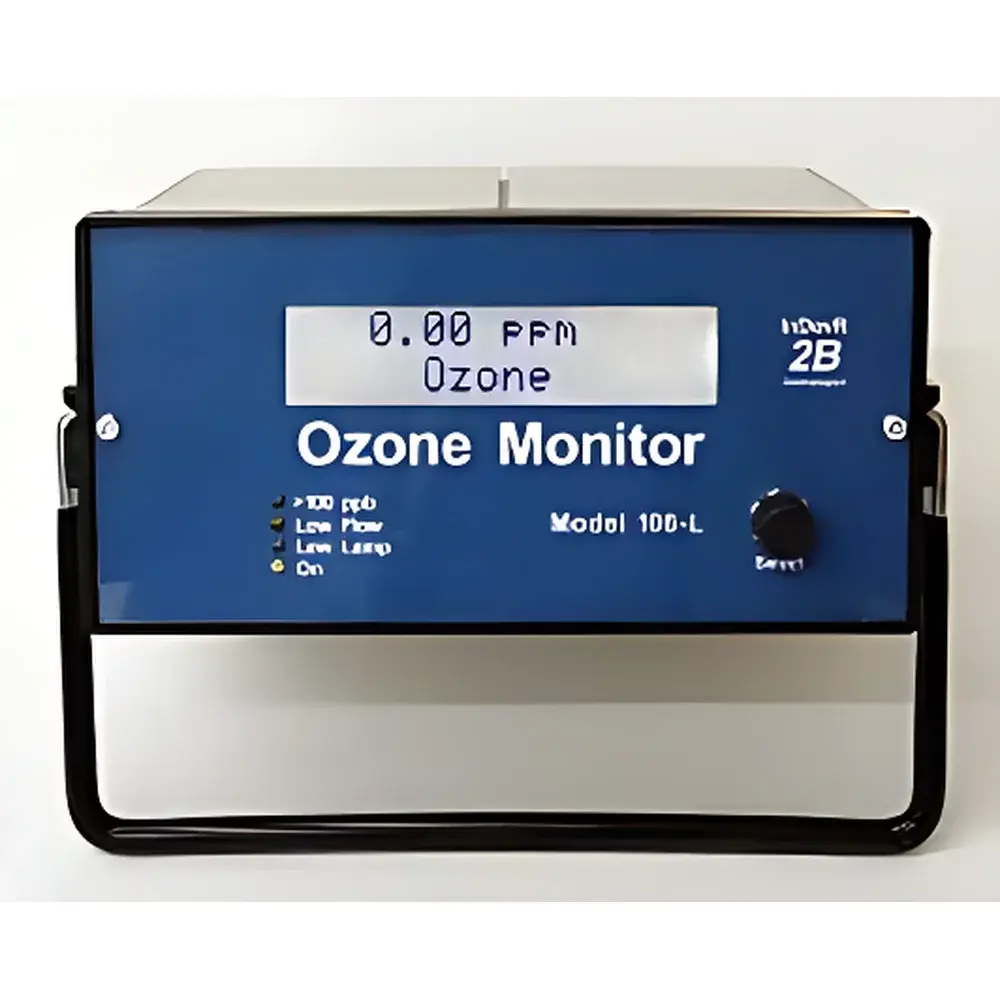
2B Technologies Model 106 UV Absorption Ozone Analyzer
| Origin | USA |
|---|---|
| Manufacturer Type | Authorized Distributor |
| Origin Category | Imported |
| Model | MODEL 106 |
| Pricing | Upon Request |
Overview
The 2B Technologies Model 106 UV Absorption Ozone Analyzer is a compact, field-deployable instrument engineered for high-fidelity ambient and industrial ozone (O₃) quantification using the internationally recognized 254 nm ultraviolet absorption principle—fully compliant with U.S. EPA Reference Method EQOA-0308-193 and ISO 13964:2021 for ozone measurement in air. This photometric technique leverages the strong, characteristic absorbance of ozone at 254 nm, enabling trace-level detection with inherent stability, minimal drift, and immunity to common interferents such as NO₂, SO₂, and hydrocarbons when properly configured. The analyzer operates across three calibrated OEM configurations (OEM-106-L, -M, and -H), supporting measurement ranges from sub-part-per-trillion (ppt) background levels up to 20 wt% ozone in concentrated process streams—making it suitable for both regulatory-grade ambient monitoring and demanding industrial process control applications.
Key Features
- UV photometric detection at 254 nm with Nafion®-based dew line for active water vapor management, minimizing humidity-induced spectral interference
- Three interchangeable OEM sensor modules: OEM-106-L (0–100 ppm, 0.1 ppb resolution), OEM-106-M (0–1000 ppm, 0.01 ppm resolution), and OEM-106-H (0–20 wt%, 0.01 wt% resolution)
- Measurement accuracy: ±2 ppb or ±2% of reading (whichever is greater), validated per ASTM D5012-22 calibration traceability protocols
- Low-power operation: 4.2 W nominal consumption at 12 V DC; compatible with external battery packs, solar chargers, or universal AC adapters
- Integrated real-time clock and non-volatile data logger storing up to 12,288 time-stamped records (configurable averaging intervals: 10 s, 1 min, 5 min, or 1 hr)
- Multi-interface digital output: USB 2.0 (CDC class), RS-232 (TTL level), plus analog outputs (0–2.5 V and 4–20 mA) with user-selectable span (e.g., 0–1 ppm, 0–100 ppm)
- Compact footprint: 9.5 × 21.0 × 21.6 cm (3.75 × 8.25 × 8.50 in); weight: 2.1 kg (4.7 lb)—designed for tripod mounting, vehicle integration, or handheld survey use
Sample Compatibility & Compliance
The Model 106 is optimized for gaseous samples with flow rates of ~1 L/min and accommodates inlet gas temperatures from 0 °C to 40 °C and relative humidity up to 95% RH (non-condensing). Its Nafion® dry tube system actively removes water vapor without chemical scrubbing, preserving ozone integrity and eliminating artifacts associated with permeation-based drying. The analyzer meets key regulatory and quality framework requirements: U.S. EPA EQOA-0308-193 equivalency, ISO/IEC 17025-compliant calibration documentation support, and full compatibility with GLP/GMP environmental data capture workflows. Optional firmware enables audit-trail logging and user-access controls aligned with FDA 21 CFR Part 11 principles for regulated environments.
Software & Data Management
Data acquisition and configuration are managed via 2B Technologies’ proprietary O3Soft™ software (Windows/macOS/Linux), which supports real-time visualization, remote parameter adjustment, firmware updates, and batch export to CSV or netCDF formats. All logged entries include UTC timestamp, ozone concentration (in selectable units: ppb, ppm, pphm, mg/m³), internal temperature, barometric pressure, and diagnostic flags (e.g., lamp intensity, flow rate, filter status). The USB interface supports CDC-class virtual COM port emulation, allowing seamless integration into SCADA systems, LabVIEW DAQ environments, or Python-based IoT telemetry stacks using standard serial libraries.
Applications
- Ambient air quality monitoring networks (urban, rural, and background stations) meeting national reference method criteria
- Indoor air quality assessment in laboratories, cleanrooms, healthcare facilities, and ozone-generating equipment enclosures
- Industrial hygiene monitoring for occupational exposure limit (OEL) compliance (e.g., OSHA PEL = 0.1 ppm TWA)
- Process control and safety interlocks in ozone generation systems (water treatment, semiconductor fabrication, pharmaceutical sterilization)
- Mobile and drone-mounted atmospheric profiling campaigns requiring low-SWaP (Size, Weight, and Power) instrumentation
- Educational and research deployments where trace gas methodology training and reproducible photometric fundamentals are emphasized
FAQ
What ozone concentration units does the Model 106 support?
The instrument natively reports in ppb, ppm, pphm, and mg/m³, with unit selection configurable via O3Soft™ or serial command.
Is the Model 106 suitable for continuous unattended operation?
Yes—it features robust thermal management, internal diagnostics, and a 12,288-record buffer enabling >1 year of hourly-averaged data storage without external intervention.
How often does the instrument require calibration?
Field calibration is recommended every 3–6 months using a certified ozone transfer standard; zero checks can be performed daily using an activated carbon scrubber.
Can the Model 106 operate on battery power alone?
Absolutely—the 4.2 W power draw allows >24 hours of continuous operation on a standard 12 V, 7 Ah sealed lead-acid or LiFePO₄ battery pack.
Does the analyzer meet international regulatory standards for ambient ozone monitoring?
Yes—its 254 nm UV absorption methodology is formally recognized under U.S. EPA EQOA-0308-193, EU Directive 2008/50/EC Annex III, and ISO 13964:2021 as an equivalent measurement method.







