
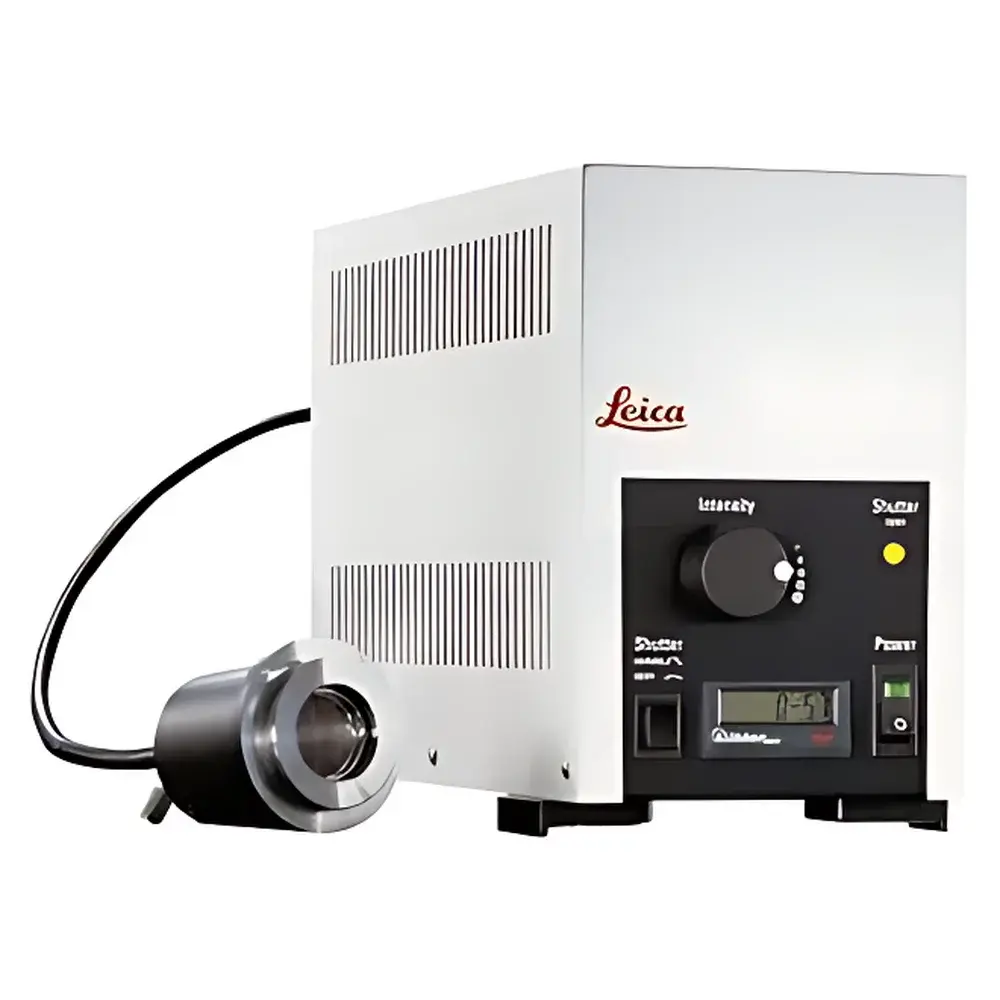
Leica EL6000 External Fluorescence Excitation Light Source
| Brand | Leica |
|---|---|
| Origin | Germany |
| Model | Leica EL6000 |
| Lamp Type | Mercury-metal halide (calibration-free) |
| Rated Lamp Life | >2000 h |
| Shutter Response Time | ≤6 ms |
| Integrated Attenuator | Yes, for photobleaching reduction |
| Compatibility | All Leica upright, inverted, and stereo microscopes via liquid light guide |
| Weight Optimization | Designed to minimize load on stereo microscope Z-axis |
Overview
The Leica EL6000 is a high-stability, externally mounted fluorescence excitation light source engineered for demanding life science imaging applications. It operates on the principle of broadband arc-lamp illumination—specifically utilizing a mercury-metal halide lamp—to deliver intense, spectrally rich excitation energy across UV–visible wavelengths (typically 340–650 nm). Unlike integrated microscope light engines, the EL6000 decouples thermal and optical loads from the microscope body by routing excitation light via a liquid light guide (LLG), thereby eliminating heat-induced drift, specimen heating, and thermal stress on sensitive optical components. This architecture supports long-term stability in time-lapse imaging, live-cell observation, and quantitative fluorescence assays where signal fidelity and specimen viability are critical.
Key Features
- Thermal Isolation Architecture: Heat-generating lamp module is physically separated from the microscope stand, reducing thermal load on objectives, stages, and specimens—particularly essential for extended live-cell imaging sessions.
- Calibration-Free Mercury-Metal Halide Lamp: Delivers consistent spectral output without routine alignment or recalibration; rated for >2000 hours of stable operation under standard duty cycles.
- Ultra-Fast Integrated Mechanical Shutter: Closes excitation light within ≤6 ms, enabling precise temporal control for FRAP, FRET, and calcium imaging protocols requiring millisecond-scale light gating.
- Variable Intensity Attenuation: Built-in neutral-density filter wheel provides stepwise attenuation (e.g., 1%, 10%, 50%, 100%) to minimize phototoxicity and photobleaching during live-sample interrogation.
- Modular Liquid Light Guide Interface: Compatible with all Leica DM series upright and inverted microscopes, as well as M-series stereo platforms—ensuring uniform coupling efficiency and minimal transmission loss (<15% typical over 3 m).
- Z-Axis Load Optimization: Compact, low-mass excitation head design reduces mechanical burden on stereo microscope focusing mechanisms, preserving fine focus repeatability and stage stability.
Sample Compatibility & Compliance
The Leica EL6000 is routinely deployed in GLP-compliant core imaging facilities and academic laboratories performing multiplexed immunofluorescence, GFP/RFP-tagged protein tracking, and developmental biology studies. Its spectral output aligns with common fluorophore excitation bands (DAPI, FITC, TRITC, Cy3, Cy5), supporting ISO/IEC 17025-aligned validation workflows. While the device itself does not carry CE IVD or FDA 510(k) designation, its use in research settings adheres to ISO 13485-adjacent documentation practices when integrated into instrument qualification (IQ/OQ/PQ) protocols. No laser safety classification applies, as it employs non-coherent arc-lamp emission.
Software & Data Management
The EL6000 integrates natively with Leica Application Suite (LAS) X and LAS AF software environments via TTL and USB 2.0 interfaces. Full remote control includes shutter actuation, intensity stepping, lamp on/off sequencing, and synchronization with camera exposure timing—enabling automated multi-channel acquisition and hardware-triggered timelapse routines. Audit trail functionality (within LAS X v3.7+) logs all illumination parameter changes with timestamp, user ID, and session context, satisfying basic requirements for 21 CFR Part 11-compliant data integrity in regulated research environments.
Applications
- Long-duration live-cell fluorescence microscopy with minimized photodamage
- High-resolution confocal-ready widefield screening on Leica DMi8 and DM6 B platforms
- Stereo-fluorescence imaging of whole-mount embryos or organoids using M205 FA/M165 FC systems
- Quantitative colocalization analysis requiring stable, reproducible excitation intensity
- Teaching laboratory setups where robustness, ease of maintenance, and operator safety are prioritized
FAQ
Is the EL6000 compatible with non-Leica microscopes?
No—mechanical, optical, and electronic integration is exclusively validated for Leica upright, inverted, and stereo microscope models using proprietary LLG coupling and TTL signaling protocols.
What lamp replacement procedure is required?
Lamp replacement is performed at the module level; no optical realignment is needed due to factory-fixed collimation and pre-centered filament geometry.
Does the EL6000 support spectral filtering or wavelength selection?
No—it delivers broadband excitation; spectral selection must be achieved externally via filter cubes or motorized filter wheels mounted in the microscope’s fluorescence turret.
Can shutter timing be synchronized with sCMOS or EMCCD cameras?
Yes—via programmable TTL output with sub-millisecond jitter, fully compatible with Andor, Hamamatsu, and Photometrics camera trigger inputs.
Is service documentation available for IQ/OQ validation?
Leica provides a Factory Acceptance Test (FAT) report and lamp performance certification; full IQ/OQ templates are available through Leica Service Partners upon request.




