
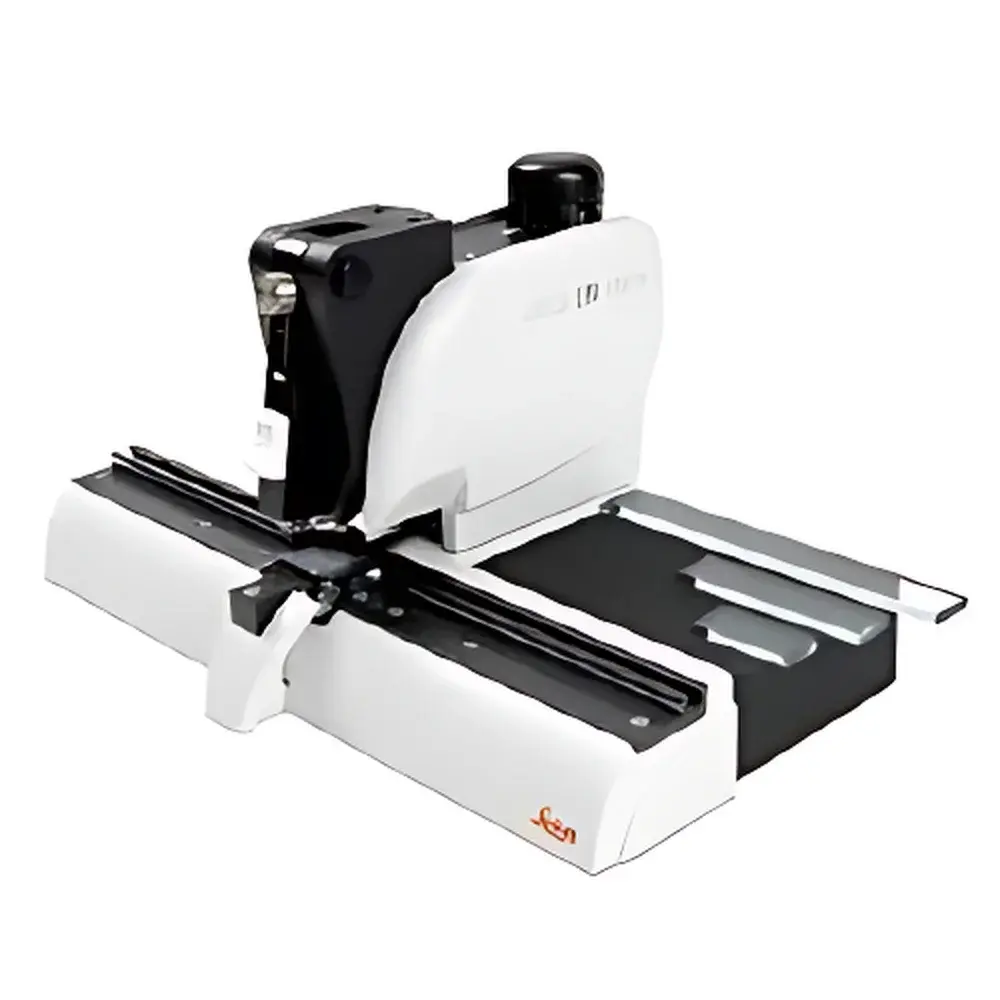
Leica EM KMR3 Glass Knife Maker
| Brand | Leica |
|---|---|
| Origin | Austria |
| Model | EM KMR3 |
| Principle | Balanced Fracture Method |
| Cutting Wheel Material | Tungsten Carbide |
| Adjustable Cutting Pressure | 5-step calibrated scale |
| Fracture Angle | 45° |
| Fracture Pressure Control | Calibrated rotary knob with auto-reset |
| Knife Tray | Drawer-type, tool-free access |
| Compatible Glass Rod Diameters | 6.4 mm, 8 mm, 10 mm |
| Support Mechanism | Precision-ground stainless steel hemispherical fulcrum |
| Repeatability | High (engineered for consistent edge geometry and minimal micro-chipping) |
Overview
The Leica EM KMR3 is a precision-engineered glass knife maker designed exclusively for ultramicrotomy sample preparation in transmission electron microscopy (TEM) laboratories. It implements the balanced fracture method—a physically rigorous technique first formalized by Leica in 1962—where controlled tensile stress is applied symmetrically across a pre-scored glass rod to induce a clean, reproducible cleavage plane perpendicular to the scoring line. Unlike empirical or mechanical snap-break systems, the EM KMR3 relies on static force equilibrium: the glass rod rests on a single, highly polished stainless steel hemispherical fulcrum, minimizing contact area and eliminating torsional distortion during fracture. This architecture ensures that fracture initiation occurs precisely at the scored line, yielding knives with atomically sharp, straight edges and negligible edge deviation—critical for producing 50–100 nm serial sections of biological or polymer specimens without chatter, compression, or knife marks.
Key Features
- True balanced fracture mechanism with calibrated dual-pressure actuation: independent adjustment of cutting force (via tungsten carbide roller) and fracture pressure (via rotary knob), both featuring engraved scales and mechanical auto-reset for repeatable setup.
- Tungsten carbide cutting wheel—hardness >1500 HV—resists wear over thousands of scoring cycles while maintaining dimensional stability and edge fidelity.
- Ergonomically optimized chassis with low-center-of-gravity base and intuitive lever placement reduces operator fatigue during high-throughput knife production.
- Drawer-integrated knife tray enables immediate retrieval of freshly fractured glass knives without tools, gloves, or secondary handling—minimizing contamination risk and preserving edge integrity.
- Modular glass rod support system accommodates standard diameters (6.4 mm, 8 mm, and 10 mm) with interchangeable alignment guides, ensuring optimal load distribution regardless of rod thickness.
- ISO 9001-certified manufacturing process; all critical components—including fulcrum spheres and pressure cams—are metrologically verified for geometric tolerance ≤ ±0.5 µm.
Sample Compatibility & Compliance
The EM KMR3 is compatible with borosilicate and soda-lime glass rods meeting ASTM C148-22 specifications for optical homogeneity and thermal stability. It supports knife geometries required for both diamond-knife calibration and routine TEM sectioning workflows. The instrument complies with IEC 61000-6-2 (EMC immunity) and IEC 61000-6-4 (EMC emissions) standards. Its mechanical design adheres to ISO 13857 safety principles for accessible moving parts. While not a medical device, its output—glass knives used in diagnostic TEM workflows—is routinely validated under GLP-compliant histopathology protocols (e.g., CAP/CLIA-accredited labs) and referenced in USP for ultrastructural sample integrity assessment.
Software & Data Management
The EM KMR3 operates as a fully manual, analog precision instrument—no embedded firmware, no connectivity, and no software dependencies. This architecture eliminates cybersecurity vulnerabilities, ensures long-term operational continuity beyond obsolescence cycles, and satisfies audit requirements for environments governed by FDA 21 CFR Part 11 (where electronic records are absent). All parameter settings—cutting pressure step, fracture pressure value, and rod diameter selection—are recorded manually in lab notebooks or LIMS-compatible log sheets. Calibration certificates for the tungsten carbide wheel and fulcrum sphere are supplied with each unit and traceable to PTB (Physikalisch-Technische Bundesanstalt) standards.
Applications
- Preparation of glass knives for ultrathin sectioning of epoxy-embedded biological tissues (e.g., neural tissue, kidney biopsies) prior to TEM imaging.
- Fabrication of sacrificial knives used to condition diamond knives and verify cutting performance before critical specimen sectioning.
- Production of custom-edged knives for focused ion beam (FIB)-SEM lift-out sample preparation where edge geometry directly influences lamella quality.
- Teaching laboratories requiring demonstrable correlation between fracture physics (stress distribution, Young’s modulus, surface energy) and observable knife morphology under optical inspection.
- Materials science labs preparing cross-sections of multilayer thin-film stacks (e.g., PV cells, battery electrodes) where compressive artifacts must be eliminated.
FAQ
Does the EM KMR3 require electrical power or compressed air?
No. It is a purely mechanical instrument driven by hand-applied force, with no motors, solenoids, or pneumatic components.
Can it produce knives from quartz or sapphire rods?
No. It is engineered specifically for standardized glass rods (6.4–10 mm diameter) with defined fracture toughness and elastic modulus. Quartz and sapphire exceed the machine’s stress-transfer capacity and risk fulcrum damage.
Is operator training required for consistent results?
Yes. While the interface is intuitive, optimal knife quality requires understanding of scoring depth-to-thickness ratios, ambient humidity effects on glass surface energy, and post-fracture edge inspection under 100× stereomicroscopy—topics covered in Leica’s certified EM Sample Prep workshops.
What maintenance does the EM KMR3 require?
Annual verification of fulcrum sphericity (via profilometry), cleaning of the tungsten carbide wheel with ethanol and lint-free wipes, and re-lubrication of the fracture pressure cam with Dow Corning® 111 silicone grease.
How does it compare to the older EM KMR2 model?
The EM KMR3 introduces improved fulcrum material hardness (62 HRC vs. 58 HRC), enhanced drawer rail damping, and tighter tolerance control on the 45° angle guide block (±0.1° vs. ±0.3°), resulting in 22% higher yield of usable knives per glass rod batch.




