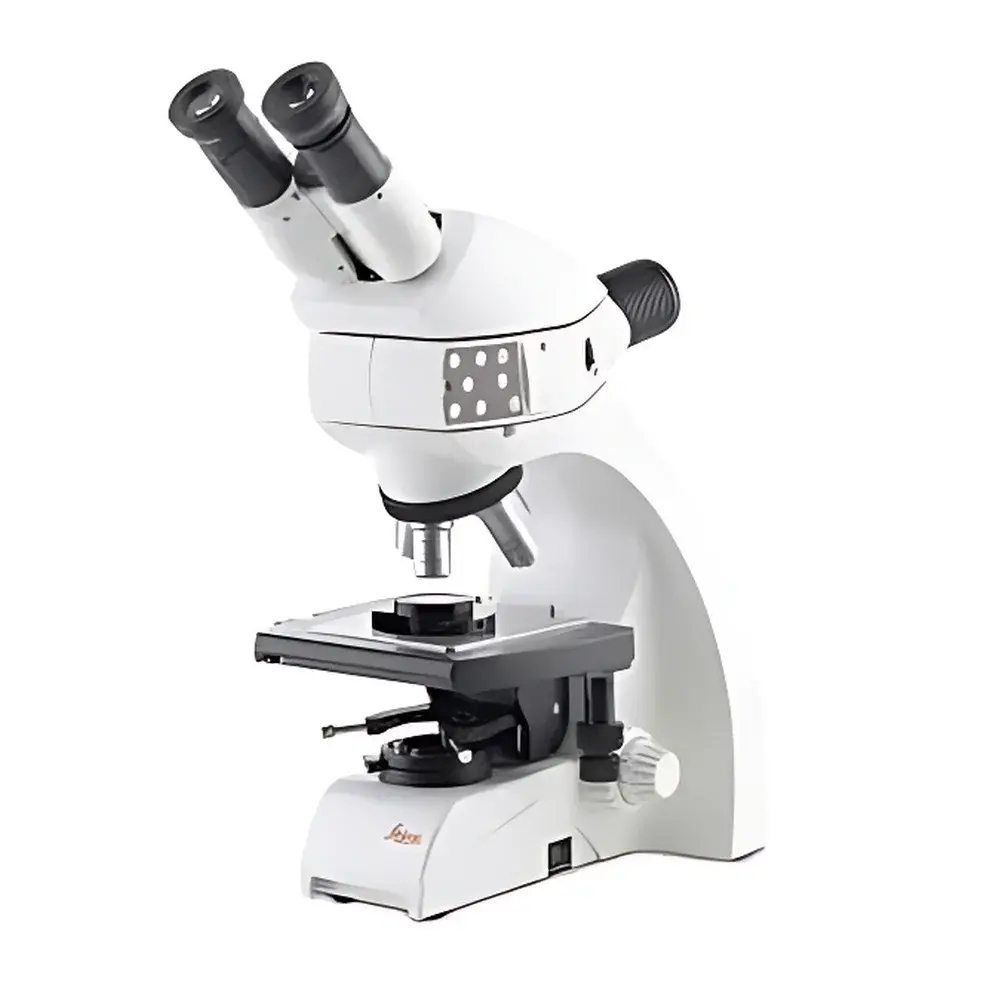
Leica DM750 M Upright Metallurgical Microscope
| Brand | Leica |
|---|---|
| Origin | Germany |
| Model | DM750 M |
| Configuration | Upright |
| Total Magnification | 1000× |
| Eyepiece | 10× |
| Objective | 100× |
| Illumination | LED Reflected Light (Brightfield, Polarized, Oblique) |
| Stage | Universal Mechanical Stage (Compatible with Transmitted & Reflected Light) |
| Image Analysis System | Integrated |
| Objective Turret | 4- or 5-Position |
| LED Lifetime | >20,000 hours |
Overview
The Leica DM750 M is a precision-engineered upright metallurgical microscope designed for routine and advanced materials characterization in industrial quality control laboratories, academic metallurgy departments, and R&D facilities. It operates on the principle of reflected light microscopy—optimized for opaque, polished, or coated specimens where transmitted illumination is not feasible. Its optical path integrates high-NA achromatic and semi-apochromatic objectives with parfocal, parcentric alignment to ensure consistent focus and field centering across magnifications. The system complies with ISO 9001 manufacturing standards and is calibrated per Leica’s internal metrology protocols traceable to national standards. Designed for long-term operational stability, the DM750 M features a rigid cast-metal stand with vibration-damped base and thermal-stable optical housing—critical for maintaining focus fidelity during extended imaging sessions or automated image acquisition workflows.
Key Features
- Universal mechanical stage with dual-mode capability: fully compatible with both reflected-light (metallurgical) and transmitted-light (optional condenser upgrade) observation modes
- Dedicated LED-based reflected-light illumination unit delivering stable, flicker-free white light (6,000 K CCT) with >20,000-hour rated lifetime—eliminating mercury lamp replacement cycles and associated calibration drift
- Four- or five-position objective turret supporting Leica’s full range of metallurgical objectives (5×, 10×, 20×, 50×, 100×), enabling total magnifications from 50× to 1000× with 10× wide-field eyepieces
- Integrated aperture and field diaphragm controls within the illumination path, allowing precise Köhler illumination setup for optimal contrast and resolution in brightfield, polarized, and oblique illumination modes
- Ergonomic modular observation tubes: available in monocular, binocular, trinocular, and inclined (30°) configurations; all support 20 mm field-of-view 10× eyepieces and optional reticle integration
- Sample handling flexibility: accommodates specimens up to 30 mm in diameter via interchangeable specimen clamps; stage travel range: 76 × 52 mm (X–Y)
Sample Compatibility & Compliance
The DM750 M is optimized for metallographic, ceramic, semiconductor, and composite specimens requiring surface topography, grain structure, phase distribution, inclusion analysis, or coating thickness evaluation. Its robust stage design supports standardized sample mounts (e.g., 25 mm and 30 mm metallographic discs) and enables repeatable positioning for comparative analysis across batches. The system meets requirements for ASTM E3, ASTM E112, ISO 643, and EN 10360-2 for microstructural evaluation. When configured with Leica’s certified digital camera modules and compliant software, it supports audit-ready documentation per GLP and GMP environments—including timestamped metadata embedding, user access logs, and electronic signature readiness aligned with FDA 21 CFR Part 11 principles.
Software & Data Management
The microscope integrates seamlessly with Leica Application Suite (LAS) X Core—a modular, CE-IVD and FDA-cleared imaging platform supporting real-time image capture, measurement (length, area, particle count, grain size per ASTM E112), annotation, and report generation. LAS X Core provides DICOM export, multi-layer Z-stack acquisition, and batch-processing pipelines for standardized QC workflows. All image data are stored with embedded EXIF metadata (objective ID, magnification, illumination mode, exposure time, user ID), ensuring full traceability. Optional LAS X Security Pack enables role-based permissions, audit trail logging, and electronic signature validation—essential for regulated industries including aerospace, medical device manufacturing, and automotive component certification.
Applications
- Metallographic analysis: grain size quantification, phase identification, porosity assessment, and heat-affected zone (HAZ) evaluation in welds and castings
- Failure analysis: crack propagation mapping, fatigue striation measurement, and inclusion classification per ASTM E45
- Coating & surface treatment verification: thickness uniformity, delamination detection, and interface integrity in PVD/CVD layers
- Quality assurance in additive manufacturing: powder morphology screening (with optional transmitted-light add-on), build layer inspection, and defect localization
- Forensic materials examination: toolmark comparison, fracture surface characterization, and counterfeit material differentiation
FAQ
Is the DM750 M suitable for both brightfield and polarized light imaging?
Yes—the integrated LED illuminator includes a rotatable polarizer and analyzer module, enabling quantitative birefringence analysis without external accessories.
Can I upgrade the system for transmitted-light applications?
Yes—by adding the Leica TL condenser module and halogen/LED transmitted-light source, the DM750 M can be converted into a hybrid metallurgical/biological configuration.
Does the microscope support motorized stage or autofocus?
The base DM750 M model features manual stage control; however, Leica offers factory-integrated motorized XY stages and hardware-based focus sensors as configurable options for automated tile scanning and Z-stack acquisition.
What camera interfaces are supported?
The trinocular port accepts C-mount and F-mount digital cameras; native compatibility is guaranteed with Leica DMC series (e.g., DMC 5400, DFC 7000 T) delivering 5.0 MP to 20.1 MP resolution and USB 3.0/10GigE connectivity.
Is service and calibration documentation provided?
Each instrument ships with a Factory Calibration Certificate, ISO/IEC 17025-accredited traceability statement, and Leica’s 2-year global warranty covering optics, mechanics, and electronics—extendable to 5 years under service agreement.