
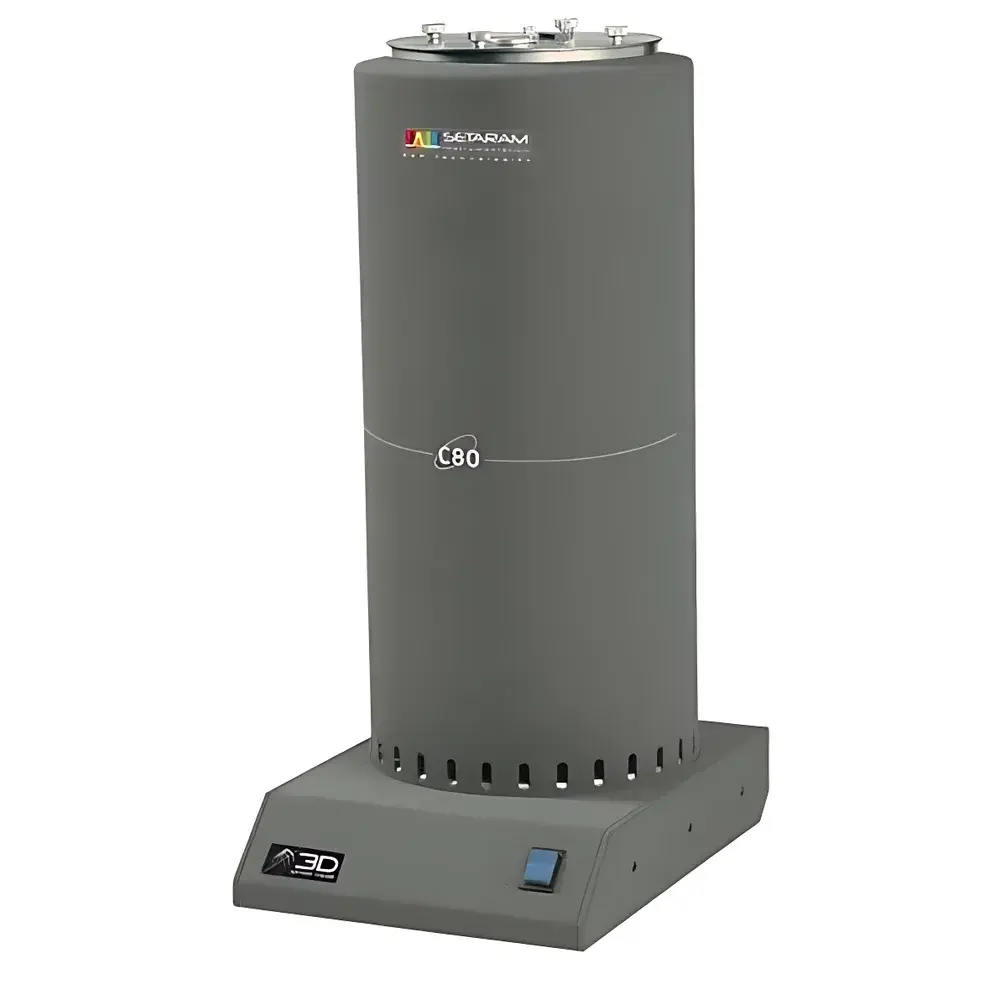
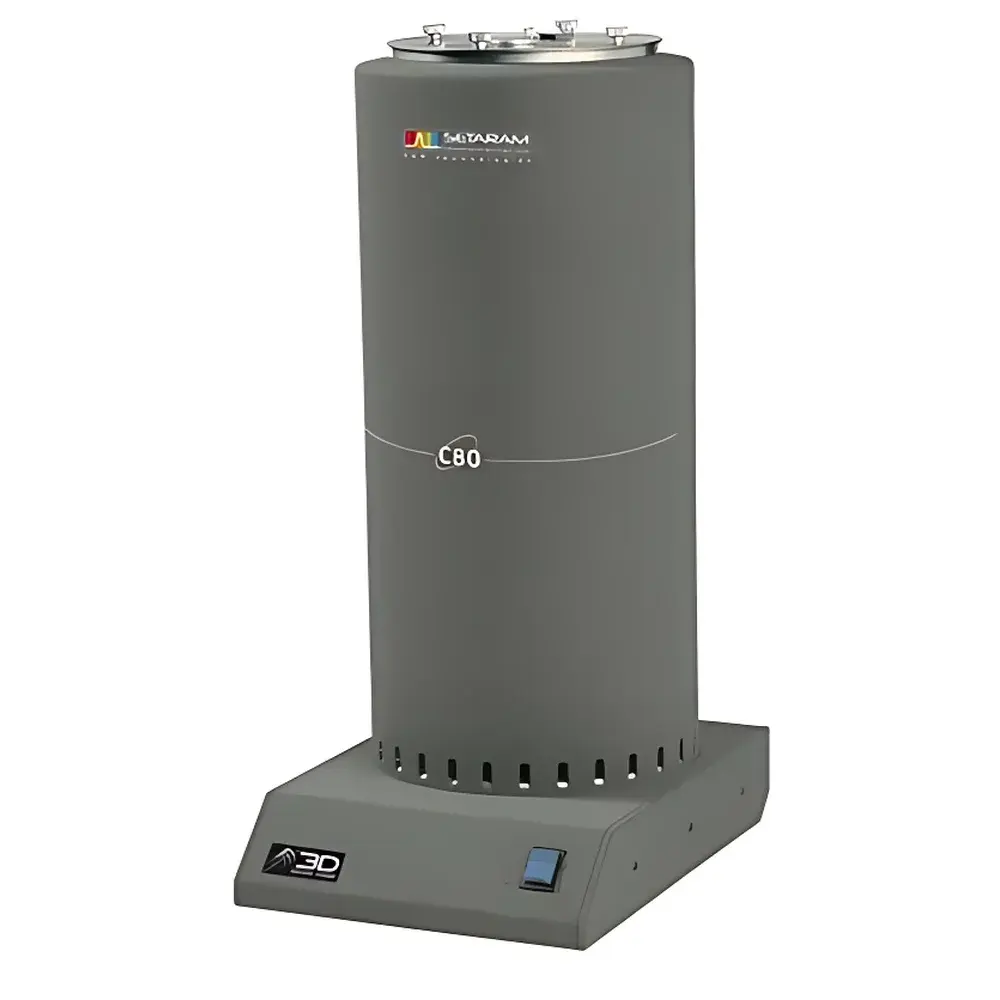

Setaram C80 High-Sensitivity Calvet-Type Microcalorimeter
| Brand | Setaram |
|---|---|
| Origin | France |
| Model | C80 |
| Temperature Range | Ambient to 300 °C |
| Temperature Accuracy | ±0.1 °C |
| Temperature Precision | ±0.05 °C |
| Heating/Cooling Rate | 0.001–2 K/min |
| Enthalpy Accuracy | ±1% |
| Calorimetric Precision | ±0.1% |
| Heat Flow Resolution | 0.10 µW |
| Maximum Sample Volume | 12.5 mL |
| Pressure Rating | Up to 1000 bar |
| Sensor Type | 3D Calvet Thermopile Array |
| Sample Cell Materials | Stainless Steel, Hastelloy C, or Custom Alloys |
| Cell Types | Ampoule, Flip-Mix, Membrane-Mix, Fluid Circulation, Liquid Heat Capacity, Vacuum, Adsorption, High-Pressure Pressure-Monitoring, and Safety Cells |
Overview
The Setaram C80 is a high-sensitivity, Calvet-type microcalorimeter engineered for quantitative thermodynamic and kinetic characterization of physical and chemical processes under controlled temperature and pressure conditions. Unlike conventional differential scanning calorimeters (DSC), which rely on symmetric twin-furnace configurations and limited sample geometry, the C80 implements a true three-dimensional thermopile sensor array based on the Calvet principle—ensuring near-complete capture of heat flow from all spatial directions. This architecture delivers exceptional signal-to-noise ratio, baseline stability, and absolute enthalpy accuracy, making it suitable for both low-energy transitions (e.g., protein folding, polymer crystallization) and high-power exothermic reactions (e.g., catalytic oxidation, cement hydration, energetic material decomposition).
Key Features
- Calvet 3D-sensor technology with isotropic heat flux detection, minimizing thermal lag and positional artifacts inherent in planar DSC systems
- Dual operational modes: isothermal titration and dynamic temperature scanning, each supporting programmable ramp/hold profiles with sub-millikelvin thermal stability
- Modular cell platform accommodating up to 12.5 mL sample volume—enabling representative-scale testing for process-relevant kinetics and safety evaluation
- Pressure-rated cells certified to 1000 bar, integrated with real-time pressure transducers compliant with ISO 17025 traceability requirements
- Dedicated safety cell configuration featuring simultaneous precise reagent dosing, mechanical mixing, and in situ pressure monitoring—designed for UN GHS Test Series H.1–H.4 and ASTM E1981 process hazard analysis
- Cell materials include ASTM B575 Grade C Hastelloy and electropolished 316L stainless steel, ensuring compatibility with corrosive media (e.g., CO₂-saturated amines, nitric acid-based propellants)
- Thermal control precision of ±0.05 °C and enthalpy accuracy of ±1% validated per ISO 11357-1 and USP <1163> guidelines
Sample Compatibility & Compliance
The C80 supports heterogeneous sample forms—including powders, gels, slurries, viscous liquids, and solid composites—without requiring pelletization or dilution. Its large-volume cell design eliminates mass-transfer limitations common in micro-DSC systems, enabling direct measurement of reaction enthalpies in industrially relevant concentrations. All standard cells comply with GLP documentation standards, including full audit trails for temperature setpoints, pressure logs, and dosing events. Optional configurations meet FDA 21 CFR Part 11 requirements for electronic records and signatures when paired with Setaram’s TCS software. The instrument has been deployed in laboratories accredited to ISO/IEC 17025 for calorimetric determination of heat of combustion (ASTM D240), hydration enthalpy (ASTM C1679), and thermal stability of pharmaceutical intermediates (ICH Q1A–Q5C).
Software & Data Management
Controlled via Setaram’s TCS (Thermal Control Software) v5.x, the C80 provides synchronized acquisition of heat flow, temperature, pressure, and dosing volume data at 10 Hz resolution. Raw signals are stored in HDF5 format with embedded metadata (operator ID, calibration certificate ID, cell serial number). Batch processing supports automated peak integration using tangent-onset and extrapolated onset algorithms per ISO 11357-2. Export modules generate ASTM E698-compliant kinetic reports (activation energy, reaction order) and support integration with third-party platforms including MATLAB, Python (via PySetaram API), and LIMS systems via OPC UA. All audit trails are time-stamped, digitally signed, and immutable—fully satisfying ALCOA+ principles for regulated environments.
Applications
- Catalysis research: Quantification of adsorption/desorption enthalpies, reaction heats in fixed-bed and slurry-phase reactors
- Cement and concrete science: Real-time monitoring of hydration kinetics, sulfate attack mechanisms, and admixture compatibility
- Carbon capture & storage: Thermodynamics of CO₂ absorption in aqueous amine solutions and solid sorbents under elevated partial pressures
- Energetic materials: Adiabatic time-to-explosion modeling, compatibility screening of propellant formulations, and thermal runaway threshold mapping per BAM test methods
- Pharmaceutical development: Polymorph transition energetics, excipient–API interaction screening, and lyophilization cycle optimization
- Hydrogen storage: Enthalpy of hydride formation/decomposition in metal–organic frameworks and complex hydrides at variable H₂ pressures
- Geochemical modeling: Clay mineral–water interaction enthalpies and dissolution thermodynamics under reservoir-relevant T–P conditions
FAQ
What distinguishes the Calvet 3D-sensor from conventional DSC sensors?
The Calvet sensor surrounds the sample cell with concentric thermopile rings, capturing >95% of emitted heat regardless of direction—unlike DSC’s differential heat-flux measurement across a single plane, which introduces systematic errors in asymmetric or multi-phase reactions.
Can the C80 perform isothermal titration calorimetry (ITC)?
Yes—using the flip-mix or membrane-mix cell, the C80 executes precise, automated reagent injections with real-time heat integration, delivering binding constants and stoichiometry comparable to dedicated ITC instruments but with extended concentration and temperature ranges.
Is pressure calibration traceable to national standards?
All pressure transducers are factory-calibrated against NIST-traceable deadweight testers, with certificates issued per ISO/IEC 17025 and included in the instrument’s validation package.
How is data integrity ensured during long-duration isothermal runs (e.g., 72+ hours)?
TCS implements cyclic memory buffering, redundant power-fail recovery, and automatic baseline drift correction using reference-cell referencing—validated in interlaboratory studies for cement hydration monitoring per RILEM TC 262-SCI protocols.
Are custom cell geometries available for proprietary reactor designs?
Setaram offers OEM cell engineering services, including finite-element thermal modeling, ASME Section VIII Div. 2 pressure vessel certification, and integration with external gas/liquid delivery systems via standardized Swagelok interfaces.



