
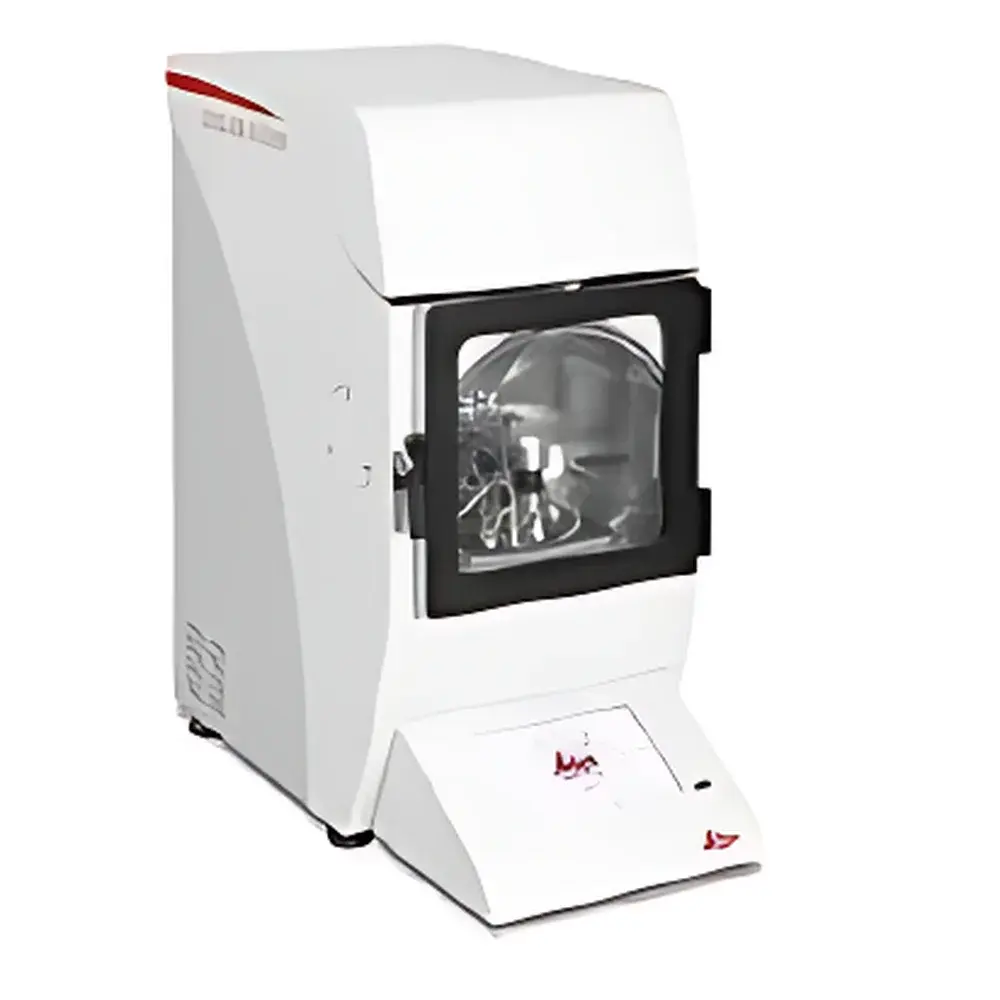
Leica EM ACE600 High-Vacuum Coating System
| Brand | Leica |
|---|---|
| Origin | Austria |
| Model | EM ACE600 |
| Vacuum Level | 2 × 10⁻⁶ mbar |
| Pumping System | Diaphragm Pump + Turbo Molecular Pump (Oil-Free) |
| Thickness Control | Quartz Crystal Monitor (Resolution: 0.1 nm) |
| Sputtering Current Range | 0–150 mA |
| Chamber Dimensions | 200 mm (W) × 150 mm (D) × 195 mm (H) |
| Sample Stage | Motorized Rotation + Adjustable Working Distance (30–100 mm) |
| Coating Modes | Ion Sputtering, Carbon Filament Evaporation, Carbon Rod (Resistive) Evaporation, Electron Beam Evaporation, Dual-Source Configurations (e.g., Sputter + E-beam), Glow Discharge (Optional) |
| Compatibility | EM VCT100 Cryo-Transfer System |
Overview
The Leica EM ACE600 is a high-vacuum, multi-mode coating system engineered for precision sample preparation in electron microscopy laboratories. It operates on a robust oil-free vacuum architecture—comprising a diaphragm pre-pump and a turbo molecular pump—to achieve a base pressure of 2 × 10⁻⁶ mbar, essential for minimizing hydrocarbon contamination and ensuring ultra-thin, pinhole-free conductive layers. Unlike conventional low-vacuum sputter coaters, the EM ACE600 supports multiple physical vapor deposition (PVD) techniques—including argon ion sputtering, resistive carbon filament evaporation, carbon rod (thermal resistance) evaporation, and high-resolution electron beam evaporation—enabling tailored coating strategies for diverse imaging and analytical requirements. Its design adheres to fundamental principles of thin-film physics: precise kinetic energy control during sputtering, thermal gradient management during evaporation, and real-time mass-thickness monitoring via quartz crystal microbalance (QCM) technology. This enables reproducible sub-nanometer thickness control critical for high-magnification FESEM imaging, EDS/WDS quantification, TEM grid support film fabrication, and cryo-EM specimen stabilization.
Key Features
- Oil-free high-vacuum system with integrated diaphragm and turbo molecular pumps, eliminating oil backstreaming and ensuring clean deposition environments.
- Quartz crystal thickness monitor with 0.1 nm resolution, providing real-time feedback and closed-loop thickness control across all coating modes.
- Modular source configuration supporting up to ten distinct operational modes: single-source sputtering, carbon filament evaporation, carbon rod evaporation, electron beam evaporation, dual sputter, sputter-carbon filament, sputter-carbon rod, sputter-electron beam, dual electron beam, and optional glow discharge for grid hydrophilization.
- Patented pulsed carbon filament evaporation technology, delivering superior uniformity and reduced thermal stress compared to continuous evaporation methods.
- Intuitive 7-inch capacitive touchscreen interface with pre-programmed, customizable coating protocols and full audit trail logging compliant with GLP/GMP documentation standards.
- Rectangular chamber (200 × 150 × 195 mm) optimized for spatial uniformity and accommodates standard SEM stubs, TEM grids, and multi-well specimen carriers.
- Motorized rotating sample stage with adjustable working distance (30–100 mm), enabling consistent angular coverage and optimal shadowing control.
Sample Compatibility & Compliance
The EM ACE600 is validated for use with a broad spectrum of electron microscopy samples, including biological tissues, polymers, ceramics, metals, and cryo-preserved specimens. Its compatibility with the Leica EM VCT100 cryo-transfer system allows seamless integration into cryo-EM workflows, where carbon films must be deposited under contamination-free conditions prior to vitrified sample transfer. All coating processes meet ISO 14644-1 Class 5 cleanroom air equivalency when operated in controlled laboratory environments. The system supports compliance with ASTM E1558 (standard guide for preparing metallographic specimens), ISO/IEC 17025 (for accredited testing labs), and FDA 21 CFR Part 11 requirements when configured with electronic signature and audit trail functionality.
Software & Data Management
Control firmware features a deterministic real-time operating system that ensures repeatable sequence execution—vacuum ramping, plasma ignition, source activation, thickness termination, and venting—all fully automated. Each run generates a timestamped log file containing vacuum profile data, current/voltage traces, QCM frequency shift curves, and user authentication metadata. Export formats include CSV and XML for integration with LIMS platforms. Remote monitoring via Ethernet (TCP/IP) is supported, allowing centralized lab management without compromising local security protocols.
Applications
- High-resolution FESEM imaging: Ultra-thin gold/palladium or platinum/iridium coatings (≤2 nm) for charge dissipation without edge artifacts.
- EDS/WDS analysis: Continuous carbon films (5–15 nm) deposited via e-beam or carbon filament evaporation to minimize X-ray absorption and enhance spectral fidelity.
- TEM specimen support: Uniform amorphous carbon films on copper grids for lattice-resolution imaging and electron tomography.
- Cryo-EM grid preparation: Glow discharge activation followed by carbon evaporation under high vacuum to improve ice layer adhesion and reduce preferred orientation.
- DNA shadowing and replica preparation: Electron beam-deposited platinum/carbon bilayers for high-contrast topographic contrast at molecular scale.
FAQ
What vacuum level does the EM ACE600 achieve, and why is it critical for high-resolution EM coating?
The system reaches a base pressure of 2 × 10⁻⁶ mbar using an oil-free turbomolecular pumping stack. This eliminates hydrocarbon contamination that causes charging artifacts and reduces signal-to-noise ratio in FESEM and TEM.
Can the EM ACE600 deposit both metal and carbon films on the same sample without breaking vacuum?
Yes—dual-source configurations (e.g., sputter + e-beam) allow sequential metal and carbon deposition within a single vacuum cycle, minimizing contamination risk and improving workflow efficiency.
Is the quartz crystal monitor calibrated traceably to NIST standards?
The QCM sensor is factory-calibrated against certified reference materials; users may perform in-situ recalibration using certified thickness standards per ASTM E1447.
Does the system support automated method validation for regulated environments?
When equipped with optional software modules, the EM ACE600 provides IQ/OQ documentation templates, electronic signatures, and 21 CFR Part 11-compliant audit trails for pharmaceutical and clinical research labs.




