
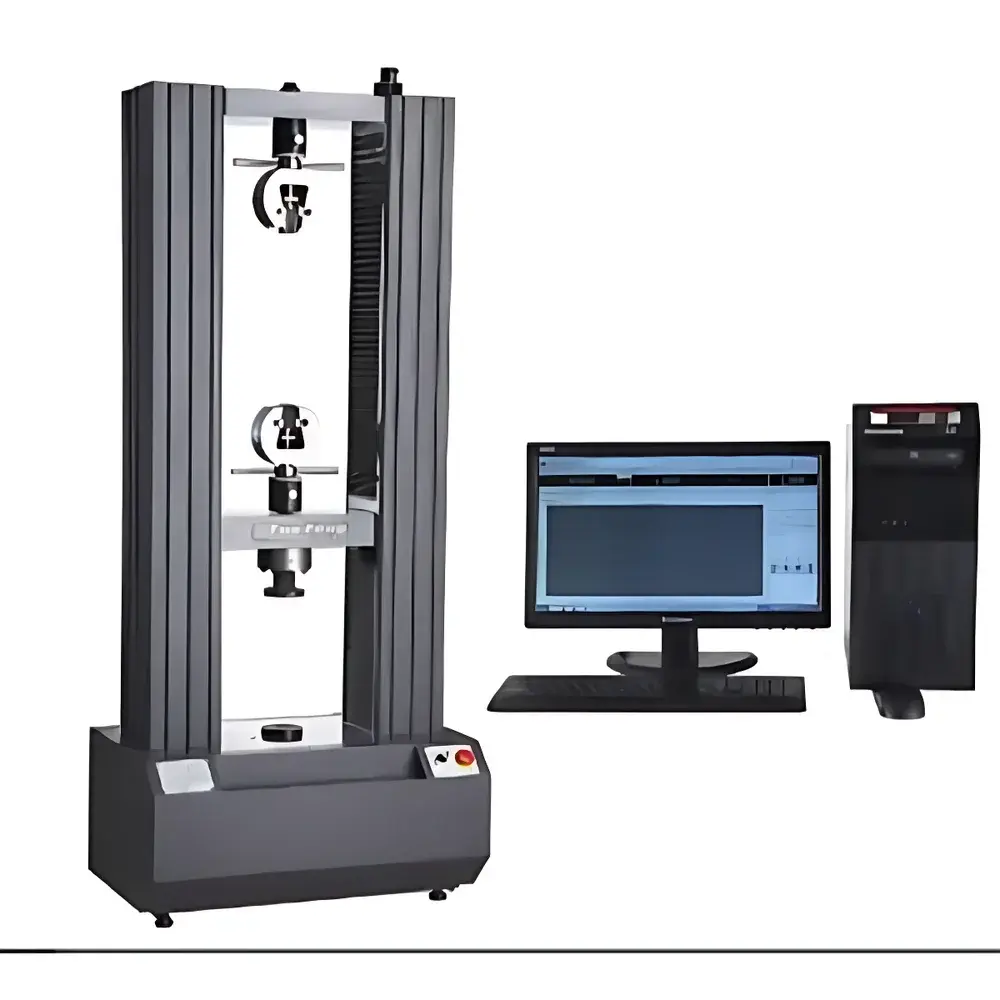
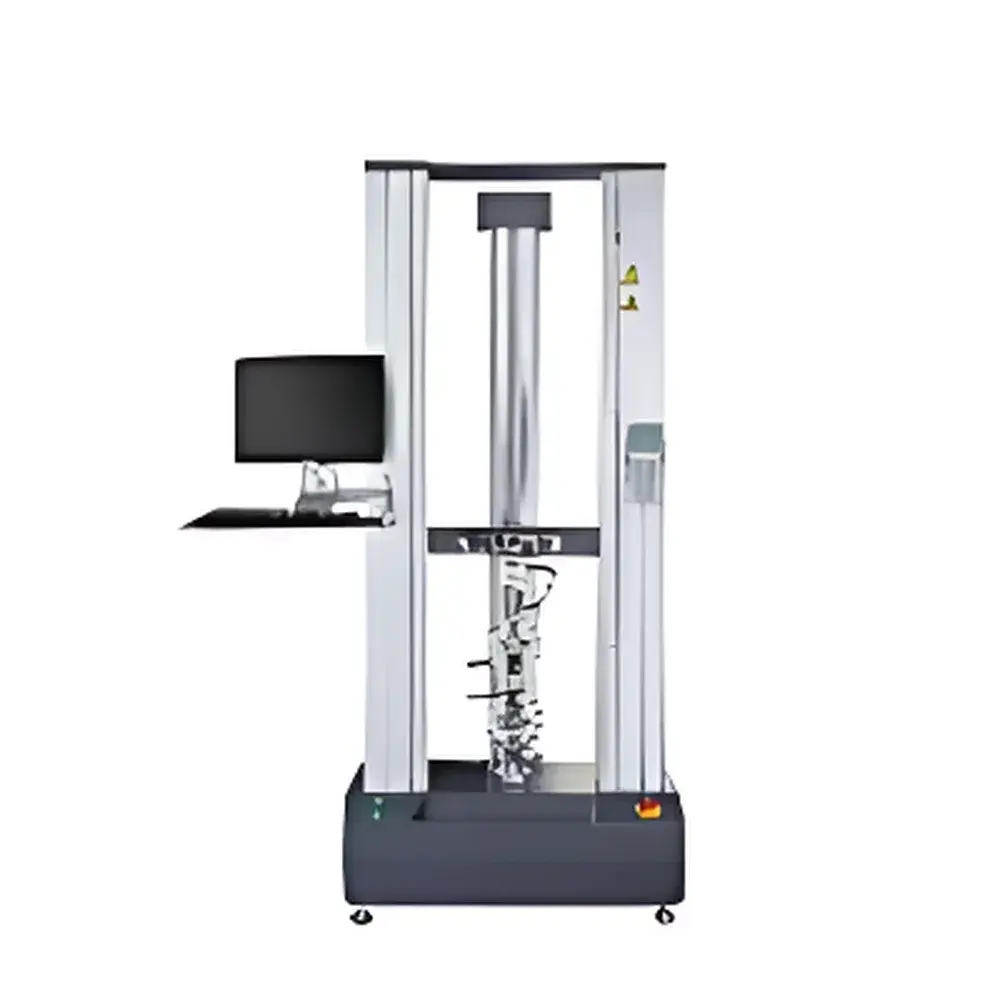
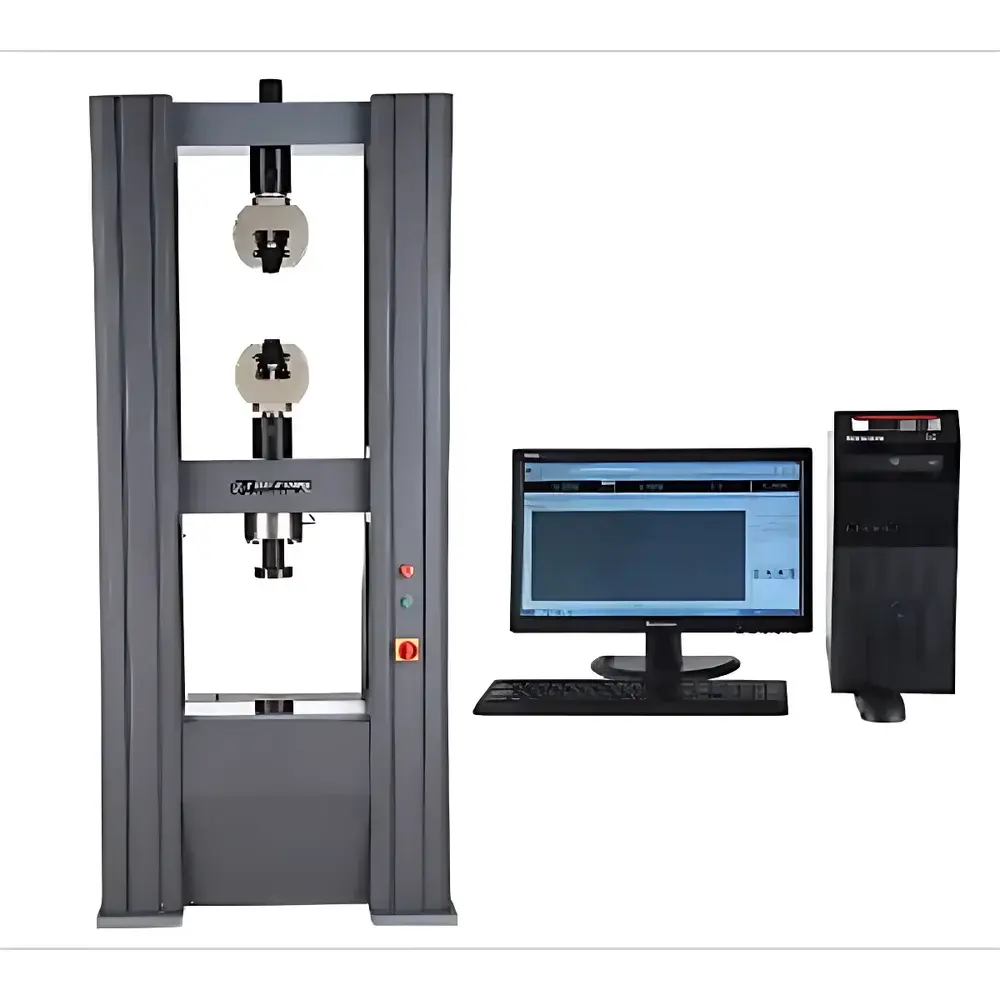
Tuofeng TFW-264 Steel Strand Oblique Tensile Testing Machine
| Brand | Tuofeng |
|---|---|
| Origin | Shanghai, China |
| Manufacturer Type | Direct Manufacturer |
| Equipment Type | Electromechanical Universal Testing Machine |
| Model | TFW-264 |
| Force Capacity | 200 kN |
| Accuracy Class | 0.5 |
| Effective Force Range | 0.2%–100% of Full Scale |
| Load Measurement Accuracy | ±0.005% of Reading |
| Force Resolution | 1 part in ±500,000 full-scale codes (single-range, no switching) |
| Drive System | Imported Servo Motor with Worm Gear Reducer |
| Lead Screw | High-Precision Ball Screw |
| Effective Test Width | 600 mm (customizable) |
| Max Stroke | 800 mm (height-adjustable) |
| Speed Range | 0.001–500 mm/min (infinitely variable) |
| Displacement Measurement | Optical Encoder |
| Displacement Accuracy | ±0.005% of Reading |
| Strain Measurement | Optional Extensometer or Large-Deformation Clip Gauge |
| Strain Accuracy | ±0.005% of Reading |
| Safety Protection | Electronic Limit Switches, Emergency Stop Button, Overload Protection (10% above rated capacity) |
| Crosshead Control | Dual-Speed (Fast/Slow) Motorized Adjustment with Manual Point-to-Point Positioning |
| Return Function | Automatic or Manual High-Speed Return to Initial Position |
| Grips | Custom-Fabricated for Steel Strand Geometry and Surface Finish |
| Power Supply | 220 V AC, 3.0 kW |
| Dimensions (W×D×H) | 1100 × 900 × 2600 mm |
| Net Weight | ~1500 kg |
| Compliance | GB/T 16491–2008, JJG 475–2008, ASTM E4, ASTM E8, ISO 6892-1, ISO 15630-2, EN 10002-1, JIS Z 2241 |
Overview
The Tuofeng TFW-264 Steel Strand Oblique Tensile Testing Machine is a high-precision electromechanical universal testing system engineered specifically for the mechanical characterization of prestressed steel strands under non-axial (oblique) loading conditions. Unlike conventional axial tensile testers, this machine integrates angular fixture alignment capability—enabling controlled deviation of the load application axis relative to the strand’s longitudinal centerline—to replicate real-world installation stresses encountered in post-tensioned concrete structures, bridge cable systems, and geotechnical anchorage applications. Its core measurement architecture adheres to the Couette-type force transduction principle, where load is measured via a calibrated strain-gauge-based load cell mounted in-line with the actuator train, ensuring traceable static and dynamic force fidelity per ISO/IEC 17025 metrological requirements. The rigid C-frame construction, reinforced crosshead guidance, and zero-backlash ball-screw transmission deliver sub-micron positional stability during ramp-and-hold protocols—critical for evaluating time-dependent phenomena such as stress relaxation and creep compliance in high-strength steel alloys.
Key Features
- Oblique-load configuration support: Adjustable angular fixtures (±5° to ±15° relative to vertical axis) with precision angular indexing and locking mechanisms to maintain consistent off-axis geometry across repeated tests.
- 0.5-class accuracy certified per GB/T 16491–2008 and validated against ASTM E4 reference standards; full-scale resolution of 1:500,000 ensures reliable detection of micro-yield onset in 1860 MPa-grade strands.
- Dual-mode displacement control: High-resolution optical encoder (±0.005% reading accuracy) coupled with optional clip-on extensometers (capable of measuring 0.1%–100% strain) for simultaneous axial and lateral deformation monitoring.
- Multi-stage safety architecture: Hardware-level electronic limit switches, redundant emergency stop circuitry, and software-enforced overload cutoff at 110% of rated capacity (220 kN) prevent mechanical damage during catastrophic failure events.
- Thermally stable frame design: Cast-iron base and reinforced steel columns minimize thermal drift during extended-duration tests (>24 h), supporting long-term relaxation studies compliant with ASTM A1038 and EN 10138-3.
- Modular grip interface: Quick-change adapter plates accommodate standard wedge-type grips, hydraulic self-tightening clamps, and custom-designed multi-point contact jaws optimized for 7-wire parallel-strand geometries (e.g., Ø12.7 mm, Ø15.2 mm).
Sample Compatibility & Compliance
The TFW-264 accommodates steel strands conforming to ASTM A416/A416M (low-relaxation 7-wire strand), EN 10138-3 (prestressing steels), GB/T 5224 (Chinese national standard for prestressed concrete steel wires and strands), and JIS G3536. It supports test specimen lengths up to 2,500 mm and diameters from 9.3 mm to 15.7 mm. All test routines—including oblique tensile strength, yield load at 0.1% offset, elastic modulus, elongation at break, and relaxation ratio after 1,000 hours—are executable within a single platform while maintaining full auditability. The system meets GLP-compliant data integrity requirements: electronic signatures, user access levels (admin/operator/auditor), and immutable audit trails are embedded in firmware. Calibration certificates are NIST-traceable and include uncertainty budgets per ISO/IEC 17025 Annex A.5.
Software & Data Management
TuofengTest v5.2 software operates natively on Windows 10/11 (64-bit) and supports multilingual UI (English, Simplified Chinese, Traditional Chinese). It implements FDA 21 CFR Part 11–compliant electronic records functionality, including role-based permissions, biometric or token-based login, and tamper-evident audit logs for all test parameter modifications, result exports, and calibration events. Real-time plotting includes synchronized force–displacement, stress–strain, and time–relaxation curves. Users may define custom test sequences—e.g., preload → hold → oblique ramp → unloading → recovery—and export ASCII, CSV, or XML datasets compatible with MATLAB, Python (pandas), and LIMS integration via OPC UA. Raw data files retain metadata tags (operator ID, environmental temperature/humidity, calibration date, fixture ID), enabling full traceability through ISO 17025 Clause 7.7.
Applications
- Validation of oblique tensile performance for post-tensioning anchorages in precast concrete segmental bridges per AASHTO LRFD Bridge Design Specifications.
- Relaxation behavior assessment of galvanized and epoxy-coated strands under sustained loads at elevated temperatures (up to 60°C), aligned with EN 10138-3 Annex B.
- Interfacial bond strength evaluation between strand and grout in duct-injected systems using modified pull-out fixtures.
- Quality assurance testing for strand manufacturers seeking ISO 9001:2015 certification and third-party type approval (e.g., PCI, DIBt).
- Research into torsional–tensile coupling effects in stranded configurations, supported by optional torque sensor add-ons and synchronized data acquisition.
- Failure mode analysis (necking, wire slippage, interfacial debonding) via high-speed imaging synchronization (via TTL trigger output).
FAQ
Does the TFW-264 support fully automated oblique angle adjustment during testing?
No—angular alignment is manually set and mechanically locked prior to test initiation to ensure geometric repeatability and eliminate dynamic misalignment artifacts.
Can the system perform relaxation tests exceeding 1,000 hours without operator intervention?
Yes—when configured with uninterruptible power supply (UPS), environmental chamber integration, and remote monitoring via Ethernet, the machine executes unattended long-term relaxation protocols with periodic auto-sampling and data backup.
Is ASTM E349-compliant wedge grip calibration included in the standard package?
Yes—each unit ships with NIST-traceable calibration documentation for both load cell and displacement transducers, plus a separate certificate verifying wedge grip parallelism and clamping force uniformity per ASTM E349 Annex A2.
What is the maximum allowable ambient temperature for continuous operation?
The system is rated for continuous duty at ambient temperatures from 10°C to 40°C and relative humidity ≤80% non-condensing, per IEC 61000-6-2 EMC immunity specifications.
Are software updates provided free of charge for the lifetime of the instrument?
Yes—registered users receive all major and minor software releases, security patches, and regulatory compliance updates (e.g., new 21 CFR Part 11 features) at no additional cost under the Tuofeng Lifetime Support Agreement.



