
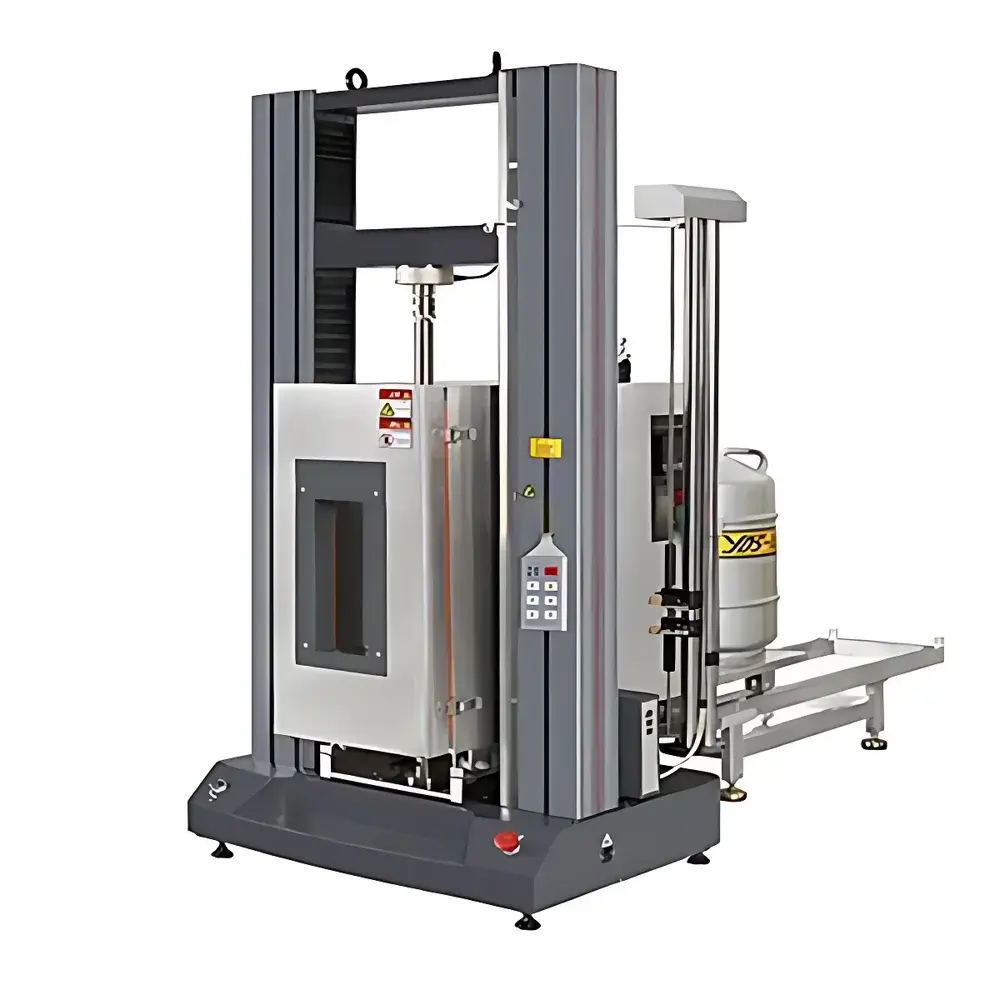
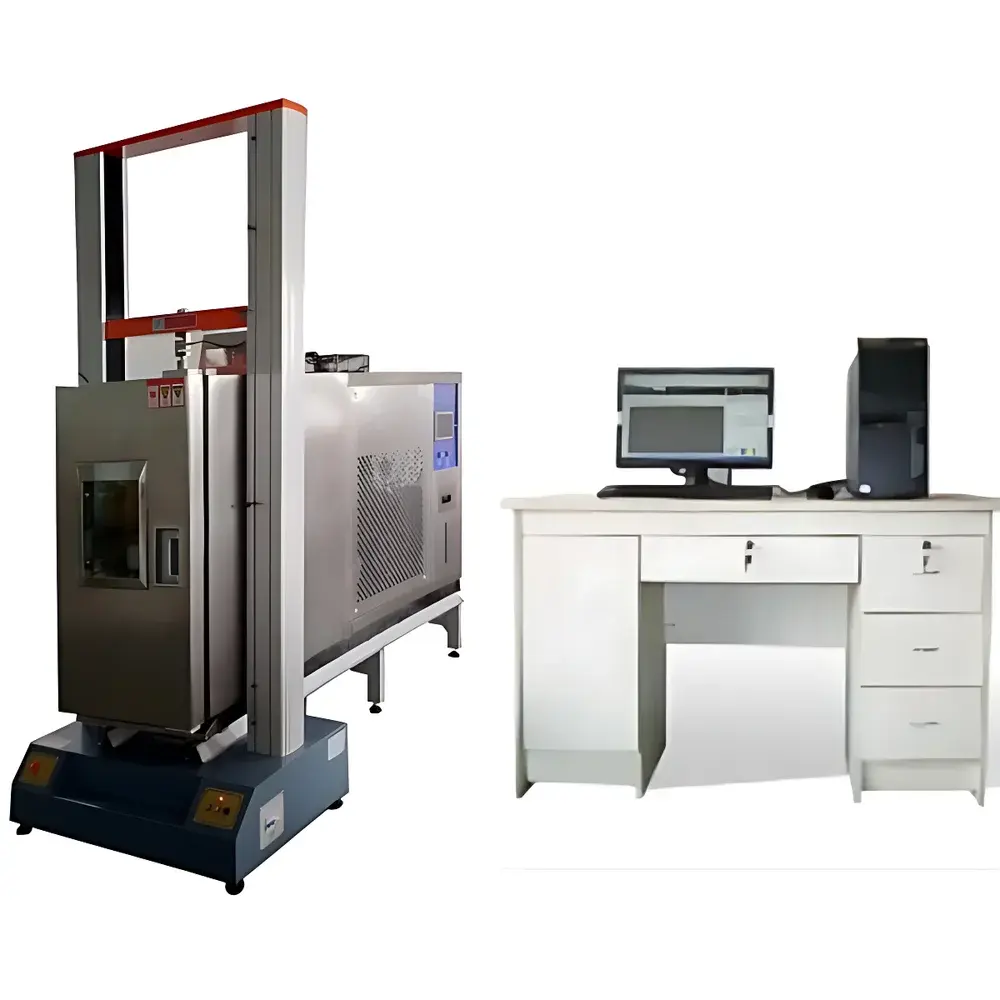
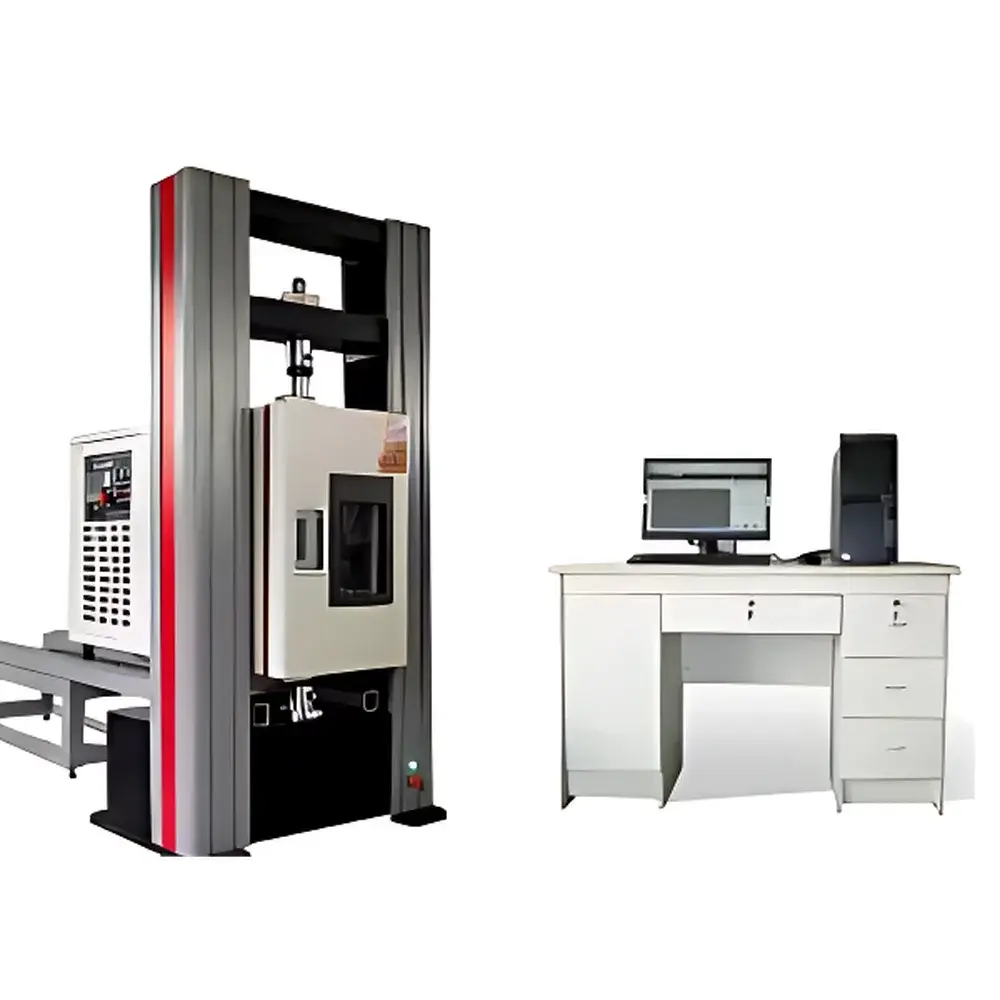
Tuofeng TFW-171 High-Low Temperature Universal Testing Machine
| Brand | Tuofeng |
|---|---|
| Origin | Shanghai, China |
| Manufacturer Type | Direct Manufacturer |
| Country of Origin | China |
| Model | TFW-171 |
| Instrument Type | Electromechanical Universal Testing Machine |
| Max Test Load | 5–100 kN (configurable) |
| Accuracy Class | 0.5 |
| Force Measurement Range | 0.4–100% FS |
| Force Indication Error | ±0.5% of reading |
| Force Resolution | 1/500,000 of full scale, unbroken range |
| Deformation Measurement Range | 0.2–100% FS |
| Deformation Error | ±0.5% of reading |
| Deformation Resolution | up to 1/300,000 |
| Displacement Error | ±0.5% of reading |
| Column Spacing | 840 mm |
| Crosshead Travel (standard) | 1000 mm |
| Host Dimensions | 1250 × 560 × 2400 mm (W×D×H) |
| Power Supply | AC 220 V / 50 Hz ±10%, 750 W |
| Host Weight | ~380 kg |
| Environmental Chamber Temp Range | −40 °C to +100 °C |
| Chamber Heating Power | 1.5 kW |
| Chamber Internal Dimensions | 360 × 300 × 500 mm (W×D×H) |
| Chamber Control | Programmable PID with Pt100 sensors |
| Temp Uniformity | ±2 °C over 100 mm vertical zone |
| Temp Stabilization Time | ≤5 min (both above/below 0 °C) |
| Chamber Construction | 304 stainless steel exterior, 316 mirror-finish interior, ceramic fiber insulation |
| Safety | Leakage current protection, overcurrent circuit breaker |
Overview
The Tuofeng TFW-171 High-Low Temperature Universal Testing Machine is an electromechanical materials testing system engineered for precision mechanical property evaluation under controlled thermal conditions. It integrates a high-stiffness dual-column universal testing frame with a programmable environmental chamber capable of stable operation from −40 °C to +100 °C. The system operates on the principle of servo-controlled load application and displacement measurement, compliant with fundamental mechanics-of-materials test methodologies including uniaxial tension, compression, flexure, peel, tear, and shear. Its modular architecture allows seamless transition between ambient and conditioned testing without hardware reconfiguration. Designed to meet the metrological requirements of ISO 7500-1, ASTM E4, and GB/T 16491, the TFW-171 delivers traceable force measurement accuracy to Class 0.5 per ISO 376 — ensuring suitability for R&D validation, quality control release, and regulatory submission workflows in regulated industries.
Key Features
- Electromechanical actuation with closed-loop digital servo control, enabling precise strain-rate and load-rate programming per ISO 6892-1 and ASTM D638.
- Force transducer resolution of 1 part in 500,000 of full scale, maintained across the entire measurement range without range switching — eliminating step errors during dynamic loading.
- High-resolution extensometry support: deformation resolution up to 1/300,000 FS, validated against ISO 9513 criteria for Class 1 extensometers.
- Integrated environmental chamber featuring dual-zone temperature control (heating via NiCr alloy elements; cooling via compressor-based refrigeration), with real-time monitoring via dual Pt100 sensors positioned at top and bottom of test zone.
- Thermal chamber uniformity certified to ±2 °C over a 100 mm vertical measurement zone — verified per ASTM E2203 and IEC 60068-3-5.
- Structural rigidity optimized for minimal frame deflection (<0.05 mm/kN), critical for accurate modulus determination in low-stiffness polymers and composites.
- Full compliance with electromagnetic compatibility (EMC) standards EN 61326-1 and safety standard EN 61000-6-2 for laboratory deployment.
Sample Compatibility & Compliance
The TFW-171 accommodates specimens ranging from thin polymer films (≥0.05 mm thick) to structural metal coupons (up to 50 mm wide × 10 mm thick), with clamping options including pneumatic wedge grips, hydraulic side-action grips, and specialized fixtures for peel/adhesion testing. All thermal chamber interfaces feature dual 50 mm-diameter access ports with sliding ceramic insulation blocks to minimize thermal bridging during in-situ testing. The system supports standardized specimen geometries per ASTM D638 (tensile bars), ISO 527 (plastics), ASTM C1161 (ceramics), and ISO 178 (flexural). Software-driven test sequences are fully audit-trail enabled and configurable to satisfy FDA 21 CFR Part 11 requirements when paired with electronic signature modules. Calibration documentation adheres to ISO/IEC 17025 guidelines, and factory calibration certificates include as-found/as-left data with uncertainty budgets.
Software & Data Management
The Windows-based test control and analysis software provides real-time synchronization of load, displacement, and temperature channels at ≥1 kHz sampling rate. It supports automated parameter derivation per ISO 527-2 (e.g., tensile strength, yield point, elongation at break, Young’s modulus) and custom calculation templates for non-standard metrics (e.g., creep compliance, stress relaxation time constants). Data export formats include CSV, XML, and PDF with embedded metadata (operator ID, calibration date, environmental conditions). Raw data files are stored in binary format with SHA-256 checksum integrity verification. Audit trail logging records all user actions, parameter modifications, and report generation events with timestamps and operator authentication. Optional integration with LIMS platforms via OPC UA or RESTful API enables direct ingestion into enterprise quality management systems (QMS).
Applications
- Low-temperature ductility assessment of automotive thermoplastics (e.g., PP-EPDM blends at −30 °C per SAE J2116).
- High-temperature creep behavior of aerospace aluminum alloys (e.g., 7075-T6 at 150 °C under sustained load).
- Adhesion strength quantification of pressure-sensitive adhesives on PET substrates across thermal cycling profiles.
- Mechanical degradation kinetics of biodegradable polymers (PLA, PHA) under accelerated aging at 60 °C/95% RH.
- Interfacial fracture toughness of ceramic-metal brazed joints using four-point bending with in-chamber DIC correlation.
- Validation of ASTM D790 flexural modulus for fiber-reinforced composites at service temperatures ranging from −40 °C to +85 °C.
FAQ
What temperature ramp rates does the environmental chamber support?
The chamber achieves a maximum heating rate of ≥3.3 °C/min (from −40 °C to +100 °C in <30 minutes) and a cooling rate of ≥1.5 °C/min (from +100 °C to −40 °C in ≤60 minutes), verified under no-load conditions per IEC 60068-3-5.
Can the system perform simultaneous multi-channel measurements (e.g., load + strain + temperature + video)?
Yes — the controller features 8 synchronized analog input channels and optional digital I/O expansion, supporting third-party extensometers, thermal imaging feeds (via USB3), and high-speed camera triggers with sub-millisecond timing alignment.
Is the software qualified for GMP/GLP environments?
The base software meets ALCOA+ data integrity principles; full 21 CFR Part 11 compliance requires optional validation package (IQ/OQ/PQ protocols, electronic signature module, and role-based access control configuration).
What maintenance intervals are recommended for the thermal chamber compressor?
Compressor oil and filter replacement is scheduled every 2000 operating hours or biannually, whichever occurs first, per manufacturer service bulletin TFW-CHM-SV-2023.
Does the system support ASTM E8/E21 high-temperature tensile testing above 100 °C?
No — the standard chamber is rated to +100 °C. For elevated-temperature applications up to 300 °C, Tuofeng offers the TFW-171-HT variant with resistive furnace integration and water-cooled load train components.



