
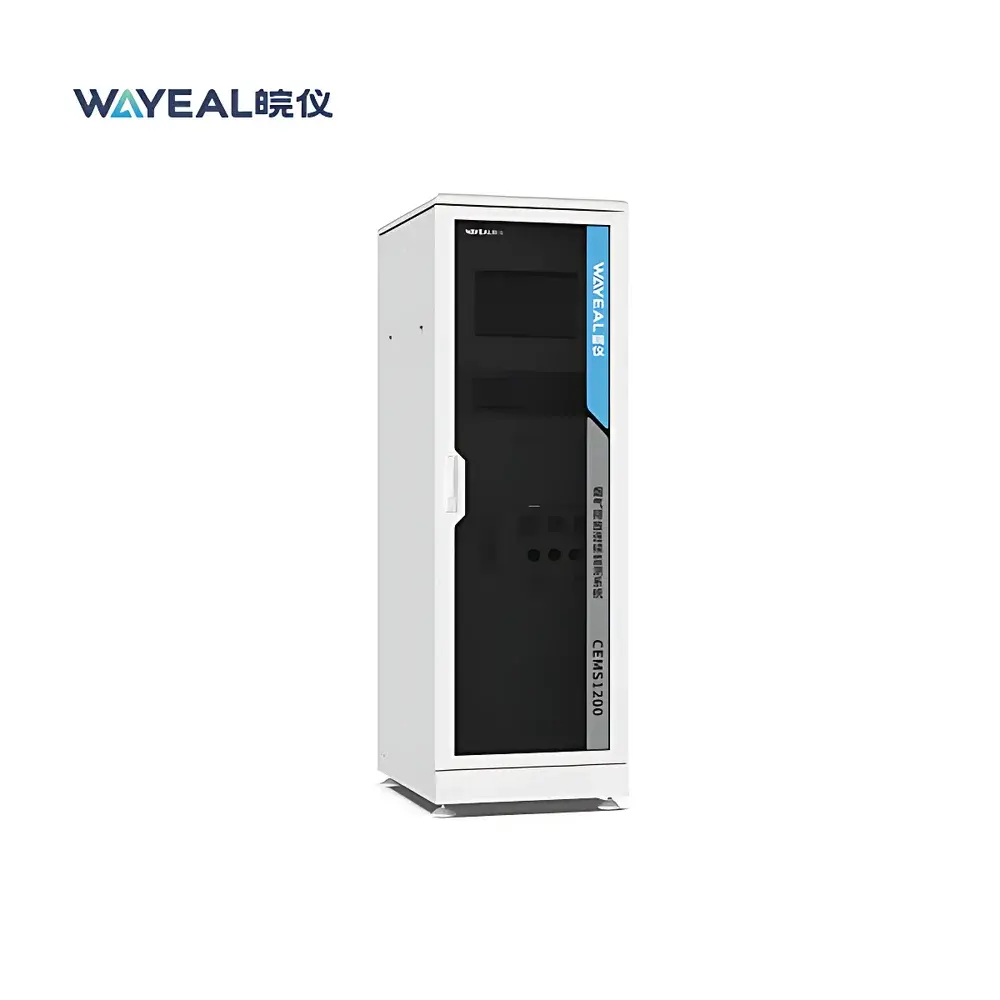
WAYEAL CEMS1200 Flue Gas Continuous Emission Monitoring System (CEMS)
| Brand | WAYEAL |
|---|---|
| Origin | Anhui, China |
| Manufacturer Type | Original Equipment Manufacturer (OEM) |
| Country of Origin | China |
| Model | CEMS1200 |
| Instrument Type | Continuous Emission Monitoring System (CEMS) |
| Measured Parameters | SO₂, NOₓ (NO, NO₂), O₂ |
| Measurement Principle (O₂) | Electrochemical Sensor |
| Measurement Principle (Temperature) | PT100 or Thermocouple Sensor |
| Measurement Principle (Pressure) | Piezoresistive Pressure Transducer |
| Measurement Principle (Flow Velocity) | Pitot Tube |
| Measurement Principle (Humidity) | High-Temperature Capacitive Hygrometer |
| Sampling Method | Direct Extraction – Hot/Wet Method |
| Certified SO₂ Range | 0–70 mg/m³ |
| Certified NO Range | 0–65 mg/m³ |
| Particulate Matter Method | Laser Forward Scattering |
| Certified PM Range | 0–15 mg/m³ |
| Data Interface | Modbus RTU/TCP, OPC UA, 4–20 mA, RS-232/485 |
| Compliance Support | GB/T 16157, HJ 75–2017, HJ 76–2017, ISO 12039, EN 15267 |
Overview
The WAYEAL CEMS1200 is a fully integrated, rack-mounted Continuous Emission Monitoring System (CEMS) engineered for regulatory-grade, real-time measurement of key flue gas constituents—including sulfur dioxide (SO₂), nitrogen oxides (NOₓ), oxygen (O₂), particulate matter (PM), temperature, static pressure, volumetric flow velocity, and relative humidity—in industrial stack environments. Designed in accordance with Chinese national standards (HJ 75–2017 and HJ 76–2017) and aligned with international reference methodologies (ISO 12039 for SO₂/NOₓ; EN 15267 for system certification), the CEMS1200 employs a direct-extraction hot/wet sampling architecture. This configuration preserves the native moisture content of the flue gas stream, eliminating condensation-related analyte loss and enabling accurate quantification of water-soluble gases—particularly critical for low-concentration SO₂ and NO monitoring under stringent ultra-low emission regulations. All physical parameters are acquired via traceable, NIST-traceable (or equivalent national metrology institute) transducers: electrochemical cells for O₂, platinum resistance thermometers (PT100) or Type K thermocouples for temperature, piezoresistive pressure sensors for static pressure, calibrated pitot tubes for isokinetic flow velocity determination, and high-temperature capacitive hygrometers rated to 180 °C for in-situ humidity assessment.
Key Features
- Hot/wet direct extraction sampling train with heated probe, sample line (maintained at >180 °C), and thermostatically controlled conditioning unit—ensuring gas-phase integrity throughout transport.
- Dual-channel UV-Vis differential optical absorption spectroscopy (DOAS) or electrochemical sensor modules (configurable per application) for certified SO₂ and NOₓ detection; NO₂ quantified either via chemiluminescence (CLD) or spectral deconvolution within DOAS.
- Laser-based forward scattering particulate monitor with factory-calibrated 0–15 mg/m³ range, compliant with HJ 76–2017 optical equivalence requirements for opacity and mass concentration correlation.
- Integrated data acquisition and processing unit (DAPU) supporting dual-redundant storage, timestamped raw signal logging (≥1 Hz), and automated zero/span validation cycles per HJ 75–2017 Section 7.3.
- Self-diagnostic firmware with event-triggered alarm logging (e.g., flow fault, heater failure, calibration timeout), configurable relay outputs, and LED status indicators mapped to EN 14181 QA/QC tiers.
- Native support for Modbus RTU/TCP, OPC UA (compliant with IEC 62541), and analog 4–20 mA outputs—enabling seamless integration with plant DCS, SCADA, and provincial environmental supervision platforms.
Sample Compatibility & Compliance
The CEMS1200 is validated for operation across coal-fired power plants, waste-to-energy facilities, cement kilns, and glass melting furnaces with flue gas temperatures up to 300 °C and dust loadings ≤10 g/Nm³. Its hot/wet design eliminates the need for chiller-based dew point suppression, thereby avoiding SO₂ dissolution artifacts common in cold-dry systems. All analytical subassemblies carry third-party verification under HJ 76–2017 (China’s CEMS performance specification), including 7-day stability testing, interference testing against CO, CO₂, NH₃, and HCl, and linear range validation per GB/T 16157. The system meets EN 14181 QA Level 2 requirements for automated performance checks and supports audit-ready electronic records compliant with GLP principles—though formal 21 CFR Part 11 compliance requires optional digital signature and audit trail modules.
Software & Data Management
The embedded CEMS Manager software provides browser-based configuration (HTTPS-secured), real-time multi-parameter trending, automatic report generation (hourly/daily/monthly emission summaries), and customizable alert thresholds. Raw sensor outputs—including voltage, current, and digital counts—are stored locally on industrial-grade SSD with ≥30 days’ retention (configurable). Data export supports CSV, XML, and EPA-compatible .DAT formats. Remote diagnostics are enabled via secure VPN tunneling; firmware updates follow signed package verification protocols. All calibration events, maintenance logs, and QA/QC results are time-stamped, user-attributed, and immutable—satisfying HJ 75–2017 recordkeeping mandates for environmental enforcement audits.
Applications
- Regulatory compliance monitoring for thermal power generation units subject to China’s “Ultra-Low Emissions” policy (SO₂ ≤ 35 mg/m³, NOₓ ≤ 50 mg/m³, PM ≤ 10 mg/m³).
- Process optimization in lime kilns and sintering plants where O₂ feedback enables combustion stoichiometry control.
- Stack testing support for environmental impact assessments (EIAs) requiring simultaneous multi-parameter profiling over 72-hour continuous runs.
- Baseline characterization prior to installation of FGD or SCR systems, providing pre- and post-treatment comparative datasets.
- Integration into enterprise-level environmental information management systems (EIMS) for cross-site emissions aggregation and carbon accounting linkage.
FAQ
What is the certified measurement range for SO₂ and NO under HJ 76–2017?
The CEMS1200 is certified for SO₂ (0–70 mg/m³) and NO (0–65 mg/m³) using hot/wet sampling—verified via multi-point linearity tests and interference challenge per Annex B of HJ 76–2017.
Does the system support remote calibration and span checks?
Yes—automated zero/span sequences are programmable via the CEMS Manager interface; external gas standards (certified SO₂/NO/O₂/N₂ mixtures) are introduced through dedicated calibration ports with flow-controlled solenoid valves.
Can particulate matter data be correlated with opacity readings?
The laser forward scattering PM module outputs mass concentration (mg/m³); opacity correlation requires separate transmissometer installation—though both signals may be synchronized and logged within the same DAPU timestamp frame.
Is the system compatible with EU-MRV or IMO DCS reporting frameworks?
While designed primarily for Chinese regulatory frameworks, its Modbus/OPC UA interfaces and standardized emission calculation algorithms (per ISO 14644-1 for volumetric flow correction) allow adaptation to MRV/DCS data schemas with middleware configuration.
What maintenance intervals are recommended for the hot/wet probe and sampling line?
Probe filter replacement every 3 months (or per differential pressure alarm); heated line insulation inspection quarterly; full system performance audit annually per HJ 75–2017 Section 9.2.
Related Products







