
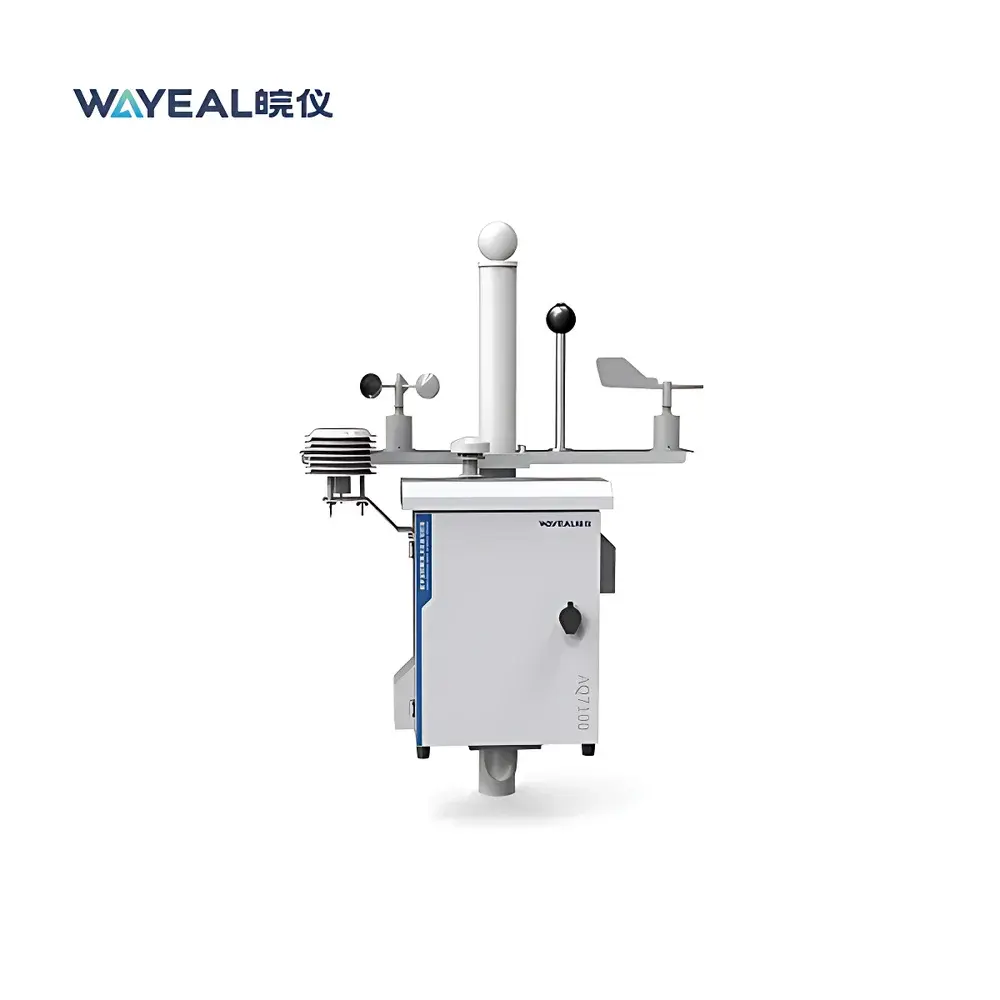
WAYEAL AQ7100 Compact Ambient Air Quality Monitoring System
| Brand | WAYEAL |
|---|---|
| Origin | Anhui, China |
| Manufacturer Type | Original Equipment Manufacturer (OEM/ODM) |
| Country of Origin | China |
| Model | AQ7100 |
| Pricing | Available upon Request |
| Measured Parameters | SO₂, NO₂, CO, O₃, PM₂.₅, PM₁₀, TVOC, Temperature, Relative Humidity |
Overview
The WAYEAL AQ7100 Compact Ambient Air Quality Monitoring System is an integrated, multi-parameter environmental sensing platform engineered for high-density spatial deployment in urban, industrial, and peri-urban settings. Utilizing electrochemical sensors for gaseous pollutants (SO₂, NO₂, CO, O₃), laser scattering photometry for particulate matter (PM₂.₅ and PM₁₀), and metal-oxide semiconductor (MOS) technology for total volatile organic compounds (TVOC), the AQ7100 delivers continuous, real-time measurements with calibrated traceability to reference-grade instrumentation. Its compact form factor (W × D × H: 320 × 240 × 180 mm) and low power consumption (<15 W nominal) enable flexible installation on utility poles, building facades, traffic signal cabinets, or portable mast systems—supporting both fixed-site networks and mobile deployment configurations. Designed for operation across ambient temperature ranges of −20 °C to +50 °C and relative humidity up to 95% non-condensing, the system incorporates active temperature and humidity compensation algorithms to maintain measurement stability under variable meteorological conditions.
Key Features
- Modular sensor architecture supporting field-replaceable gas and particulate modules—enabling rapid recalibration and maintenance without full-system downtime.
- Integrated dual-channel optical particle counter with Mie scattering detection and size binning resolution down to 0.3 µm for PM₂.₅ and PM₁₀ mass concentration estimation per ISO 16000-23 and EN 12341.
- Onboard microprocessor with embedded Linux OS, supporting local data buffering (up to 30 days at 1-min intervals) and automatic failover to cellular (LTE Cat-M1/NB-IoT) or Ethernet communication upon primary network loss.
- Automatic zero/span drift correction via scheduled internal reference checks using stable gas permeation sources and clean-air purging cycles—reducing manual intervention frequency by ≥70% compared to conventional low-cost monitors.
- IP65-rated enclosure with UV-stabilized polycarbonate housing and corrosion-resistant aluminum mounting frame—certified for outdoor exposure per IEC 60529 and tested per IEC 60068-2 environmental stress protocols.
Sample Compatibility & Compliance
The AQ7100 is validated for ambient air sampling in accordance with EPA Method TO-15 (for VOC screening), EN 14662 (for benzene), and ISO 7203 (for electrochemical gas sensor performance). While not a certified reference method instrument per EU Directive 2008/50/EC Annex VI, it meets the technical specifications for indicative monitoring under Section 4.3 of the Directive when deployed within a quality-assured network design incorporating co-location with certified reference analyzers for periodic bias correction. Data output complies with EN 17373:2020 (data format for air quality monitoring networks) and supports metadata tagging for traceability in GLP-aligned workflows. All firmware and calibration records are timestamped and cryptographically signed to support audit readiness under ISO/IEC 17025:2017 laboratory accreditation requirements.
Software & Data Management
The AQ7100 interfaces natively with WAYEAL’s CloudAir™ Platform—a secure, ISO 27001-certified SaaS environment offering role-based access control, automated QA/QC flagging (e.g., spike detection, sensor saturation alerts), and configurable API endpoints (RESTful JSON over HTTPS). Raw and processed data streams are archived with immutable write-once storage, supporting 21 CFR Part 11-compliant electronic signatures for audit trails. Advanced analytics modules include backward trajectory modeling (HYSPLIT integration), source apportionment via positive matrix factorization (PMF), and machine learning–driven anomaly detection trained on historical regional emission profiles. Export formats include CSV, NetCDF4, and EPA AQS-compatible flat files for regulatory reporting.
Applications
- Urban hyperlocal air quality mapping—deployed at sub-kilometer grid spacing to resolve intra-city pollution gradients near schools, hospitals, and residential zones.
- Roadside monitoring along highways, intersections, and tunnels to quantify traffic-related emissions (NOₓ, PM, CO) and assess mitigation effectiveness of low-emission zones (LEZs).
- Industrial fence-line monitoring for refineries, chemical plants, and waste treatment facilities—configured with enhanced VOC sensitivity and alarm thresholds aligned with local environmental permits.
- Wildfire and agricultural burning early warning—leveraging rapid-response PM and CO trends coupled with geotagged thermal imaging integration.
- Environmental impact assessment (EIA) baseline studies and post-construction compliance verification for infrastructure projects including airports, rail corridors, and port expansions.
FAQ
Is the AQ7100 suitable for regulatory compliance reporting?
The AQ7100 is designed for indicative monitoring and source identification—not as a certified reference method. Regulatory submission requires co-location with FRM/FEM instruments and documented network-wide calibration protocols.
What is the recommended calibration interval?
Field calibration is advised every 90 days using certified span gases and aerosol standards; zero checks should be performed weekly via built-in clean-air purge cycle.
Can the system operate off-grid?
Yes—optional solar-charged lithium iron phosphate (LiFePO₄) battery pack enables continuous operation for >72 hours during grid outages, with intelligent power management prioritizing critical sensor functions.
Does the platform support third-party integrations?
Yes—via documented REST API, MQTT broker interface, and OPC UA gateway option for SCADA and enterprise GIS platforms.
How is data security ensured during transmission?
All communications use TLS 1.2+ encryption; device authentication employs X.509 certificates, and firmware updates require digital signature verification prior to installation.
Related Products







