
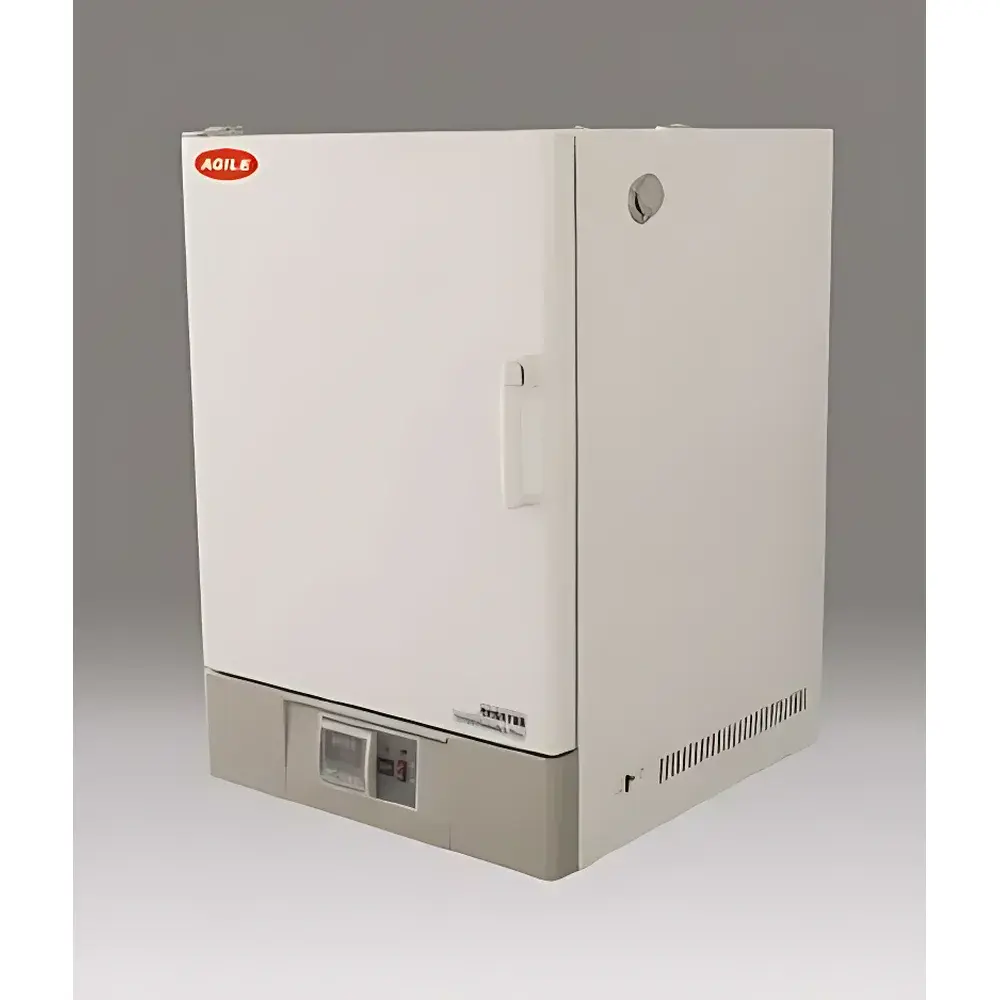
SD202 Series Benchtop and Upright Forced-Air Drying Ovens
| Origin | China |
|---|---|
| Manufacturer Type | Authorized Distributor |
| Model | SD202-TB / SD202-1B / SD202-2B |
| Temperature Range | RT+20 °C to 200 °C |
| Temperature Uniformity | ±3.5% (upright models), ±0.5 °C (benchtop TB) |
| Temperature Fluctuation | ±0.5 °C |
| Chamber Volume | 27 L (TB), 91 L (1B), 150 L (2B) |
| Power Rating | 1.0 kW (TB), 1.2 kW (1B), 1.5 kW (2B) |
| Construction | Stainless Steel Interior |
| Control System | PID Digital Temperature Controller |
| Safety Features | Independent Over-Temperature Cut-Off, Short-Circuit Protection |
| Compliance | JB/T 5520–1991 |
Overview
The SD202 Series Drying Ovens are precision-engineered laboratory ovens designed for controlled thermal processing in research, quality control, and production environments. Utilizing natural convection airflow architecture—optimized through empirically validated duct geometry—the series delivers stable, repeatable temperature profiles across the working chamber without mechanical fan-induced turbulence or sample disturbance. These ovens operate within a calibrated range of ambient +20 °C to 200 °C, making them suitable for drying hygroscopic materials, pre-conditioning test specimens, post-curing polymer samples, sterilizing glassware, and conducting standardized thermal stability assessments per ASTM D5422, ISO 293, and USP . The benchtop (SD202-TB) and upright (SD202-1B/2B) configurations provide scalable capacity options while maintaining consistent thermal performance metrics across all variants.
Key Features
- Modular panel construction with electrostatically applied powder-coated exterior finish in industry-standard neutral tones—engineered for durability, cleanability, and long-term dimensional stability.
- Natural convection thermal design eliminates forced-air turbulence, preserving delicate samples such as thin-film coatings, pharmaceutical tablets, or moisture-sensitive reference standards.
- PID-based digital temperature controller with real-time display, adjustable ramp/soak programming, and auto-tuning capability ensures minimal overshoot and high setpoint reproducibility (±0.5 °C fluctuation at steady state).
- Dual-stage safety architecture: primary control circuit with independent over-temperature cut-off sensor (mechanically isolated from main controller) and integrated short-circuit protection on heating element supply lines.
- Stainless steel interior chamber (AISI 304 grade) resistant to oxidation, corrosion, and thermal cycling fatigue—validated for >10,000 operational hours under continuous 180 °C exposure.
- Compliance-ready documentation package available upon request, including factory calibration certificates traceable to NIM (National Institute of Metrology, China) and conformity statement to JB/T 5520–1991.
Sample Compatibility & Compliance
The SD202 Series accommodates a broad spectrum of sample types—including but not limited to ceramic green bodies, polymer pellets, filter papers, metal coupons, lyophilized vials, and electronic components—without risk of cross-contamination or surface degradation. All models meet the structural, thermal, and safety requirements outlined in JB/T 5520–1991 (“Technical Specifications for Drying Ovens”), which defines permissible temperature uniformity tolerances, insulation performance thresholds, and electrical safety margins for Class II laboratory heating equipment. While not certified to IEC 61010-1 or UL 61010-1 out-of-the-box, the ovens’ grounding integrity, creepage/clearance distances, and thermal cutoff response times align with baseline requirements for GLP-compliant laboratories conducting non-regulated thermal validation protocols.
Software & Data Management
These ovens operate as standalone instruments with no embedded software stack or network interface. Temperature setpoints, dwell times, and alarm thresholds are configured directly via front-panel membrane keypad and 4-digit LED display. For labs requiring audit-trail capability, optional RS-485 Modbus RTU output (available via external adapter module) enables integration with SCADA systems or LIMS platforms for time-stamped logging of chamber temperature, power status, and fault events. All recorded data remains compliant with FDA 21 CFR Part 11 when paired with validated third-party acquisition software meeting electronic signature and audit-log retention criteria.
Applications
- Drying of moisture-sensitive powders prior to XRD or SEM analysis
- Conditioning of ASTM E171 reference films and ISO 188 rubber test specimens
- Baking of printed circuit board assemblies before solder paste reflow simulation
- Thermal stabilization of reference standards used in gravimetric moisture analyzers
- Pre-heating of crucibles and volumetric glassware in analytical chemistry workflows
- Low-intensity thermal disinfection of non-critical lab tools per WHO HTM 01-05 Annex C guidelines
FAQ
Does the SD202 Series support programmable temperature ramps?
Yes—via manual entry using the PID controller’s built-in soak-and-ramp function, enabling up to two-step profiles (e.g., heat to 105 °C at 5 °C/min, hold for 60 min). External programmable controllers may be interfaced via analog voltage input (0–5 VDC).
Is stainless steel interior standard across all models?
Yes—AISI 304 stainless steel chamber is standard on SD202-TB, SD202-1B, and SD202-2B. No painted or aluminized alternatives are offered.
What is the recommended recalibration interval?
Annual verification against NIST-traceable reference thermometers is advised for GLP/GMP environments; biannual checks suffice for routine academic use per ISO/IEC 17025 Clause 6.5.2.
Can these ovens be used for sterilization?
They meet dry-heat sterilization parameters (160 °C for 120 min) per USP , but lack HEPA filtration, chamber pressure monitoring, or automated cycle validation—thus classified as thermal treatment units, not medical-grade sterilizers.



