
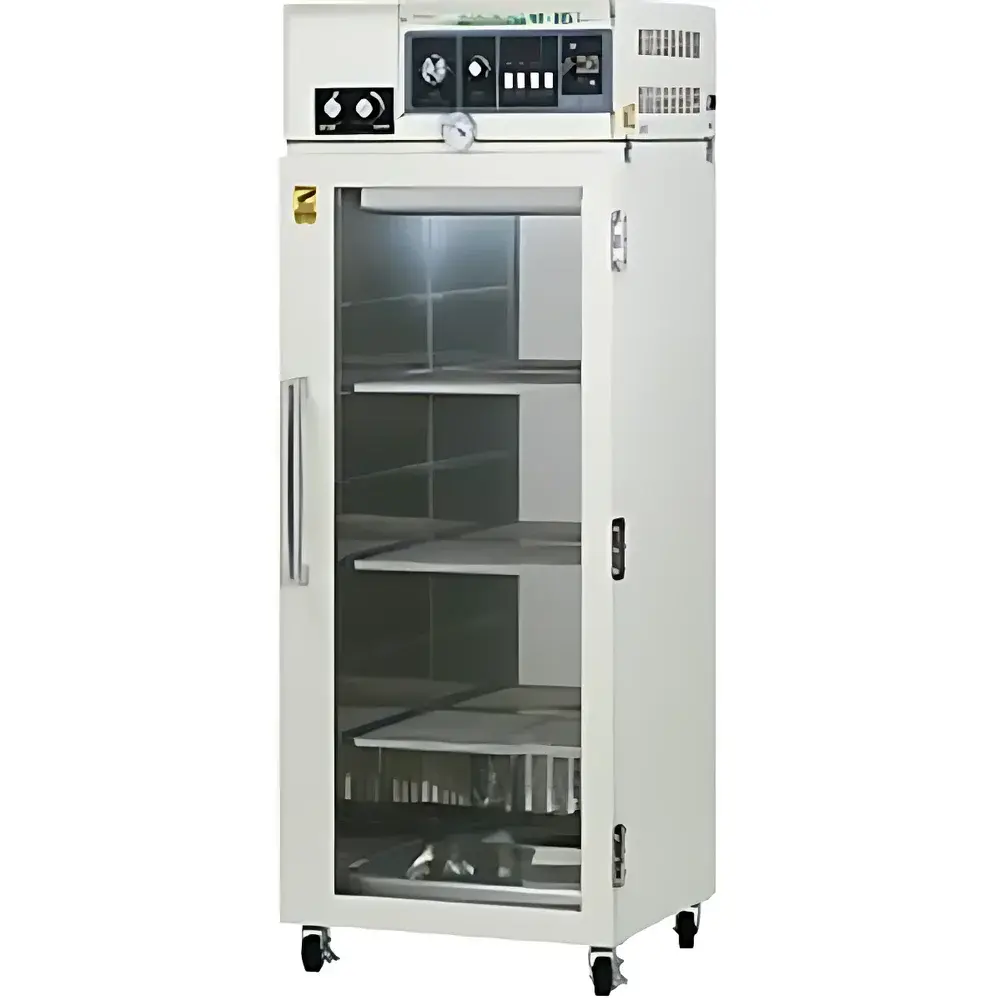
TAITEC M-16N Medium-Temperature Forced-Air Drying Oven
| Brand | TAITEC |
|---|---|
| Origin | Japan |
| Model | M-16N |
| Instrument Type | General-Purpose Forced-Convection Oven |
| Temperature Range | Ambient +5°C to 80°C |
| Temperature Uniformity | ±0.25°C to ±0.95°C |
| Chamber Dimensions (W×D×H) | 460 × 400 × 1200 mm |
| External Dimensions (W×D×H) | 610 × 535 × 1630 mm |
| Heating Power | 400 W × 5 elements |
| Air Circulation | Forced convection via internal blower |
| Sterilization Lamp | 6 W UV-C lamp with 60-min mechanical timer |
| Control System | Pt-based proportional-integral time-ratio controller |
| Interior Material | Stainless steel (SUS304) |
| Door | Full-view tempered glass |
| Shelving | 3 adjustable stainless steel shelves |
| Drain Pan | Integrated removable drip tray |
| Filtration | Built-in particulate air filter |
| Power Supply | AC 100 V, 21 A |
| Weight | Approx. 98 kg |
Overview
The TAITEC M-16N is a medium-temperature forced-air drying oven engineered for precision thermal processing in research laboratories, quality control environments, and pharmaceutical production support areas. It operates on the principle of uniform convective heat transfer—employing a multi-element resistive heating system combined with a high-efficiency internal blower to ensure consistent airflow distribution throughout the chamber. Unlike natural-convection ovens, the M-16N’s forced-circulation architecture minimizes thermal gradients, enabling reproducible drying, conditioning, and low-intensity sterilization of temperature-sensitive samples—including polymeric labware, coated glassware, and moisture-labile reference standards. Its operational envelope (ambient +5°C to 80°C) is specifically calibrated for applications where excessive thermal stress must be avoided, such as pre-weighing sample preparation, residual solvent removal from HPLC vials, or stabilization of hygroscopic reagents prior to analytical use.
Key Features
- Stainless steel interior (SUS304) for corrosion resistance, ease of decontamination, and long-term dimensional stability under repeated thermal cycling
- Full-view tempered glass door enabling real-time visual monitoring without compromising thermal integrity or operator safety
- Dedicated 6 W UV-C germicidal lamp with integrated 60-minute mechanical timer—designed for non-contact surface decontamination of glassware and metal tools between usage cycles
- Removable stainless steel drip tray located at the base to collect condensate or residual rinse water from wet instruments, preventing cross-contamination and maintaining chamber hygiene
- Particulate air filtration system continuously supplies filtered ambient air into the chamber, reducing airborne contamination during drying protocols
- Pt-based time-ratio proportional temperature controller delivering stable setpoint maintenance across the full operating range, with documented uniformity of ±0.25°C to ±0.95°C per IEC 60068-3-5 test methodology
- Three independently adjustable stainless steel shelves accommodating heterogeneous load configurations while preserving laminar airflow patterns
Sample Compatibility & Compliance
The M-16N supports a broad range of laboratory materials including borosilicate glass, polycarbonate, polypropylene, stainless steel, and anodized aluminum components. Its gentle thermal profile ensures compatibility with ISO 8573-1 Class 4 compressed air–compatible instrumentation and ASTM E29-23–compliant drying validation protocols. The stainless steel construction meets FDA-recommended criteria for non-porous, cleanable surfaces in GLP-regulated environments. While not certified for sterile barrier systems, its UV-C lamp complies with JIS T 9251:2018 requirements for low-level environmental disinfection in non-critical zones. The unit is CE-marked and conforms to IEC 61010-1:2010 for electrical safety in laboratory equipment.
Software & Data Management
The M-16N utilizes a hardware-based analog control architecture without embedded firmware or digital data logging. Temperature setpoints and UV exposure duration are configured manually via front-panel dials and mechanical timers. For laboratories requiring audit-ready records, external validation-grade data loggers (e.g., compliant with 21 CFR Part 11 when paired with appropriate software) may be connected via optional thermocouple inputs. The absence of network interfaces or cloud connectivity aligns with air-gapped facility requirements in regulated manufacturing settings where cyber-resilience is prioritized over remote monitoring capability.
Applications
- Drying of volumetric glassware, pipette tips, and reusable centrifuge tubes post-wash cycle
- Conditioning of desiccants, reference standards, and calibration weights under controlled humidity-adjacent conditions
- Thermal stabilization of polymer-based sensors and microfluidic substrates prior to functional testing
- Low-temperature dehydration of botanical extracts and excipient blends in preformulation studies
- UV-assisted surface decontamination of non-critical lab tools—supplementing but not replacing autoclave or chemical sterilization
- Use as a stable ambient-equivalent incubation chamber for temperature-sensitive enzyme assays or cell culture accessories
FAQ
Is the M-16N suitable for sterilizing surgical instruments?
No. The 6 W UV-C lamp provides only surface-level microbial reduction and does not meet ISO 14937 or AAMI ST58 requirements for medical device sterilization.
Can the oven be used for moisture content analysis per AOAC or USP <921>?
It may serve as a drying step within validated gravimetric methods, but final compliance requires independent verification of chamber uniformity and traceable calibration against NIST-traceable references.
Does the unit include over-temperature protection?
Yes—a redundant mechanical high-limit thermostat interrupts power if chamber temperature exceeds 90°C, satisfying IEC 60068-2-2 Annex A safety provisions.
What maintenance is required for the air filter?
The particulate filter should be inspected weekly and replaced every 6 months under continuous operation, or immediately if visibly soiled, to maintain specified airflow velocity and thermal homogeneity.
Is the stainless steel interior electropolished?
No—the chamber features standard mill-finish SUS304, which provides adequate cleanability for routine lab use but is not optimized for ultra-low-particulate environments such as ISO Class 5 cleanrooms.



