
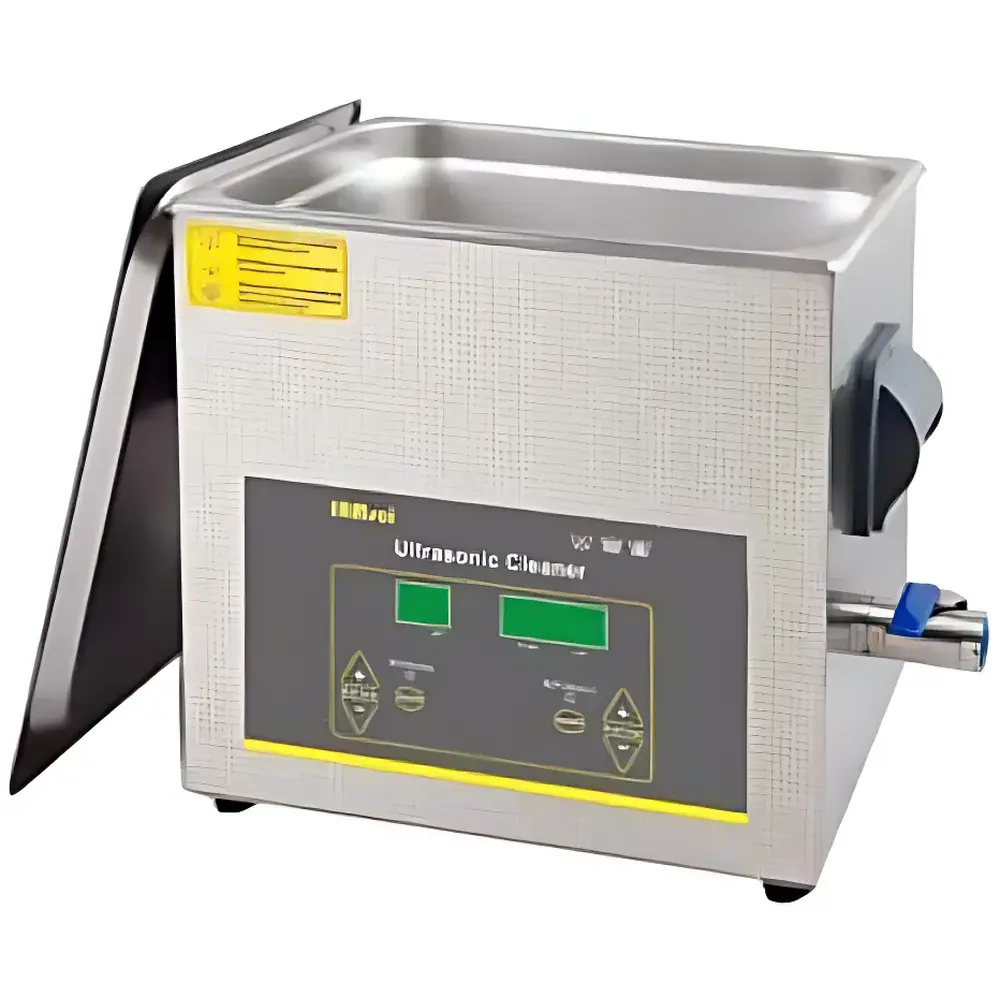
IRM DTH Digital Ultrasonic Cleaner
| Brand | IRM |
|---|---|
| Origin | Hebei, China |
| Manufacturer Type | Manufacturer |
| Product Category | Domestic |
| Model | DTH Digital Series |
| Instrument Type | General-Purpose |
| Capacity | 2 L |
| Ultrasonic Frequency | 40 kHz |
| Ultrasonic Power | 50 W |
| Adjustable Power | Yes |
| Adjustable Temperature | Yes (0–80 °C) |
| Adjustable Timer | Yes (1–99 min) |
| Sound-Dampening Lid | Included |
| Drain/Inlet | Manual or Automatic |
Overview
The IRM DTH Digital Ultrasonic Cleaner is a benchtop general-purpose cleaning system engineered for precision, reproducibility, and operational flexibility in laboratory, quality control, and light industrial environments. It operates on the principle of ultrasonic cavitation—high-frequency sound waves (40 kHz) generate microscopic vacuum bubbles in the cleaning solution that implode with localized energy, dislodging particulate matter, organic residues, biofilms, and adsorbed contaminants from surfaces, crevices, blind holes, and complex geometries without mechanical abrasion. This physical cleaning mechanism ensures consistent decontamination of delicate components—including optical lenses, microfluidic devices, surgical instruments, electronic PCBs, and analytical sample vials—while eliminating manual scrubbing and reducing reliance on aggressive solvents. Designed to meet routine GLP-compliant workflows, the DTH series integrates digital control architecture with robust stainless-steel construction to support repeatable, traceable, and low-risk cleaning protocols.
Key Features
- Digital LED interface with independent, real-time adjustment of ultrasonic power (variable output), heating temperature (0–80 °C), and cleaning duration (1–99 minutes)
- High-efficiency piezoelectric transducer array delivering stable 40 kHz output at 50 W nominal power—optimized for broad-spectrum contaminant removal while minimizing thermal drift and acoustic shadowing
- One-piece seamless SUS304 stainless-steel tank (no weld seams), cold-rolled stainless steel exterior with embossed finish for corrosion resistance and structural rigidity
- Integrated sound-dampening lid to reduce ambient noise and prevent solvent evaporation during heated operation
- Stainless steel mesh basket (argon-welded construction) for secure part placement and uniform energy coupling
- Manual or automatic drain/inlet configuration supporting flexible integration into lab water management systems
- Core components sourced from internationally certified suppliers to ensure long-term reliability under continuous daily use
Sample Compatibility & Compliance
The DTH series accommodates a wide range of sample types and materials—including glassware, metal tools, ceramic substrates, polymer components, and silicon wafers—without surface degradation or dimensional alteration. Its non-contact cleaning action preserves calibration integrity of metrology standards and avoids micro-scratching of optics or sensors. The unit complies with standard electrical safety requirements for Class I laboratory equipment (IEC 61010-1). While not certified for sterile processing per ISO 13485 or FDA 21 CFR Part 820, it supports pre-sterilization cleaning steps aligned with ISO 15883-1 and AAMI ST79 guidelines when used with validated cleaning chemistries. Temperature and timer settings enable adherence to method-defined cleaning SOPs required in ISO/IEC 17025-accredited laboratories.
Software & Data Management
The DTH Digital series operates via embedded firmware with no external PC dependency. All operational parameters are stored locally in non-volatile memory and displayed in real time on the front-panel LED screen. While it does not feature USB/Ethernet connectivity or audit-trail logging, its deterministic digital controls provide full parameter traceability for batch documentation: users record setpoints (temperature, time, power level) and runtime in lab notebooks or LIMS-integrated forms. For regulated environments requiring electronic records, the device may be operated within a documented procedure that defines calibration intervals (e.g., annual verification of temperature sensor accuracy per ASTM E74 or NIST-traceable thermometer), timer deviation limits (< ±2 s over 60 min), and transducer performance checks using aluminum foil erosion tests per ASTM D2603.
Applications
- Pretreatment of HPLC vials, GC autosampler trays, and ICP-MS sample introduction components
- Cleaning of watchmaking parts, dental handpieces, and endoscopic accessories prior to autoclaving
- Removal of flux residues and solder paste from printed circuit boards before AOI inspection
- Decontamination of reusable pipette tips, centrifuge tubes, and electrophoresis combs
- Preparation of SEM/TEM specimens by eliminating hydrocarbon contamination from handling
- Routine maintenance of viscometers, density meters, and refractometer prisms
FAQ
Is the ultrasonic frequency fixed at 40 kHz, or can it be varied?
The DTH series operates exclusively at 40 kHz—a frequency selected for optimal balance between cavitation intensity and penetration depth in aqueous and mild solvent-based solutions.
Does the unit include temperature calibration certification?
No factory-issued calibration certificate is provided; however, the built-in PT100 sensor is field-verifiable using a NIST-traceable reference thermometer per ASTM E74.
Can this cleaner be used with flammable solvents?
No. The DTH series is rated for aqueous and water-miscible solutions only. Use with flammable or chlorinated solvents requires explosion-proof equipment meeting ATEX or UL 1203 standards.
What is the recommended maintenance interval for transducers?
Under normal usage (≤4 hours/day), transducer performance should be verified quarterly using the aluminum foil test (ASTM D2603); visual inspection of tank integrity and lid seal condition is advised before each use.
Is the drain valve compatible with standard lab floor drain connections?
The manual drain port accepts 10 mm ID tubing; adapters for 1/2″ NPT or quick-connect fittings may be added externally per facility plumbing specifications.



