
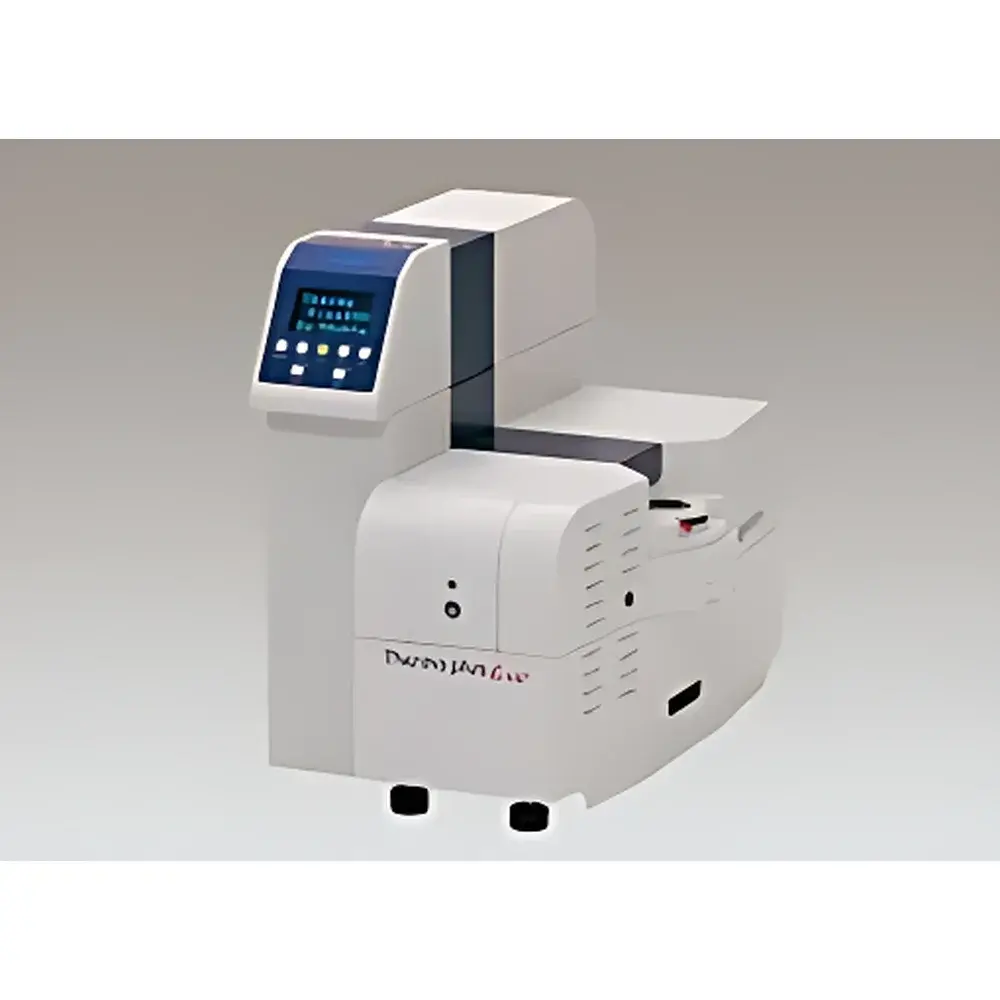
Rigaku Thermo Plus EVO TG-DTA Series Simultaneous Thermal Analyzer
| Brand | Rigaku |
|---|---|
| Origin | Japan |
| Model | TG-DTA |
| Temperature Range | RT–1100°C (standard), RT–1500°C (high-temp) |
| Max Heating Rate | 100°C/min |
| Atmosphere Options | Air, Inert Gas, Flowing Gas, Vacuum |
| Max Sample Mass | 1 g |
| TG Range | ±0.1–±250 mg |
| TG Sensitivity | 0.1 µg |
| DTA Range | ±1.5–±1000 µV |
| Sample Crucible | Ø2 mm × 2.5 mm height |
| Sample Holder Orientation | Horizontal |
| Forced Cooling | Yes (1500°C → 50°C in ≤20 min) |
| ECO Mode | Yes (30% power reduction in standby) |
| ASC Compatibility | Up to 24 samples |
| Optional IR Furnace | Yes |
| Dynamic TG Modes | SIA, DRC, CRC |
| Multi-unit Control | Up to 8 units per PC |
Overview
The Rigaku Thermo Plus EVO TG-DTA Series is a high-precision simultaneous thermal analyzer engineered for rigorous materials characterization in academic research laboratories, pharmaceutical development, advanced ceramics R&D, and quality control environments. It integrates thermogravimetric analysis (TG) and differential thermal analysis (DTA) within a single, compact instrument platform—enabling real-time, synchronized acquisition of mass change and thermal transition data under controlled atmospheric conditions. The system operates on the principle of horizontal differential triple-coil microbalance technology—a patented Rigaku design that actively compensates for mechanical drift and thermal expansion artifacts by detecting and correcting displacement signals in real time across three symmetrical sensing coils. This architecture delivers exceptional baseline stability and reproducibility, particularly critical for low-mass-loss events (e.g., dehydration, solvent evaporation, or catalytic decomposition) and subtle endo-/exothermic transitions (e.g., glass transitions, polymorphic transformations, or oxidation onset). Measurement temperature spans from ambient to 1100°C (standard configuration) or up to 1500°C (high-temperature furnace option), with programmable heating rates up to 100°C/min and forced cooling enabling rapid thermal cycling—reducing turnaround time between sequential runs without compromising data integrity.
Key Features
- Horizontal differential triple-coil microbalance: Patented Rigaku technology ensuring real-time drift correction and sub-microgram TG resolution (0.1 µg sensitivity)
- Modular furnace design: Compact resistive or optional infrared heating elements support rapid thermal response and precise isothermal control
- Intelligent temperature pre-control algorithm: Eliminates overshoot during hold segments by dynamically anticipating thermal inertia—no pre-scan required for accurate isothermal mass/heat flow quantification
- ECO power management mode: Reduces standby power consumption by ≥30% via selective deactivation of non-essential subsystems; selectable via front-panel interface or software
- Tool-free sample holder exchange: Horizontal plug-in crucible mount enables user-level replacement without soldering, calibration recalibration, or field service intervention
- Robust mechanical design: Horizontal sample placement mitigates risk of crucible dislodgement-induced damage; inertial safety logic prevents measurement interruption even if sample shifts during ramp
- Dynamic TG methodologies: Supports SIA (Step Isothermal Analysis), DRC (Dynamic Rate Control), and CRC (Constant Reaction Rate) modes for kinetic modeling and reaction mechanism elucidation
- Front-panel rotatable display: 7-inch touchscreen interface with real-time status monitoring (temperature, gas flow, balance status, error flags)
Sample Compatibility & Compliance
The Thermo Plus EVO accommodates solid, powder, and thin-film specimens up to 1 g in mass, using standardized 2 mm diameter × 2.5 mm tall alumina or platinum crucibles. Its horizontal sample geometry ensures uniform heat transfer and minimizes convection-related artifacts—critical for quantitative interpretation of multi-step decomposition pathways. The system supports ASTM E1131 (standard test method for compositional analysis by TG), ISO 11358 (polymer thermal degradation), and USP <631> (residual solvents in pharmaceuticals). Optional vacuum and flowing-gas configurations enable compliance with GLP/GMP workflows requiring documented atmosphere traceability. All firmware and software modules adhere to FDA 21 CFR Part 11 requirements for electronic records and signatures when deployed with audit-trail-enabled configurations.
Software & Data Management
Thermo Plus EVO is operated via Rigaku’s dedicated Thermal Analysis Suite (TAS) v4.x—compatible with Windows 10/11 64-bit platforms. TAS provides full instrument control, method scripting, real-time data visualization, and post-run analysis including derivative (DTG/DTA) calculation, peak integration, baseline correction, and multi-curve overlay. The software supports automated calibration routines (temperature, mass, DTA signal), self-diagnostic reporting, and scheduled firmware updates over secure HTTPS. Data files are stored in vendor-neutral ASCII format with embedded metadata (timestamp, operator ID, method name, instrument serial number), ensuring long-term archival compatibility. Dual-backup functionality writes identical datasets simultaneously to internal SSD and network-mapped storage—meeting institutional data integrity policies. Up to eight Thermo Plus EVO units can be orchestrated from a single workstation, enabling high-throughput screening protocols with centralized logging and cross-instrument comparison tools.
Applications
This analyzer serves diverse application domains requiring correlated mass-loss and thermal-event correlation: polymer thermal stability assessment (degradation onset, filler content, moisture content); inorganic material phase transformation studies (e.g., carbonate decomposition, oxide reduction); battery cathode/anode material cycling behavior; catalyst deactivation kinetics; pharmaceutical polymorph screening and excipient compatibility testing; and geochemical mineralogical analysis (e.g., clay dehydration, carbonate purity). Its compatibility with GC-MS coupling (via heated transfer line interface) further extends utility to evolved gas analysis (EGA), enabling identification of volatile decomposition products—supporting mechanistic validation beyond conventional TG/DTA interpretation.
FAQ
What is the maximum operating temperature for standard and high-temperature configurations?
Standard models operate up to 1100°C; high-temperature variants extend to 1500°C using reinforced furnace components and optimized insulation.
Can the instrument perform isothermal measurements with high stability?
Yes—the integrated temperature pre-control algorithm and high-resolution PID tuning ensure stable isothermal holds with minimal overshoot and drift, eliminating the need for preliminary conditioning scans.
Is ASTM or ISO compliance supported out-of-the-box?
The system meets hardware and software prerequisites for ASTM E1131, ISO 11358, and USP <631>>; formal validation documentation and IQ/OQ protocols are available upon request.
How does the ECO mode affect measurement readiness?
ECO mode suspends non-critical subsystems (e.g., auxiliary displays, fan speed) but retains full thermal stabilization readiness; resumption to active measurement state requires <5 seconds.
What sample throughput enhancements are available?
The optional Automatic Sample Changer (ASC) supports unattended analysis of up to 24 samples; modular mounting allows field installation without factory service intervention.



