
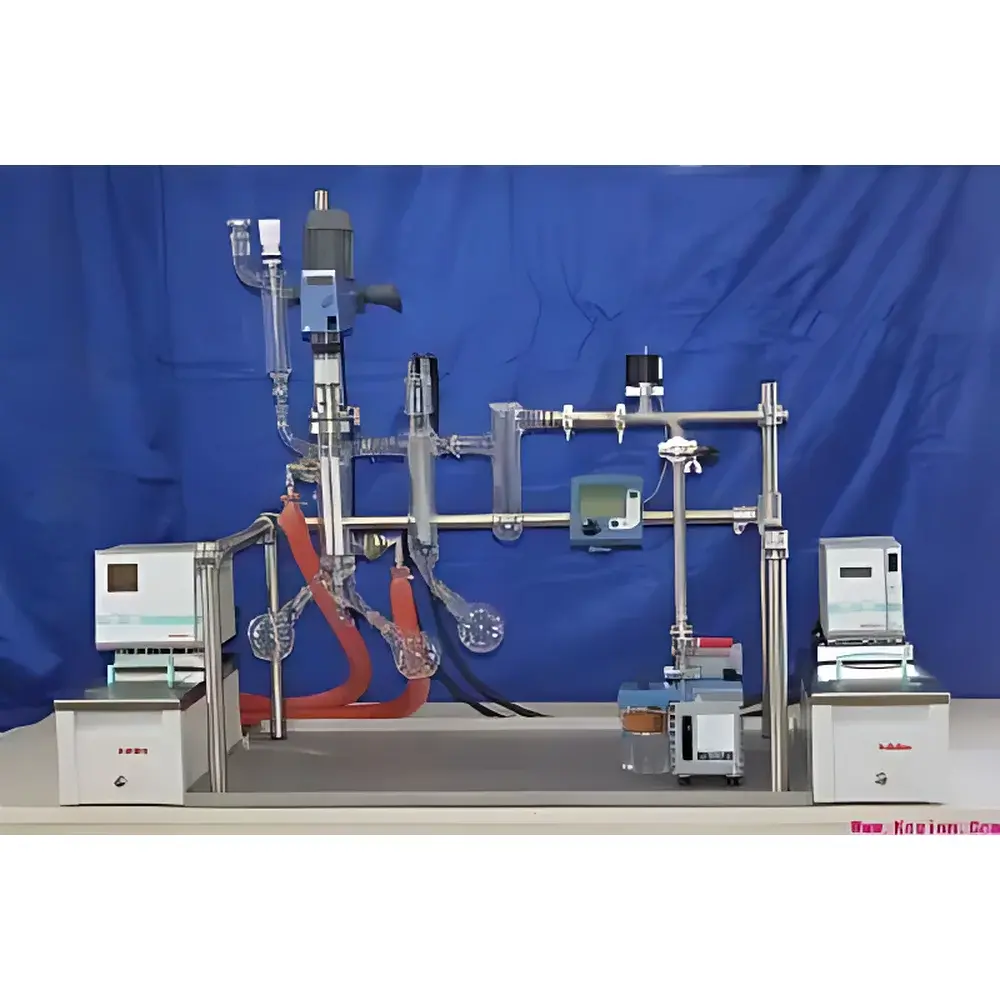
UIC KDL2 Short-Path (Molecular) Distillation System
| Brand | UIC GmbH |
|---|---|
| Origin | Germany |
| Model | KDL2 |
| Feed Rate | 0.5–1.5 kg/h |
| Effective Evaporation Area | 0.028 m² |
| Evaporator Internal Diameter | 120 mm |
| Condenser Area | 0.018 m² |
| Collection Vials | 3-position rotatable receiver system |
| Construction Material | Borosilicate Glass 3.3 |
| Max Operating Temperature | 250 °C |
| Min Operating Pressure | 0.001 mbar |
| Heating Method | External Oil Bath |
| Film Formation | Self-cleaning Roller Film System |
Overview
The UIC KDL2 Short-Path (Molecular) Distillation System is a precision-engineered, benchtop-scale purification platform designed for high-vacuum thermal separation of thermally labile, high-boiling, and oxidation-sensitive compounds. Operating on the physical principles of short-path distillation—where evaporated molecules travel a distance shorter than their mean free path—and molecular distillation—where separation relies on differences in molecular weight and vapor pressure under ultra-high vacuum—the KDL2 enables selective fractionation without significant thermal degradation. Its all-borosilicate glass 3.3 construction ensures chemical inertness, optical transparency for real-time process observation, and compliance with GLP laboratory practices. The system bridges the gap between feasibility studies and scalable process development, supporting batch sizes from 50 g to 3 kg per run, making it ideal for R&D laboratories in pharmaceuticals, nutraceuticals, specialty chemicals, and natural product isolation.
Key Features
- Modular dual-mode operation: Configurable as either a short-path thin-film evaporator (with external condenser) for bulk solvent removal or as a molecular distillation unit (with internal condenser) for high-resolution separation of heat-sensitive actives.
- Self-cleaning roller film system ensures uniform, controllable film thickness and minimizes residence time—critical for preserving molecular integrity of compounds such as omega-3 fatty acids, vitamins, cannabinoids, and polyphenols.
- Integrated 3-position rotatable receiver system allows sequential, uninterrupted collection of up to three distinct distillate fractions plus residue—enabling multi-stage fractional recovery without breaking vacuum or halting operation.
- Ultra-high vacuum capability (down to 0.001 mbar) supported by a two-stage rotary vane pump system and calibrated vacuum measurement, ensuring precise control over mean free path and molecular trajectory.
- Oil-bath heating with digital temperature regulation (up to 250 °C) provides stable, homogeneous thermal input; transparent glass vessel permits direct visual monitoring of film formation, boiling behavior, and phase transitions.
- Complete system includes cold trap, residue discharge unit, feed control module, and wear-part kit—designed for rapid setup, reproducible operation, and long-term serviceability under ISO 9001-maintained quality protocols.
Sample Compatibility & Compliance
The KDL2 accommodates a broad spectrum of viscous, non-Newtonian, and reactive feedstocks—including crude plant extracts, polymer precursors, silicone oils, and pharmaceutical intermediates—without risk of metal contamination or catalytic side reactions. All wetted parts are fabricated from DIN ISO 3585-compliant borosilicate glass 3.3, certified for hydrolytic class HGB 1 and resistant to thermal shock (ΔT ≤ 150 °C). The system supports documentation requirements aligned with FDA 21 CFR Part 11 (when paired with compliant data acquisition software), ASTM D2892/D5236 for distillation characterization, and ISO/IEC 17025 traceable calibration workflows. Its compact footprint and modular design facilitate integration into Class II biosafety cabinets or fume hoods for handling volatile or odoriferous materials.
Software & Data Management
While the base KDL2 operates via analog controls and manual parameter adjustment, optional digital interfaces enable integration with third-party data loggers or LabVIEW-based acquisition systems. Vacuum pressure, bath temperature, and feed rate can be monitored in real time and exported as CSV for post-run analysis. Audit trails, user access logs, and electronic signatures are achievable when deployed with validated LIMS or ELN platforms—supporting GMP-aligned process validation (e.g., IQ/OQ/PQ) and regulatory submissions requiring full traceability of critical process parameters (CPPs).
Applications
- Purification of polyunsaturated fatty acids (PUFAs) from fish oil or algal biomass
- Deacidification and deodorization of edible oils and biodiesel feedstocks
- Isolation of tocopherols, sterols, and squalene from vegetable distillates
- Recovery and concentration of active pharmaceutical ingredients (APIs) following synthesis or extraction
- Removal of residual solvents (e.g., hexane, chloroform, ethyl acetate) from botanical extracts prior to formulation
- Thermal stabilization of heat-labile polymers and monomers during pilot-scale synthesis
FAQ
What distinguishes short-path distillation from molecular distillation on the KDL2?
Short-path mode uses the external condenser for rapid solvent stripping at moderate vacuum (1–10 mbar); molecular mode engages the internal condenser under ultra-high vacuum (<0.01 mbar) to resolve components based on molecular weight and vapor pressure differentials.
Can the KDL2 handle highly viscous or solid-containing feeds?
Yes—the self-cleaning roller film system maintains consistent film dynamics across viscosities up to 50,000 cP; pre-filtration is recommended for particulates >50 µm to prevent nozzle clogging.
Is the system compatible with corrosive feedstocks such as organic acids or halogenated solvents?
Borosilicate glass 3.3 offers excellent resistance to most organic solvents and weak acids; prolonged exposure to strong oxidizers (e.g., nitric acid) or hydrofluoric acid is not advised.
What vacuum level is required for effective molecular separation of cannabinoids?
Typical operating range is 0.001–0.005 mbar at 120–180 °C, depending on the specific cannabinoid’s vapor pressure profile and desired cut point resolution.
Does UIC provide installation qualification (IQ) documentation?
Yes—factory-verified IQ templates, including dimensional verification, material certification, and vacuum leak-test reports, are supplied with each system upon request.



