
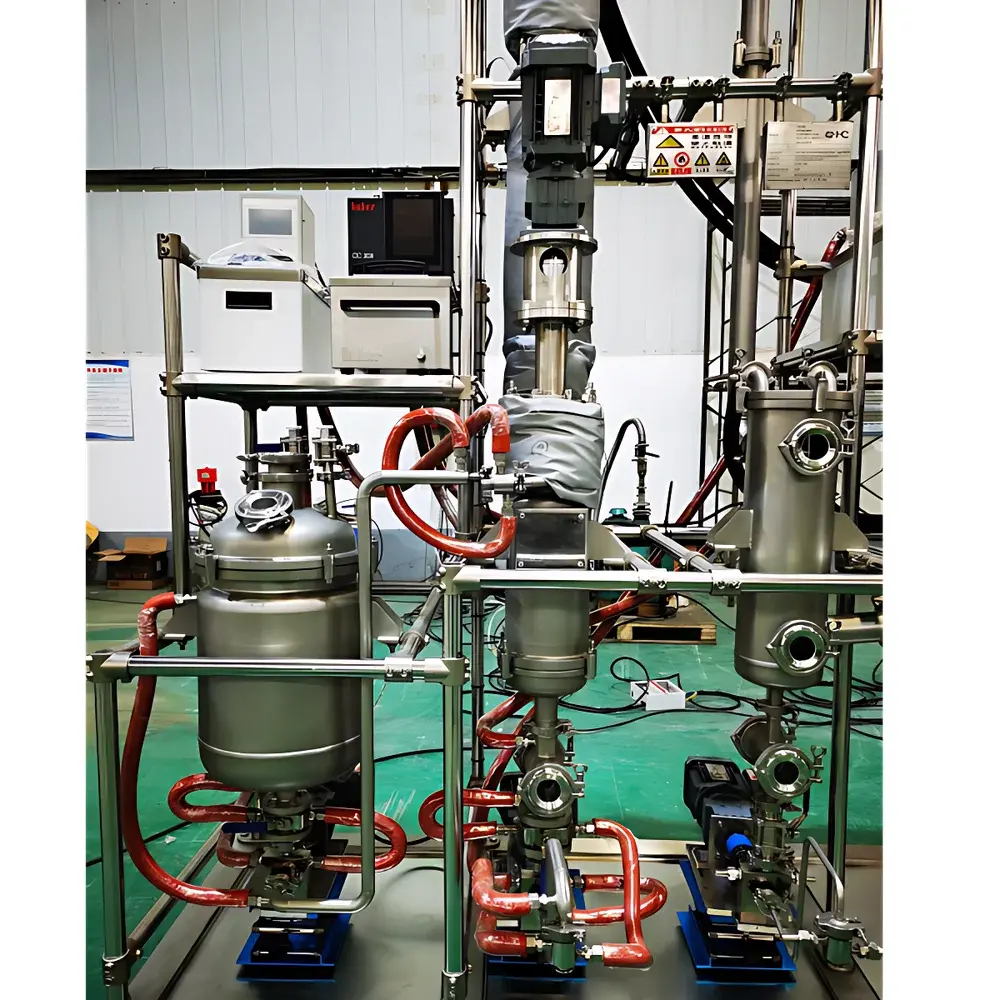
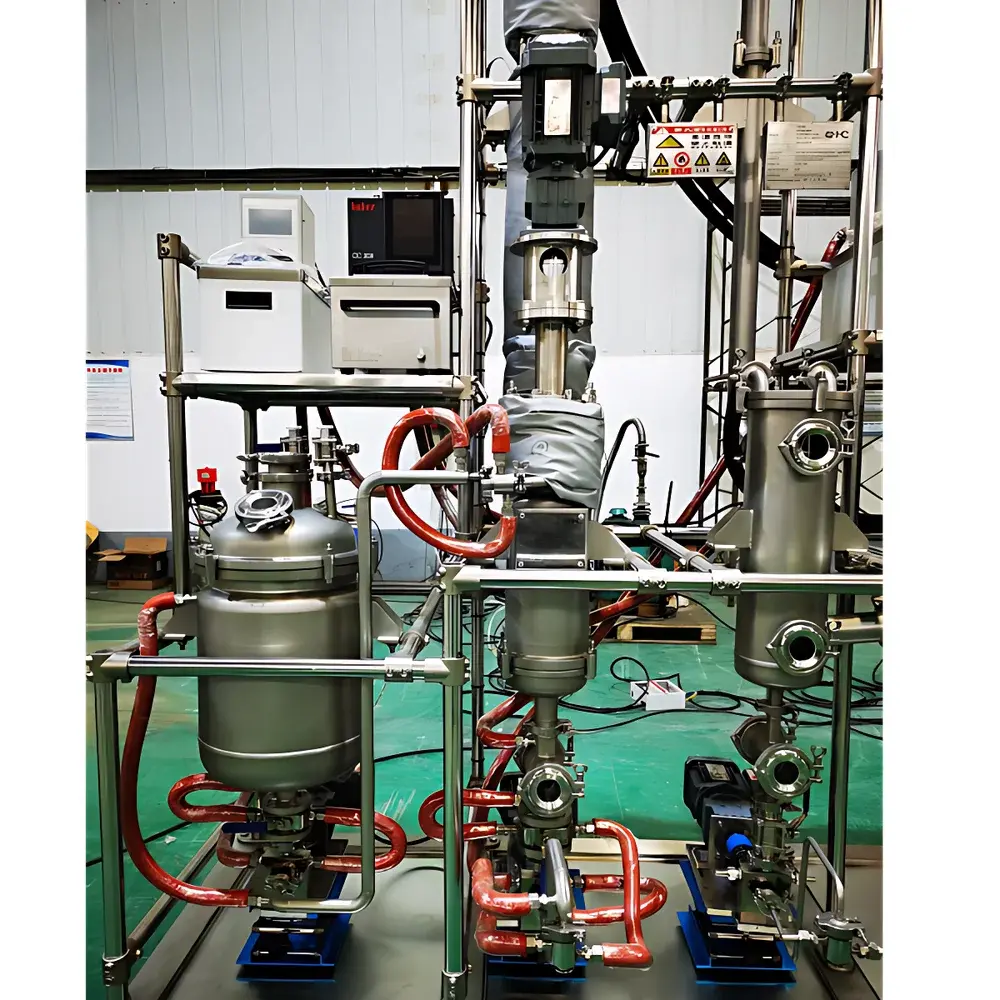
STKJ TFE6-RC Modular Molecular Distillation System
| Brand | STKJ |
|---|---|
| Origin | Beijing, China |
| Manufacturer Type | Authorized Distributor |
| Country of Origin | China |
| Model | TFE6-RC |
| Price | €500,000 |
| Feed Rate | 3–9 kg/h |
| Effective Evaporation Area | 0.08 m² |
| Evaporator Internal Diameter | 180 mm |
| Collecting Flasks | 3 |
| Condensation Area | 0.06 m² |
Overview
The STKJ TFE6-RC Modular Molecular Distillation System is a high-vacuum, short-path thermal separation instrument engineered for precise fractionation of thermally sensitive, high-boiling-point, and high-molecular-weight compounds under ultra-low pressure conditions. Operating on the principle of molecular distillation—where separation occurs based on differences in mean free path rather than boiling point—the system enables selective volatilization and condensation of target components at temperatures significantly below their atmospheric boiling points. This physical separation mechanism avoids thermal degradation, making it especially suitable for lab-scale process development, pilot-scale optimization, and low-volume production of high-value actives in pharmaceuticals, nutraceuticals, cosmetics, and specialty chemicals. Designed with an effective evaporation area of 0.08 m² and a condensation surface of 0.06 m², the TFE6-RC maintains high mass transfer efficiency while ensuring laminar flow dynamics and minimal residence time in the evaporator zone.
Key Features
- Modular architecture allowing flexible configuration of heating zones, feed systems, and collection modules to match specific process requirements.
- Self-cleaning roller film distributor ensuring uniform, thin-film formation on the 180 mm internal-diameter stainless steel evaporator surface—even for viscous or fouling-prone feeds.
- Independent temperature control for five critical zones: evaporator wall, feed preheater, distillate outlet, residue outlet, and internal condenser—enabling precise thermal management and reproducible separation profiles.
- High-performance vacuum compatibility down to 0.001 mbar (1 × 10⁻³ mbar), supported by integrated vacuum monitoring and leak-tight sealing throughout the glass-metal hybrid main body.
- Construction from AISI 316L stainless steel as standard; optional upgrade to Hastelloy C-276 or other corrosion-resistant alloys available upon request for aggressive feedstock handling.
- Oil-bath heating system delivering stable, uniform thermal input up to 350 °C at the evaporator surface, with PID-controlled feedback loops and redundant overtemperature protection.
Sample Compatibility & Compliance
The TFE6-RC accommodates a broad range of heat-labile and high-viscosity feedstocks—including unsaturated fatty acids (e.g., EPA/DHA concentrates), phospholipids, vitamin esters, natural antioxidants (e.g., tocopherols), fragrance isolates, and active pharmaceutical ingredients (APIs). Its design conforms to fundamental engineering principles outlined in ASTM D2892 (standard test method for fractional distillation of petroleum) and ISO 6618 (vacuum distillation apparatus specifications). While not certified as GMP-compliant out-of-the-box, the system supports GLP-aligned documentation practices and can be validated per user-defined IQ/OQ protocols. Traceability features—including timestamped temperature/pressure logs and configurable audit trails—are accessible via its integrated control interface, facilitating alignment with FDA 21 CFR Part 11 readiness when deployed with compliant software configurations.
Software & Data Management
The TFE6-RC operates via a dedicated industrial-grade touchscreen HMI with embedded real-time data acquisition. All process parameters—including zone temperatures, vacuum level, feed rate (via calibrated peristaltic or gear pump integration), and condensate accumulation—are logged at user-selectable intervals (1–60 s). Export formats include CSV and XML for post-processing in MATLAB, Python, or LIMS platforms. Optional Ethernet/IP or Modbus TCP connectivity allows integration into centralized laboratory automation networks. Data integrity safeguards include write-protected storage, automatic backup to external USB drives, and password-protected user roles (Operator, Technician, Administrator) to enforce procedural accountability.
Applications
- Concentration and purification of omega-3 fatty acid ethyl esters from fish oil hydrolysates.
- Deacidification and deodorization of vegetable oil distillates without oxidative damage.
- Isolation of natural tocopherol isomers from soybean or sunflower deodorizer distillates.
- Recovery of fragrance molecules (e.g., ionones, damascones) from botanical extracts.
- Removal of residual solvents and monomers from polymer precursors prior to pharma-grade formulation.
- Process development for continuous molecular distillation cascades in multi-stage purification workflows.
FAQ
What is the minimum operational pressure achievable with the TFE6-RC system?
The system is rated for sustained operation down to 0.001 mbar (1 × 10⁻³ mbar) using a combination of dual-stage rotary vane backing pump and turbomolecular high-vacuum pump (optional add-on). Actual base pressure depends on feed composition, cold trap efficiency, and ambient humidity.
Can the TFE6-RC be used for continuous operation?
Yes—it supports both batch and semi-continuous modes. With integrated feed pumps, level sensors, and automated fraction switching, users can configure extended runs exceeding 8 hours with minimal manual intervention.
Is validation documentation provided with the instrument?
STKJ supplies a Factory Acceptance Test (FAT) report, material certificates (EN 10204 3.1), and electrical safety compliance documentation (CE marking per 2014/30/EU EMC Directive and 2014/35/EU LVD). Site-specific IQ/OQ protocol templates are available upon request.
What maintenance intervals are recommended for the roller film assembly?
Under typical operation with non-abrasive feeds, the roller bearings and wiper blade require inspection every 500 operating hours and replacement every 2,000 hours—or sooner if film uniformity or distillate clarity degrades.
Does the system comply with explosion-proof requirements for solvent-rich applications?
The standard configuration is not ATEX-certified. However, hazardous-area versions with Ex d IIB T4 enclosure ratings and intrinsically safe instrumentation loops can be supplied as custom-engineered variants.



