
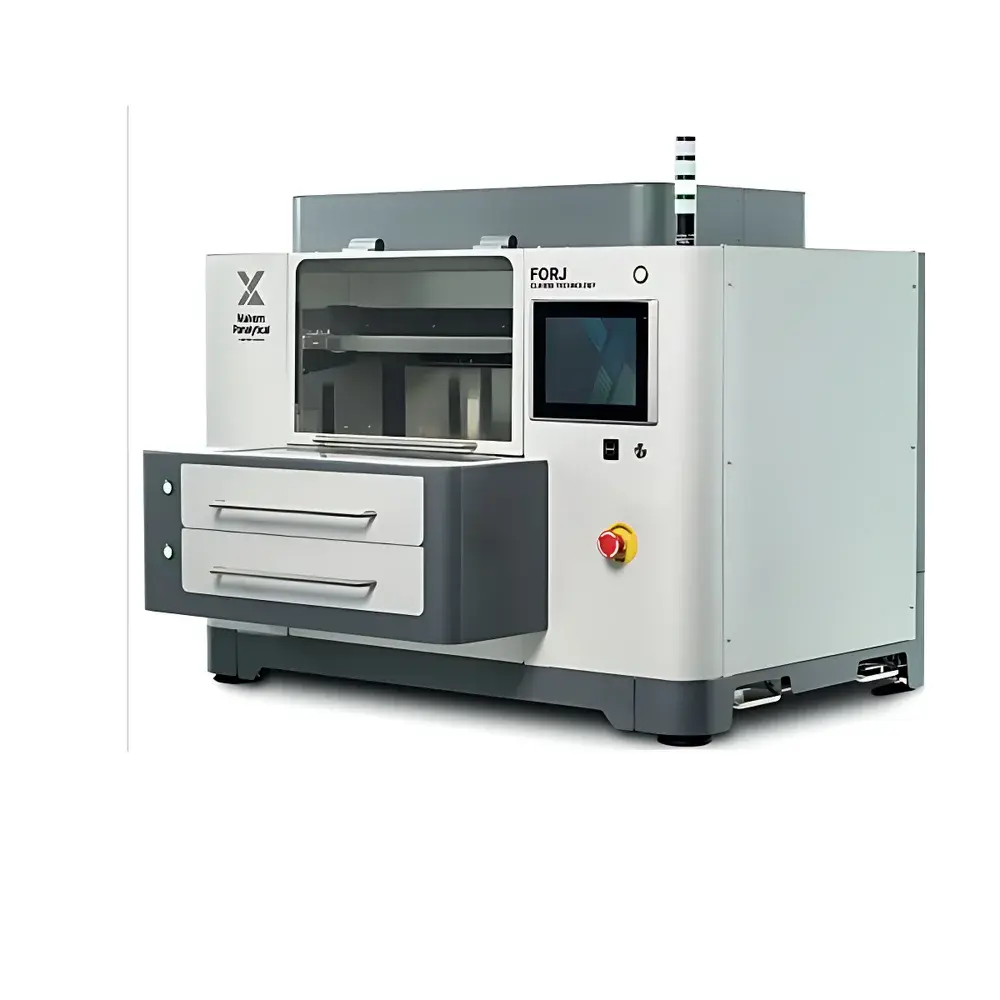
Malvern Panalytical FORJ Fully Automated Electric Fusion Furnace
| Brand | Malvern Panalytical |
|---|---|
| Origin | Canada |
| Manufacturer Type | Authorized Distributor |
| Origin Category | Imported |
| Model | FORJ |
| Quotation | Upon Request |
| Sample Capacity | 6–12 fusion beads per run |
| Maximum Operating Temperature | 1250 °C |
| Temperature Control Accuracy | ±1 °C |
| Dimensions (L×W×D) | 1020 × 720 × 710 mm |
Overview
The Malvern Panalytical FORJ Fully Automated Electric Fusion Furnace is an industrial-grade, programmable high-temperature fusion system engineered for the reproducible preparation of homogeneous glass beads from solid inorganic samples. It operates on the principle of flux-assisted alkaline fusion—typically using lithium tetraborate (Li₂B₄O₇) or lithium metaborate (LiBO₂) fluxes—at precisely controlled temperatures up to 1250 °C. This thermally driven sample homogenization process eliminates mineralogical and particle-size effects, yielding transparent, bubble-free glass discs ideal for quantitative elemental analysis by wavelength-dispersive X-ray fluorescence (WD-XRF), energy-dispersive XRF (ED-XRF), or inductively coupled plasma optical emission spectrometry (ICP-OES) and mass spectrometry (ICP-MS). Designed in collaboration with global XRF and geochemical laboratories, the FORJ integrates Claisse’s legacy in fusion methodology with modern automation architecture to deliver analytical consistency aligned with ISO 12843, ASTM E2469, and USP requirements for trace metal determination.
Key Features
- Automated fusion sequence: Integrated robotic crucible handling, programmable heating ramp/soak profiles, and synchronized flux dispensing eliminate manual intervention and operator-induced variability.
- High-stability temperature control: Dual-zone PID-controlled heating elements with real-time thermocouple feedback ensure ±1 °C accuracy across the full 500–1250 °C operating range, critical for consistent melt viscosity and bead clarity.
- Dual-sample capacity flexibility: Supports 6–12 simultaneous fusion cycles per batch—configurable via interchangeable crucible trays—optimizing throughput without compromising reproducibility.
- Robust thermal enclosure: Ceramic fiber insulation and stainless-steel outer housing maintain thermal integrity while meeting IEC 61000-6-3 electromagnetic compatibility standards and Class II electrical safety requirements.
- Integrated safety interlocks: Door position sensors, overtemperature cut-off, and inert-gas purge readiness prevent exposure to molten flux and mitigate oxidation during cooling.
Sample Compatibility & Compliance
The FORJ accommodates a broad spectrum of geological, metallurgical, cementitious, and environmental matrices—including ores, slags, fly ash, soils, ceramics, and refractory materials—provided they are pre-dried and ground to ≤75 µm. All fusion protocols comply with internationally recognized method validation frameworks: ISO/IEC 17025 for testing laboratory competence, ASTM D5686 for fused bead preparation, and CLSI EP21-A for precision assessment. The system supports GLP-compliant audit trails when paired with Malvern Panalytical’s FusionLink™ software, enabling full traceability of operator actions, parameter settings, and thermal history per sample batch—essential for regulated environments subject to FDA 21 CFR Part 11 or EU Annex 11 requirements.
Software & Data Management
FusionLink™ software provides intuitive workflow configuration, method library management, and real-time thermal profile visualization. Each fusion cycle generates a timestamped log containing setpoints, actual temperature curves, crucible ID, flux ratio, and cooling duration. Data export is supported in CSV and XML formats compatible with LIMS integration (e.g., Thermo Fisher SampleManager, LabVantage). Audit trail functionality records user login, method modification timestamps, and electronic signatures—fully compliant with ALCOA+ principles (Attributable, Legible, Contemporaneous, Original, Accurate, Complete, Consistent, Enduring, Available). Remote diagnostics and firmware updates are enabled via secure HTTPS-based connectivity, backed by Malvern Panalytical’s global service network.
Applications
- Geochemical exploration: Major and trace element quantification in igneous and sedimentary rocks for petrogenetic modeling.
- Cement and clinker QA/QC: Rapid SiO₂, Al₂O₃, Fe₂O₃, CaO, MgO, SO₃, and alkali content verification per ASTM C114 and EN 196-2.
- Metallurgical process control: Slag composition monitoring for blast furnace and steelmaking operations.
- Environmental compliance: Heavy metal speciation (Pb, Cd, As, Cr) in contaminated soils and incinerator residues under EPA Method 6010D.
- Reference material certification: Homogeneous bead production for CRM assignment in NIST, BAM, or IRMM reference labs.
FAQ
What types of fluxes are compatible with the FORJ system?
Lithium tetraborate (Li₂B₄O₇), lithium metaborate (LiBO₂), and mixed-flux formulations (e.g., 66.7% Li₂B₄O₇ + 33.3% LiBO₂) are fully supported. Optional flux dispensing modules accommodate both powdered and pre-weighed flux tablets.
Does the FORJ require external gas supply?
No continuous gas flow is required; however, optional nitrogen or argon purge capability is available for reducing atmospheres during fusion of sulfide-rich or easily oxidized samples.
Can the FORJ be integrated into an automated sample preparation line?
Yes—the system features RS-232, Ethernet, and optional OPC UA interfaces for seamless integration with robotic sample handlers, balance systems, and LIMS platforms.
What maintenance intervals are recommended?
Quarterly inspection of thermocouples and heating elements; annual calibration against NIST-traceable reference standards; ceramic insulation integrity checks every 500 operational hours.
Is training and application support included?
Malvern Panalytical provides on-site installation qualification (IQ), operational qualification (OQ), and comprehensive operator training—including method development workshops—as part of standard deployment services.



