
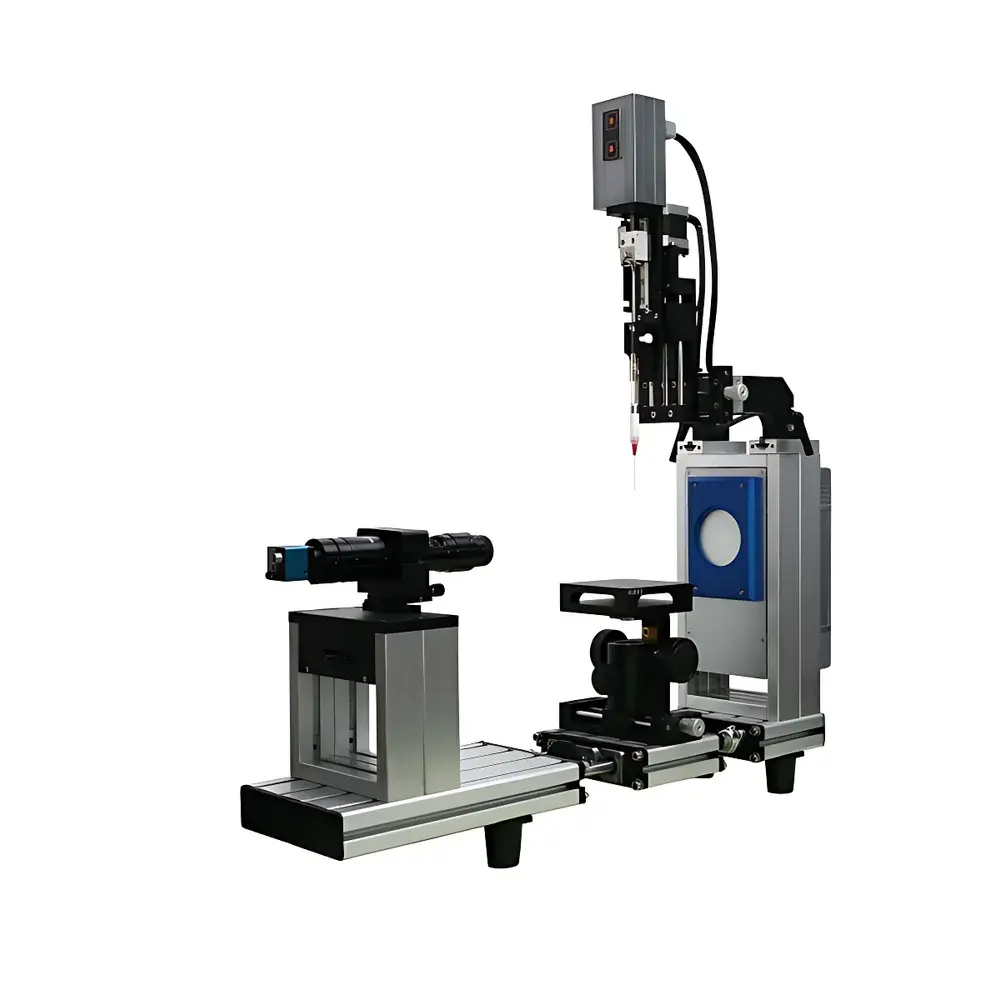
HARKE HK-15 Video-Based Optical Contact Angle Analyzer
| Brand | HARKE |
|---|---|
| Origin | Beijing, China |
| Manufacturer Type | Direct Manufacturer |
| Instrument Category | Domestic |
| Model | HK-15 |
| Instrument Kind | Video-Based Optical Contact Angle Analyzer |
| Instrument Form Factor | Benchtop Laboratory System |
| Contact Angle Measurement Range | 0–180° |
| Contact Angle Measurement Accuracy | ±0.1° |
| Sample Stage Dimensions | 100 × 100 mm |
| Optical Magnification | 0.7×–4.5× |
| Surface/Interfacial Tension Measurement Range | 0–1000 mN/m |
| Surface/Interfacial Tension Measurement Accuracy | ±0.01 mN/m |
| Imaging Frame Rate (Standard) | 40 fps (USB 3.0) |
| Optional | 100/300/1000+ fps |
| Software | HKCA10 |
| Measurement Methods | Sessile Drop, Captive Bubble, Immersion, Tilting Plate (Sliding Angle), Expansion–Contraction, Rolling-off |
| Surface Energy Calculation | Owens–Wendt, Wu, Fowkes, van Oss–Chaudhury–Good models |
| Tension Method | Pendant Drop |
| Temperature Environment | Ambient (optional heated/cooled stage or thermostatic enclosure) |
| Power Supply | 220 V / 3 A / 50 Hz |
| Weight | 25 kg |
| Dimensions (W × H × D) | 160 × 710 × ? mm (depth not specified) |
Overview
The HARKE HK-15 Video-Based Optical Contact Angle Analyzer is an engineered benchtop instrument designed for precise, repeatable quantification of solid–liquid interfacial interactions via optical drop shape analysis. It operates on the principle of sessile drop and pendant drop methodologies—leveraging high-resolution imaging, calibrated optics, and pixel-based contour fitting algorithms to determine contact angle (θ) and surface/interfacial tension (γ) in accordance with ISO 19403-2:2017, ASTM D7334–22, and GB/T 24368–2009. The system captures dynamic wetting behavior—including advancing, receding, and sliding angles—enabling thermodynamic and kinetic characterization of heterogeneous, anisotropic, or time-dependent surfaces. Its modular architecture supports both static equilibrium measurements and time-resolved analysis under controlled environmental conditions, making it suitable for R&D laboratories conducting fundamental colloid and interface science, as well as industrial QC environments validating surface treatments, coatings, membranes, and functional materials.
Key Features
- High-precision optical train featuring a motorized zoom lens (0.7×–4.5× magnification) with fixed-position detents for reproducible field-of-view calibration
- USB 3.0 high-speed camera capable of up to 1000 fps (optional), enabling capture of rapid wetting dynamics, droplet oscillation, or low-viscosity spreading events
- Motorized XYZ sample stage with programmable X-axis translation (60 mm travel) and automated drop dispensing synchronization
- Dual-mode image analysis: automatic circle-fitting and ellipse-fitting algorithms for robust θ calculation across asymmetric or distorted droplets
- Integrated pendant drop module for interfacial tension determination using Young–Laplace curve fitting, validated against NIST-traceable reference liquids
- HKCA10 software platform supporting real-time video acquisition, multi-point sequential measurement, batch processing, and GLP-compliant audit trail logging
- Expandable configuration for advanced modules: temperature-controlled stage (–20°C to 120°C), humidity chamber, tilting mechanism (±90°), and fiber/film holders
Sample Compatibility & Compliance
The HK-15 accommodates rigid and flexible substrates up to 100 × 100 mm, including polymers, metals, ceramics, papers, textiles, thin films, fibers, powders (via compressed pellet method), and porous membranes. Its non-contact optical methodology ensures measurement integrity across hydrophobic, superhydrophobic, hydrophilic, and ultralow-energy surfaces. All core measurement protocols align with internationally recognized standards: contact angle methodology per ISO 19403-1–4 and ASTM D7334; surface tension determination per ISO 1409 and ASTM D971; and solid surface energy calculation using established thermodynamic models (Owens–Wendt, Wu, Fowkes). The system architecture supports 21 CFR Part 11–compliant user access control, electronic signatures, and immutable data archiving when deployed in regulated GMP/GLP environments.
Software & Data Management
HKCA10 is a Windows-based analytical suite offering full instrument control, real-time visualization, and post-acquisition quantification. It provides synchronized triggering between syringe pump actuation and frame capture, automatic baseline detection, dynamic contact angle tracking over time, and export of raw image sequences (AVI, TIFF), numerical datasets (CSV, Excel), and publication-ready graphs. Built-in statistical tools compute mean, standard deviation, and confidence intervals across replicate measurements. Audit trails record operator ID, timestamp, parameter changes, and result modifications—essential for quality assurance documentation. Data files are structured to support LIMS integration and long-term archival in accordance with ISO/IEC 17025 requirements.
Applications
- Surface modification validation: plasma treatment, corona discharge, silanization, and self-assembled monolayer (SAM) formation
- Coating adhesion assessment: inkjet inks, paint formulations, anti-fog and anti-reflective coatings
- Biomedical material evaluation: hydrogel wettability, implant surface bioactivity, surgical textile capillarity
- Packaging performance testing: barrier film hydrophobicity, paperboard absorbency, label adhesion prediction
- Energy materials characterization: electrode wettability in batteries and fuel cells, catalyst layer infiltration
- Geological and environmental research: soil particle hydrophobicity, oil–water–rock interfacial behavior
- Quality control of nanocomposites, MOFs, aerogels, and other advanced porous media
FAQ
What contact angle methods does the HK-15 support?
Sessile drop, captive bubble, immersion, tilting plate (sliding angle), expansion–contraction cycling, and rolling-off—each configurable with automated image capture and analysis.
Can the system measure surface energy of solids?
Yes. HKCA10 implements multiple surface energy models (Owens–Wendt, Wu, Fowkes, van Oss–Chaudhury–Good) using contact angle data from at least two probe liquids.
Is the software compliant with regulatory data integrity requirements?
HKCA10 supports role-based user accounts, electronic signatures, and tamper-evident audit logs—fully configurable to meet FDA 21 CFR Part 11 and ISO/IEC 17025 documentation standards.
What is the minimum resolvable contact angle increment?
The system displays contact angle to 0.01° resolution and achieves ±0.1° measurement accuracy under standardized test conditions (ISO 19403-2).
Does the HK-15 support interfacial tension measurement between immiscible liquids?
Yes—using the pendant drop method with dual-liquid phase imaging and Young–Laplace equation fitting, covering the full 0–1000 mN/m range with ±0.01 mN/m precision.
Can measurements be performed at elevated or sub-ambient temperatures?
Optional temperature-controlled stages and environmental chambers extend operational range from –20°C to 120°C, with PID-regulated stability ±0.5°C.



