
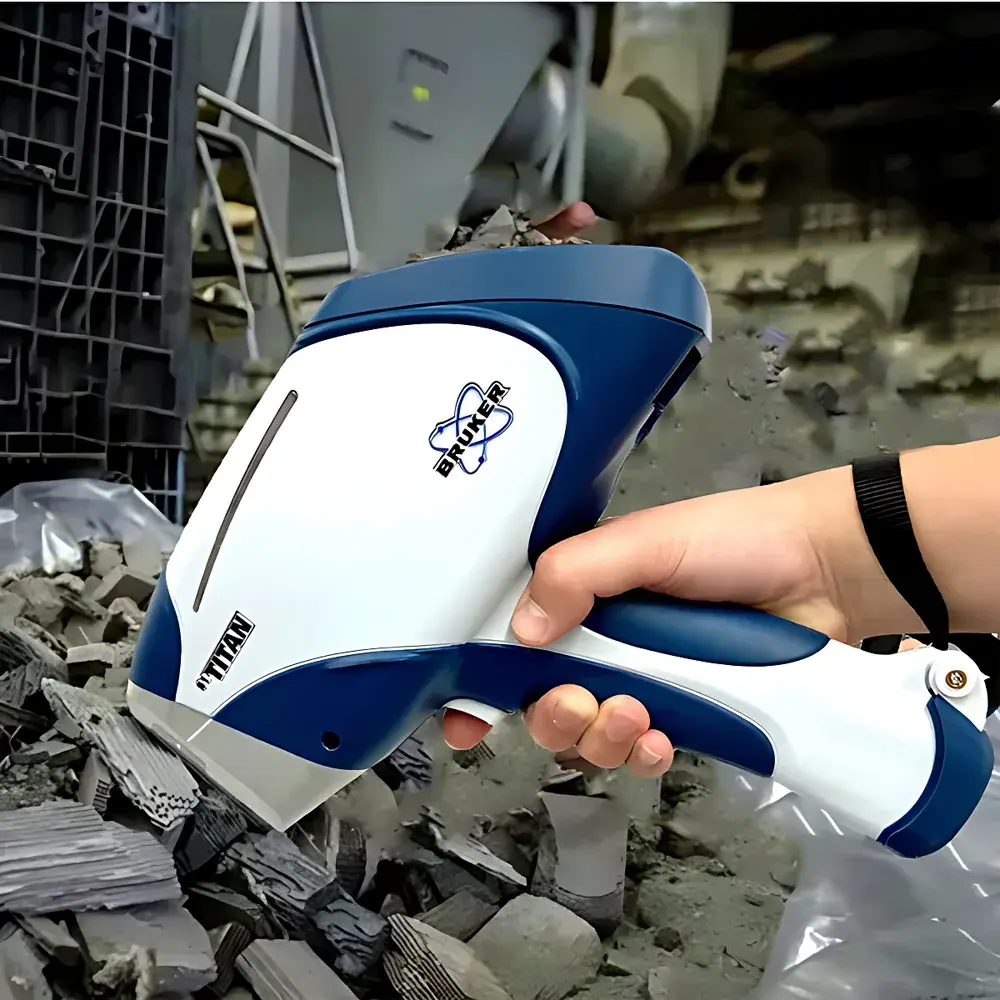
Bruker S1 TITAN Handheld Energy Dispersive X-Ray Fluorescence Spectrometer
| Brand | Bruker |
|---|---|
| Origin | Germany |
| Model | S1 TITAN Handheld |
| Application | Field-Portable Elemental Analysis |
| Element Range | Mg to U |
| Detection Limit | 1 ppm |
| Concentration Range | 1 ppm – 99.99% |
| Energy Resolution | <140 eV (Mn Kα) |
| Repeatability | ≤0.1% RSD |
| Detector | Silicon Drift Detector (SDD) |
| X-ray Tube | 50 kV |
| Weight | 1.23 kg |
| Compliance | IP54-rated enclosure, IEC 61000-4 EMC certified, RoHS compliant |
Overview
The Bruker S1 TITAN is a field-deployable, tube-based handheld energy dispersive X-ray fluorescence (ED-XRF) spectrometer engineered for rapid, non-destructive elemental quantification in demanding industrial and recycling environments. Operating on the fundamental principle of X-ray fluorescence—where primary X-rays excite sample atoms, inducing emission of characteristic secondary X-rays—the instrument delivers laboratory-grade compositional data directly at point-of-use. Its core application domain includes catalytic converter assessment, where precise quantification of platinum group elements (Pt, Pd, Rh) is critical for valuation, quality control, and regulatory compliance in automotive catalyst recycling. The system integrates a high-power 50 kV microfocus X-ray tube with SharpBeam® optimized beam geometry to maximize photon flux onto the sample while minimizing scatter, thereby enhancing signal-to-noise ratio and detection sensitivity across the Mg–U range.
Key Features
- Lightweight ergonomic design (1.23 kg) with balanced center-of-gravity for extended operator use without fatigue
- Silicon Drift Detector (SDD) with <140 eV energy resolution at Mn Kα, enabling high spectral fidelity and reliable peak deconvolution for overlapping transitions (e.g., Rh Kα/Kβ and Pd L-lines)
- SMART®Grade real-time grade-matching algorithm that automatically selects optimal acquisition parameters based on preliminary spectral feedback
- Integrated 5-inch full-color capacitive touchscreen with glove-compatible interface and on-device spectrum visualization
- IP54-rated magnesium alloy housing with sealed optical path and shock-absorbing gaskets, validated for operation in dust-prone, humid, or temperature-variable field conditions
- Battery-powered operation (hot-swappable Li-ion packs) supporting >8 hours continuous analysis per charge
Sample Compatibility & Compliance
The S1 TITAN accommodates heterogeneous, irregularly shaped catalytic converter substrates—including ceramic monoliths, metallic foils, and spent washcoat fragments—without requiring homogenization or pelletization. Its collimated beam (3 mm diameter standard) ensures representative micro-area analysis while minimizing matrix effects from substrate porosity or coating thickness variation. The instrument conforms to international safety and performance standards including IEC 62471 (photobiological safety), IEC 61000-4 (EMC immunity), and ISO 12836:2013 (XRF calibration verification protocols). For regulated environments, firmware supports audit-trail logging compliant with GLP/GMP documentation requirements; optional software modules provide 21 CFR Part 11-compliant user authentication and electronic signature functionality.
Software & Data Management
Data acquisition and processing are managed via Bruker’s proprietary MSA (Mobile Spectral Analysis) software suite, pre-installed on the device. Quantitative analysis employs fundamental parameters (FP) algorithms with matrix correction routines optimized for ceramic and metallic catalyst matrices. Calibration libraries include factory-certified catalyst-specific calibrations traceable to NIST SRMs (e.g., NIST 2781, 2782), alongside user-creatable custom calibrations. All spectra, quantitative reports, GPS-tagged location metadata, and operator IDs are exportable in CSV, PDF, or XML formats. Cloud synchronization via Bruker’s ECO Connect platform enables centralized fleet management, remote calibration updates, and multi-site data aggregation for statistical process control.
Applications
- Automotive catalyst recycling: Rapid screening and assay of Pt, Pd, Rh content in spent three-way catalytic converters (TWCs), enabling accurate material valuation and feedstock segregation
- Refinery and smelter QC: In-line verification of catalyst loading uniformity prior to canning or after regeneration cycles
- Environmental compliance monitoring: Screening for restricted substances (e.g., Pb, Cd, Cr(VI)) in catalyst scrap under ELV and RoHS directives
- Geological prospecting support: Identification of PGE-bearing mineralization in exploration drill cores or outcrops
- Scrap metal sorting: Discrimination between high-value PGM-containing components and base-metal assemblies in end-of-life vehicle dismantling
FAQ
Is the S1 TITAN suitable for analyzing intact catalytic converter bricks without cutting or grinding?
Yes. Its optimized excitation geometry and high-efficiency SDD enable robust quantification through typical ceramic monolith wall thicknesses (up to 0.25 mm), provided surface contamination is removed prior to measurement.
How does the instrument handle inter-element matrix effects common in complex catalyst washcoats?
The FP-based quantification engine incorporates empirical matrix corrections derived from >200 reference materials spanning Al₂O₃, CeO₂-ZrO₂, and mixed oxide systems, significantly reducing bias in Pt/Pd/Rh ratios.
Can calibration models be transferred between different S1 TITAN units within a facility?
Yes. Calibration files (.cal) are portable across instruments of the same generation and may be deployed via USB or network sync, ensuring method consistency across multi-unit operations.
What maintenance is required to sustain long-term analytical accuracy?
Annual verification using Bruker-certified check standards (e.g., S1-TITAN-CAL-01) is recommended; no routine detector cooling or vacuum pump servicing is required due to Peltier-cooled SDD architecture.
Does the system support regulatory reporting for ISO/IEC 17025-accredited laboratories?
When operated with validated methods and documented uncertainty budgets, raw spectral data and full audit logs meet evidentiary requirements for accredited testing per ISO/IEC 17025:2017 Clause 7.8.



