
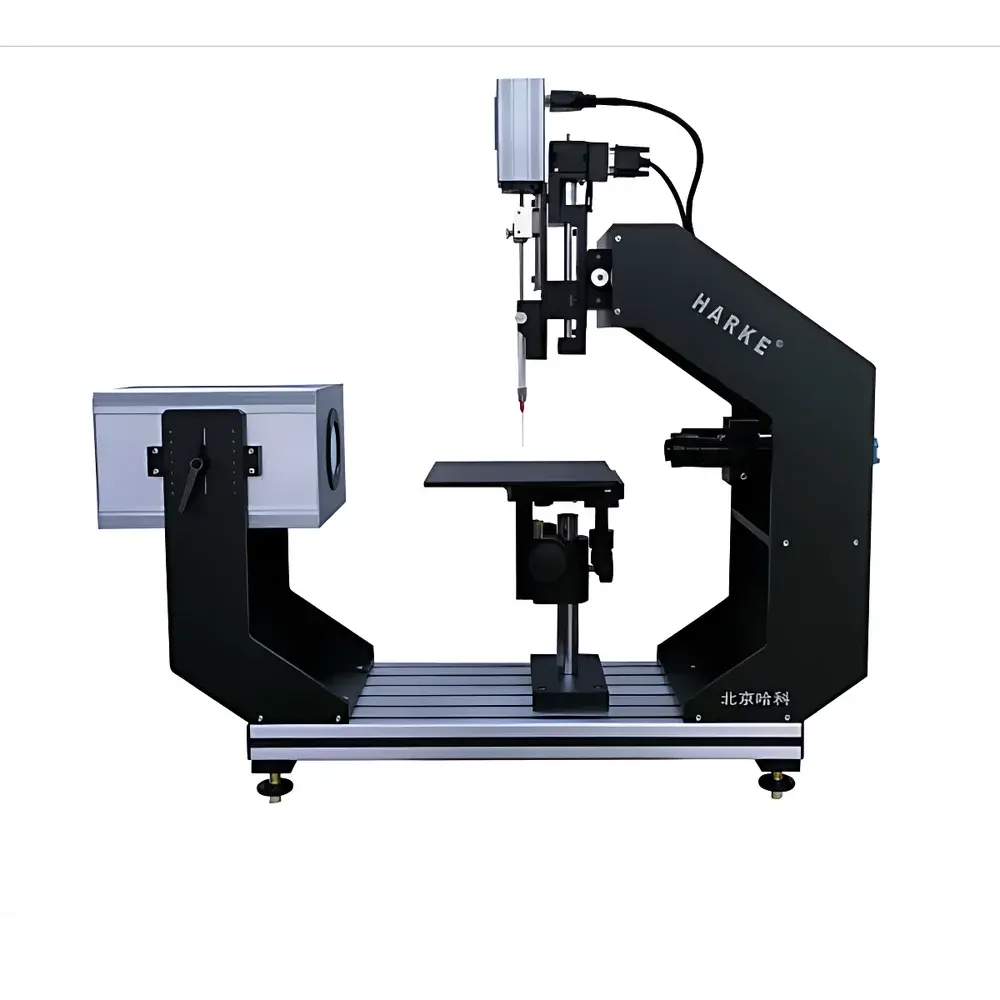
HARKE SPCAX1 Advanced Dynamic Contact Angle Analyzer
| Brand | HARKE |
|---|---|
| Model | SPCAX1 |
| Origin | Beijing, China |
| Manufacturer Type | Direct Manufacturer |
| Instrument Type | Benchtop Laboratory System |
| Contact Angle Measurement Range | 0–180° |
| Contact Angle Accuracy | ±0.1° |
| Sample Stage Dimensions | 120 mm × 120 mm |
| Optical Magnification | 0.7×–4.7× (parfocal zoom) |
| Surface/Interfacial Tension Range | 0–1000 mN/m |
| Surface/Interfacial Tension Accuracy | ±0.01 mN/m |
| Automated Dispensing Volume | 0–100 μL (computer-controlled), ±0.1 μL precision |
| Manual Syringe Capacity | 1 mL |
| Imaging System | High-resolution CMOS camera with real-time video capture, frame-by-frame playback, time-lapse snapshot, and single-frame export |
| Stage Mobility | Vertical: 50 mm |
| Horizontal (X/Y) | 70 mm × 40 mm |
| Fixed Plate Translation | 150 mm (Z-axis) |
| Dispenser Travel | 100 mm × 100 mm |
| Microscope Translation | 100 mm (Z-axis) |
| Max Sample Dimensions | 100 mm (W) × 80 mm (D) × variable height |
| Overall Dimensions | 240 mm (W) × 640 mm (D) × 630 mm (H) |
Overview
The HARKE SPCAX1 Advanced Dynamic Contact Angle Analyzer is a fully integrated benchtop instrument engineered for high-precision quantification of solid–liquid interfacial behavior. It operates on the optical sessile drop and captive bubble principles, enabling static, advancing/receding, and dynamic contact angle measurements under controlled environmental conditions. The system employs high-fidelity image acquisition via a parfocal, continuously variable magnification optical path (0.7×–4.7×), coupled with a calibrated CMOS imaging sensor capable of real-time video capture at adjustable frame rates. Measurement algorithms are grounded in rigorous geometric and physical models—including Young–Laplace fitting, tangent-based contour analysis, ellipse/circle regression, and full-profile curve-spline interpolation—ensuring traceable, reproducible results across flat, curved, tilted, and topographically complex surfaces. Designed for compliance-driven laboratories, the SPCAX1 supports GLP-aligned workflows through timestamped metadata embedding, audit-ready image logging, and parameter-locking functionality.
Key Features
- Dynamic contact angle measurement with automated advancing/receding cycle execution and hysteresis quantification
- Multi-method contact angle analysis: automatic circle, ellipse, tangent (global/local), height-width, Young–Laplace, and curve-ruler algorithms
- Parfocal zoom optics (0.7×–4.7×) with zero-focus drift—custom-designed HARKE precision lens assembly
- Computer-controlled microdispensing system (0–100 μL range, ±0.1 μL resolution) and manual 1 mL syringe option
- Motorized 6-degree-of-freedom stage system: vertical (50 mm), horizontal XY (70 mm × 40 mm), fixed plate translation (150 mm), dispenser XYZ (100 mm × 100 mm × 100 mm), and microscope Z-axis (100 mm)
- Surface energy calculation using Zisman, Fowkes, Owens–Wendt, Wu, and van Oss–Chaudhury–Good models
- Interfacial tension determination (0–1000 mN/m, ±0.01 mN/m accuracy) via pendant/sessile drop shape analysis
- Full-video recording with frame-accurate playback, programmable time-lapse snapshot, and individual frame export in TIFF/PNG
Sample Compatibility & Compliance
The SPCAX1 accommodates samples up to 100 mm wide × 80 mm depth × variable thickness, including rigid substrates (glass, silicon wafers, metals), flexible films, porous membranes, and textured or patterned surfaces. Its modular stage design permits tilt-angle adjustment and curvature compensation—critical for evaluating anisotropic or non-planar materials. All measurement protocols align with ASTM D7334 (Standard Practice for Surface Energy Analysis of Polymer Surfaces by Contact Angle Measurement), ISO 19403-2 (Contact angle measurement — Part 2: Static contact angle), and ISO 19403-4 (Dynamic contact angle). Data integrity meets FDA 21 CFR Part 11 requirements for electronic records when operated with validated software configuration and user access controls.
Software & Data Management
The proprietary HARKE AnalyzeSuite v4.x software provides a deterministic, scriptable interface for method definition, sequence automation, and batch processing. Each measurement session generates a structured project file containing raw images, processed contours, numerical outputs (contact angle, surface energy components, adhesion work, spreading coefficient), and full metadata (timestamp, operator ID, environmental temperature/humidity if externally logged, calibration status). Export options include CSV, Excel, PDF reports, and annotated image sequences. Audit trails record all parameter modifications, image reprocessing events, and user logins—supporting ISO/IEC 17025 and GMP laboratory accreditation.
Applications
- Quality control of hydrophobic/hydrophilic coatings in semiconductor packaging and medical device manufacturing
- Surface treatment validation for plasma, corona, flame, or chemical functionalization processes
- Characterization of self-cleaning, anti-fog, and anti-icing material surfaces
- Wettability assessment of battery electrode slurries, inkjet printable inks, and formulation stability screening
- Biomedical research: protein adsorption kinetics, cell-substrate interaction modeling, and biomaterial surface optimization
- Colloid and interface science: surfactant efficacy evaluation, emulsion stability prediction, and nanoparticle dispersion analysis
FAQ
What contact angle methods does the SPCAX1 support?
It implements seven algorithmic approaches: automatic circle, ellipse, global tangent, local tangent, height-width, Young–Laplace, and curve-ruler—each selectable per measurement or applied in parallel for cross-validation.
Can the system measure contact angles on curved or inclined surfaces?
Yes. Built-in geometric correction modules compensate for surface curvature and tilt angle, enabling accurate contact angle determination on cylindrical lenses, microfluidic channel walls, and angled substrates.
Is surface energy calculation included in the base software?
Yes. The software includes five established models (Zisman, Fowkes, Owens–Wendt, Wu, and van Oss–Chaudhury–Good) with customizable reference liquid databases and uncertainty propagation reporting.
Does the instrument comply with regulatory data integrity standards?
When deployed with configured user roles, electronic signatures, and audit-trail enabled, the system satisfies core requirements of 21 CFR Part 11, EU Annex 11, and ISO/IEC 17025 for traceable, tamper-evident analytical records.
What is the minimum dispense volume and its repeatability?
The automated dispenser achieves 0.1 μL resolution with ±0.1 μL volumetric accuracy across the 0–100 μL range, verified per ISO 8655-6 gravimetric calibration protocol.



