
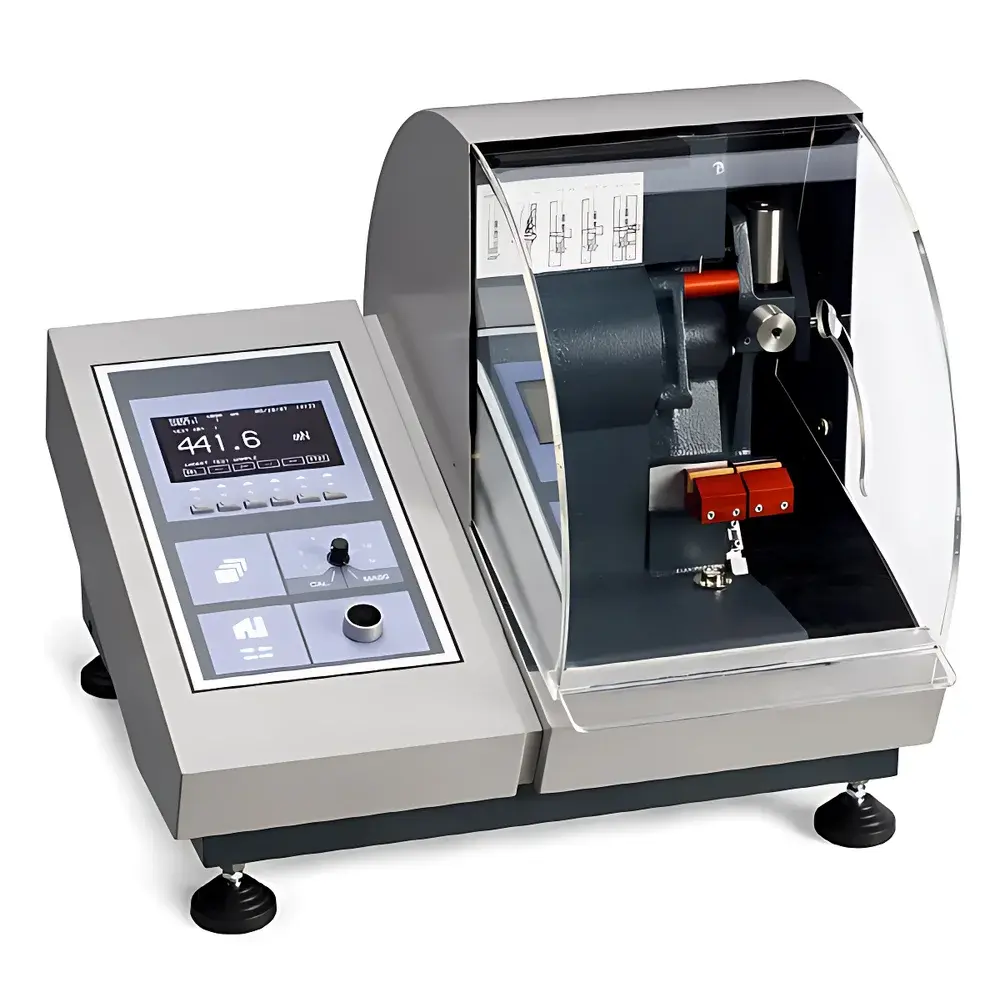
TMI 83-20 Elmendorf Tear Tester
| Brand | TMI |
|---|---|
| Origin | USA |
| Model | 83-20 |
| Measurement Principle | Pendulum-type Elmendorf method |
| Max Range | 64,000 mN |
| Range Steps | 4,000 / 8,000 / 16,000 / 32,000 / 64,000 mN |
| Accuracy | ±1% of reading or ±0.25% of selected range |
| Sample Cut | Automatic pre-notch |
| Clamping | Pneumatic-mechanical dual-action clamp |
| Display | Digital force readout |
| Data Interface | RS-232 serial output |
| Safety | Interlocked transparent guard |
| Reset Mechanism | Motorized pendulum repositioning |
Overview
The TMI 83-20 Elmendorf Tear Tester is a precision-engineered instrument designed for the quantitative determination of tear resistance in flexible sheet materials—primarily paper, board, plastic films, and nonwovens—according to standardized pendulum-based mechanical testing principles. It operates on the classical Elmendorf method (ASTM D1922, ISO 1974, TAPPI T414), wherein a pre-notched specimen is torn under controlled gravitational energy delivered by a calibrated pendulum. The instrument measures the average force required to propagate a tear across a defined length (43 mm remaining ligament), converting angular displacement—detected via high-resolution optical encoder—into millinewton (mN) output through real-time microprocessor calculation. Its robust mechanical architecture, integrated safety interlocks, and traceable calibration path ensure compliance with GLP and quality assurance protocols in packaging R&D, production QC, and third-party certification laboratories.
Key Features
- Automated pre-notch system ensures consistent 20.0 ± 0.2 mm incision depth and precise alignment relative to sample edges—eliminating operator-induced variability in notch geometry.
- Pneumatic-mechanical clamping mechanism applies uniform pressure across the full specimen width while preventing lateral slippage during tear propagation; critical for reproducible results across heterogeneous substrates.
- Motor-driven pendulum reset eliminates manual handling and guarantees repeatable starting position (vertical centerline, ±0.1°), reducing cycle time and operator fatigue.
- Digital force display provides immediate readout in mN with resolution of 1 mN over the full 64,000 mN range; selectable range steps (4k/8k/16k/32k/64k mN) optimize signal-to-noise ratio per test condition.
- Interlocked transparent polycarbonate safety guard halts pendulum motion upon door opening—meeting ANSI Z535.4 and IEC 61000-6-2 requirements for lab equipment.
- RS-232 serial interface enables direct data transfer to LIMS or Excel-based QA databases; supports ASCII-formatted timestamped outputs including sample ID, range setting, and mean tear force.
Sample Compatibility & Compliance
The 83-20 accommodates specimens measuring 75 mm × 63 mm (standard TAPPI/ISO format) with thickness up to 1.2 mm. It is validated for use with single-ply and multi-ply papers (e.g., kraft, linerboard, corrugating medium), coated and uncoated boards, biaxially oriented polypropylene (BOPP), polyester (PET), polyethylene (PE) films, and spunbond nonwovens. Test methodology conforms to ASTM D1922 (plastic films), ISO 1974 (paper and board), TAPPI T414 (tear resistance of paper), and GB/T 455 (Chinese national standard). Instrument calibration is traceable to NIST-certified reference masses and angular encoders; routine verification follows ASTM E74 procedures using certified check weights.
Software & Data Management
While the 83-20 operates as a standalone hardware platform, its RS-232 output supports integration with custom or off-the-shelf data acquisition software compliant with FDA 21 CFR Part 11 requirements—including electronic signatures, audit trails, and user-access controls. Raw output includes test sequence number, date/time stamp, selected range, raw encoder counts, calculated mN value, and pass/fail flag against user-defined specification limits. For regulated environments, instrument qualification documentation (IQ/OQ/PQ templates) and calibration certificates are available upon request.
Applications
- Quality control of linerboard and corrugated medium in packaging manufacturing—verifying resistance to edge-initiated tearing during palletization and transit.
- R&D evaluation of barrier film laminates for pharmaceutical blister packaging, where delamination-initiated tear propagation must be quantified under accelerated aging conditions.
- Supplier qualification testing for nonwoven medical gowns and drapes, ensuring minimum tear thresholds per ISO 9073-5.
- Correlation studies between Elmendorf tear values and machine-direction (MD) / cross-direction (CD) tensile properties in papermaking process optimization.
- Regulatory submission support for FDA 510(k) or EU MDR documentation requiring mechanical integrity data for sterile barrier systems.
FAQ
What standards does the TMI 83-20 comply with?
ASTM D1922, ISO 1974, TAPPI T414, DIN 53123, and GB/T 455.
Can the instrument test multi-layer laminates?
Yes—provided total thickness remains ≤1.2 mm and layers remain bonded during initial pendulum impact; delamination prior to tear propagation invalidates the measurement per ISO 1974 Clause 7.2.
Is calibration traceable to national standards?
Yes—calibration uses NIST-traceable deadweights and angular displacement references; certificate includes uncertainty budget per ISO/IEC 17025.
Does it support GLP-compliant data archiving?
When paired with validated third-party software, yes—the RS-232 stream enables full audit trail capture, including operator ID, environmental conditions (if externally logged), and calibration status flags.
What maintenance is required beyond periodic calibration?
Monthly inspection of pneumatic clamp seals, annual encoder alignment verification, and biannual lubrication of pendulum pivot bearings using ISO VG 10 synthetic oil.





