
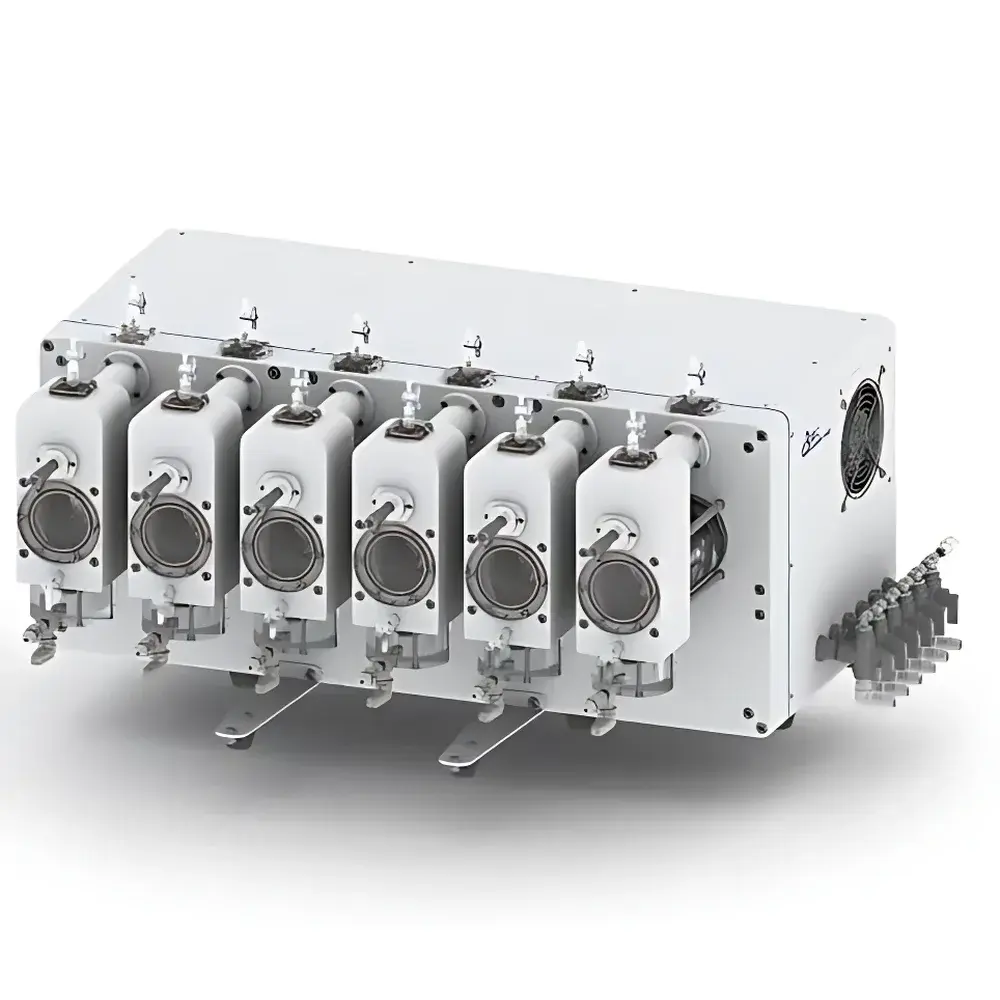
BDC VDT3600i Cardiac Valve Fatigue Testing System
| Brand | BDC |
|---|---|
| Origin | USA |
| Manufacturer Type | Authorized Distributor |
| Product Category | Imported Medical Device Testing Equipment |
| Model | VDT3600i |
| Instrument Type | Cardiovascular Implant Fatigue Tester |
| Maximum Test Pressure | 500 mmHg |
| Frequency Range | 3–50 Hz |
| Unit Weight | 160 kg |
Overview
The BDC VDT3600i Cardiac Valve Fatigue Testing System is an ISO 5840-compliant, high-fidelity in vitro platform engineered for accelerated durability assessment of transcatheter and surgically implanted heart valves—including aortic, mitral, and pulmonary prostheses. It replicates physiologically relevant hemodynamic loading through pulsatile fluid displacement driven by six independent electromagnetic actuators (RB-5™ motor system), each generating controlled pressure waveforms across the full clinical frequency spectrum (3–50 Hz). Unlike conventional fatigue testers relying on pneumatic or servo-hydraulic actuation, the VDT3600i employs a direct-drive, bellows-free fluid circuit architecture—eliminating elastomeric degradation, particulate shedding, and calibration drift associated with diaphragm-based systems. Its core measurement principle is based on real-time pressure–flow synchronization: differential pressure sensors (inlet and outlet per station) continuously monitor transvalvular gradients while volumetric displacement is precisely regulated via micrometer-adjustable throttle valves. This enables traceable, repeatable simulation of native cardiac cycles under defined afterload conditions—critical for regulatory submissions to FDA, EMA, and PMDA.
Key Features
- Six fully independent test stations, each equipped with a dedicated RB-5™ electromagnetic actuator for synchronized or asynchronous operation
- Micrometer-based throttle valve per station—enabling ±0.1 mmHg resolution in preload/afterload adjustment per valve, ensuring strict compliance with ISO 5840-3:2021 Annex C requirements
- Bellows-free fluid path design: eliminates silicone or rubber components from the primary flow loop, reducing risk of leachables, hydrolytic degradation, and biofilm nucleation
- Modular scalability: base frame supports 1–6 stations; users may deploy incrementally (e.g., 2-station configuration at installation, expanded onsite to full 6-station capacity without hardware replacement)
- Redundant station isolation: failure of one valve or fluid circuit does not interrupt operation of remaining active stations—ensuring uninterrupted data continuity during long-duration tests (≥200 million cycles)
- Integrated dual-pressure sensing per station: high-stability piezoresistive transducers (±0.25% FS accuracy) mounted upstream and downstream of each test valve
Sample Compatibility & Compliance
The VDT3600i accommodates all commercially available transcatheter heart valves (THVs) and surgical bioprostheses (tissue and mechanical), including balloon-expandable, self-expanding, and sutureless designs. Valve mounting fixtures are configurable for standard annulus diameters (19–32 mm) and support both native annulus and stent-frame anchoring geometries. The system meets ISO 5840-1:2021 (general requirements), ISO 5840-2:2021 (surgical valves), and ISO 5840-3:2021 (transcatheter valves) for fatigue testing methodology, pressure waveform fidelity, and data reporting. All pressure and timing parameters are traceable to NIST-certified standards. Audit-ready electronic records comply with FDA 21 CFR Part 11 and EU Annex 11 requirements when paired with validated Stays™ VDT software configurations.
Software & Data Management
Stays™ VDT software provides real-time acquisition, visualization, and archival of pressure, flow rate, cycle count, and actuator position data at ≥1 kHz sampling per station. Each channel is timestamped with UTC-synchronized precision (±1 ms). The software includes configurable alarm thresholds (e.g., pressure deviation >±5%, cycle dropout >3 consecutive cycles), automatic email notifications, and encrypted local database storage (AES-256). ISOCounAccuracy™ predictive modeling module calculates equivalent in vivo cycle counts using user-defined physiological parameters (heart rate, stroke volume, systemic vascular resistance), supporting extrapolation from accelerated test durations to projected clinical service life per ISO 5840-3 Clause 7.5. Raw data export formats include CSV, HDF5, and MATLAB-compatible .mat files for third-party statistical analysis (e.g., Weibull reliability modeling).
Applications
- Regulatory pre-submission fatigue validation per FDA Guidance for Industry (2022) and MDCG 2020-3
- Comparative durability benchmarking of next-generation leaflet materials (e.g., glutaraldehyde-fixed vs. decellularized tissue, polymer-based scaffolds)
- Failure mode analysis under elevated afterload conditions (e.g., hypertension simulation)
- Long-term performance evaluation of anticalcification treatments and surface modifications
- Design verification testing for novel valve anchoring mechanisms under dynamic radial force profiles
- GLP-compliant testing in contract research organizations supporting IDE and PMA pathways
FAQ
Does the VDT3600i support testing of tricuspid valves?
Yes—the modular fixture system accommodates tricuspid valve geometry with custom mounting adapters; validation per ISO 5840-3 Annex D is supported upon request.
Can pressure waveforms be customized beyond the ISO 5840 default sinusoid?
Yes—Stays™ VDT allows import of user-defined pressure-time profiles (e.g., patient-specific Doppler-derived waveforms) via CSV input, with real-time interpolation and actuator command generation.
Is on-site calibration certification included with purchase?
Each unit ships with a NIST-traceable calibration certificate covering pressure sensors, frequency response, and displacement linearity; annual recalibration services are available under BDC’s ISO/IEC 17025-accredited program.
What fluid media are compatible with the VDT3600i circulation system?
Phosphate-buffered saline (PBS), heparinized porcine blood, and serum-free cell culture media (e.g., DMEM/F12) have been validated; compatibility with glycerol–water mixtures for viscosity modulation is confirmed up to 40 cP.
How is data integrity ensured during multi-month continuous operation?
The system implements cyclic redundancy checking (CRC-32) on all sensor data packets, writes mirrored datasets to dual SSD arrays, and logs checksum-verified metadata at every 10,000-cycle interval—meeting ALCOA+ principles for long-term GxP studies.



